


Roman Xinzo: what the gas-network test pits revealed (2014-2015)
Results of the 2014-2015 archaeological intervention in Xinzo's old town: 50 test pits, Roman structures at San Roque, Santa Mariña and Dous de Maio, a hypocaust, 2,247 pieces and an early chronology.
- Intervention
- October 2014 – December 2015
- Test pits
- 50 manual test pits and monitoring of over 3,700 m of trenches
- Materials
- 2,247 pieces, 54 % Roman
- Roman chronology
- late 1st – 2nd century
Between October 2014 and December 2015, the team of Adro Arqueolóxica S.L., directed by Lino Gorgoso López, carried out archaeological monitoring of the piped-gas network works in the old town of Xinzo de Limia: 50 manual test pits and the monitoring of thousands of metres of trenches. The results, published in Gallaecia (no. 39, 2026), extend and nuance what was known of the town’s Roman enclave [1][2]. For earlier finds see Roman Xinzo: the seated statues and the ivory piece.
What was known before
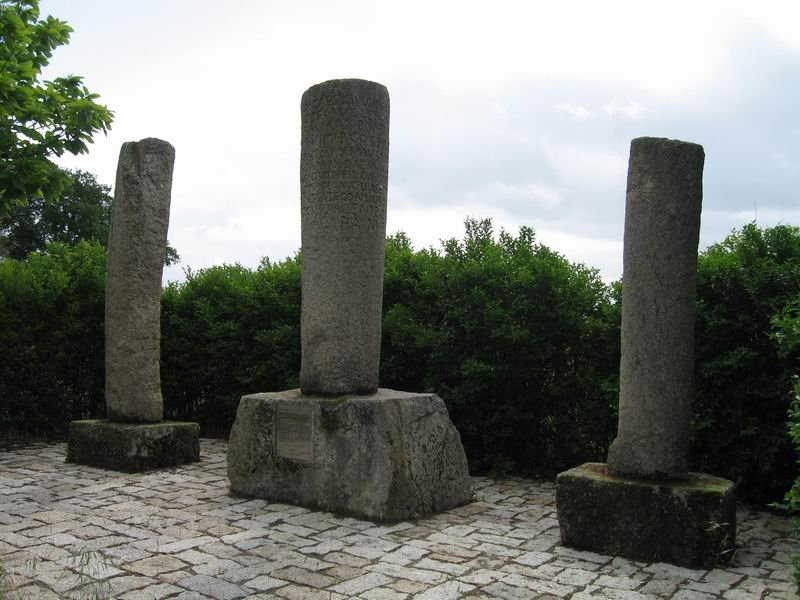
The article summarises the background: A. Ceán Bermúdez, in 1832, was the first scholar to stress Xinzo’s Roman importance; in 1972 the two seated statues and a possible paved route appeared on the Regueira or Cortiñela estate, and in 1983 an altar to Reve, besides a votive altar to Cybele or Juno on a plot on Galicia street. Between 1995 and 1996 the Archaeological Museum worked around the Old Church and confirmed a residential site (1st–4th centuries) with a late necropolis of tegula tombs. Later Fermín Pérez Losada included Xinzo among Galicia’s Roman "secondary agglomerations", and the interventions of 2002 to 2008 brought new remains on the streets of Igrexa, Peto, San Roque, Galicia and Outarelo (today Romero Nieto), with a taberna of the 1st–3rd centuries. There was also a milestone of Galerius Valerius Maximianus (293–305) at the Cortiñela and another dedicated to Maximinus and Maximus (235–238), now lost [1].
The interventions
- IT San Roque (16 test pits): from the fifth, towards the north, the first Roman structures appear: massive tegula collapses, a good-quality paving (pit 13) and domestic structures with an impluvium channel made of decorated tegulae (pit 14), plus up to five fine rubble walls in the trench, a sign of a large residential space [1].
- IT Barrio de Abaixo (19 test pits, streets Galicia, Serra de Queixa, Praza do Padrón and Alto do Furriolo): few Roman remains, except near the old town and in the square of the Polígono O Pombal, where a Roman wall with Hispanic terra sigillata appeared. In the Praza do Padrón a round well, pavements of chapacuña and slabs and a caleiro (lime kiln), of modern and contemporary date, came to light [1].
- IT Peto–Santa Mariña (12 test pits): the most fruitful. Around the Old Church there were burnt deposits, reddened clay floors and walls of Roman workmanship, some serving as foundations for the houses around the churchyard. Pit 9 found several pilae of opus latericium of a hypocaust that continued into a house [1].
- IT Dous de Maio (3 test pits): an in situ collapse of the tegula roof of a structure, showing that the site reaches the limits of the old town to the east and exceeds any earlier approach [1].
In other sectors (Toural, Polígono, Ensanche and Carretera de Castilla) only rolled Roman material was found in fills; the Toural, used as a livestock fair, gave clay floors and 19th-century coins [1].
The materials
2,247 pieces were recovered, highly fragmented: 54 % Roman, and by material 96 % pottery, 3 % metals and 1 % glass. Among Roman pottery, common ware accounts for 69 % and red-slip plates 11 %. The terra sigillata (207 fragments, 17 %) is almost all Hispanic (96 %) and comes from the Tricio kiln (La Rioja): a stamp inside a TSH 27 cup reads "MAT", probably Matritiensis, from the Prado Alto workshop. The dominant forms are TSH 37 bowl (31 %), TSH 15/17 plate (25 %), TSH 4 with burin decoration (15 %, an unusual proportion in the northwest) and TSH 27 (11 %). There is also thin-walled ware of the "Melgar type", Bracara painted pottery, oil lamps, 16 glass pieces (with a polychrome fragment that could be a millefiori bowl or a bead) and metals such as a bronze foot of a statuette [1].
From later times stand out 21 individuals of "borde en pestana" pottery (12th–15th centuries), modern earthenware from Niñodaguia, Gundibós, Tioira and Lobios, fine ware from Sargadelos and coins such as the 8 maravedís of Ferdinand VII (1823) and two "perras gordas" of 1868–1872 on the pavement of the old Toural livestock fair. Noteworthy are a small bronze bell and a Pantalla jingle in the Praza do Padrón, which the authors consider perhaps the oldest known item of this kind, and a bronze Caravaca cross on San Roque street [1]. See Anatomy of the Pantalla.
The conclusions
The authors maintain that the materials fit clearly into an early chronology, from the closing decades of the 1st century to the 2nd, with little late-imperial (3rd–4th centuries) or late Roman material, and acknowledge that this differs from the broad chronologies proposed for the Old Church. They think Xinzo’s size and function were much greater than Pérez Losada said ("a small nucleus of clearly road-based layout"), that its structure did not follow a "herringbone" grid, and that the area around the Old Church, slightly higher, formed the original nucleus, from which the settlement grew in all directions. They also detect differentiated residential areas (more luxury on Santa Mariña street than on San Roque) and propose enlarging the protected area, especially on Dous de Maio street. They regret that water-pipe works since the 1960s destroyed much of the remains [1].
The data on the length of trenches monitored vary within the article itself (3,738 m in the introduction and 3,878 m in the conclusions, out of 14,489 m of works). The text does not settle whether Xinzo or A Cidá was the Forum Limicorum, but strengthens Xinzo’s case; see The Monte do Viso and A Cidá and The Limici and Romanisation [1].
Links
- History of A Limia
- The Limici and Romanisation
- Roman Xinzo: the seated statues and the ivory piece
- Xinzo de Limia
Sources
- Gorgoso López, Lino; Méndez Santiago, Paula; Tembra Piñeiro, Ana I.; Acuña Piñeiro, Ángel: «Novas achegas ó enclave romano de Xinzo de Limia», Gallaecia, 39 (2026). https://doi.org/10.15304/gall.39.6721
- Novas achegas ó enclave romano de Xinzo de Limia (Dialnet, rexistro e PDF). https://dialnet.unirioja.es/servlet/articulo?codigo=10855830
You may also like
 History of A LimiaPrehistory and castros of A LimiaFrom the Pedra Alta de Antela to the castro of Bóveda: megaliths, the Roufeiro weapons, the Outeiro de Baltar and the gold earring of Vilar…
 History of A LimiaThe Limici in Roman inscriptions: Celer’s gladiatorial tessera and Corellius LimicusTwo epigraphic pieces outside A Limia that mention a "Limicus": the bronze gladiatorial tessera from Niebla (Huelva), of the 1st century,…
History of A LimiaThe Limici and Romanisation: Civitas, Forum Limicorum and Via NovaWhat is known of the Limici and Roman Limia: the Civitas Limicorum, the debate over where the Forum Limicorum stood (A Cidá of Nocelo da…
 History of A LimiaThe Praza Maior, the Ladeira and the Toural: history of Xinzo’s central placesHistory of the Praza Maior (fairs since the 16th century, the 1907 Espolón, the fountain), the Ladeira and the Toural (the lagoon, the…
History of A LimiaLight, chocolate, fizzy drinks and roads: the industrial and service Xinzo of the 20th centuryHow electricity (1911), the printing press, chocolate and soda factories, the Rubio Cold-Storage Slaughterhouse and buses to Ourense and…
 History of A LimiaCinemas, café, radio, school and library: Xinzo’s cultural life from 1948 to the 1970sThe cinemas Los Molinos (1948) and Antelano (1954), the Café Ideal and the Ideal 6 disco, the 1950 radio, the Colegio Santa Marina, the…
