


Prehistory and castros of A Limia
From the Pedra Alta de Antela to the castro of Bóveda: megaliths, the Roufeiro weapons, the Outeiro de Baltar and the gold earring of Vilar de Santos, the first page of the history of A Limia.
The castros of A Limia and the megalithic monuments that precede them are the first page of the history of A Limia. The Antela plain, with its surrounding hills, offered water, pasture and minerals such as tin, and that left traces from recent Prehistory until the arrival of Rome.
Megaliths and first settlers
Local tradition speaks of pile dwellings in the Lagoa de Antela, and the old website xinzodelimia.eu recorded finds of charred piles and arrowheads that were linked to lake settlements [6]. The Concello of Rairiz de Veiga also mentions remains of pile dwellings in A Veiga, the site of Monte Albán (Sabariz), excavated by López Cuevillas, and Bell Beaker pottery in O Risco [7]. These are data that should be reviewed against current archaeological studies.
The most visible monument is the Pedra Alta de Antela, a menhir marking the boundary between Cortegada (Sarreaus), Bóveda (Vilar de Barrio) and A Abeleda (Xunqueira de Ambía). It lay buried until 1975, when a farmer came upon it, and in 1986 it was set on a platform [2]. It bears medieval crosses and inscriptions that, according to Tomás Vega, could date from the 9th to the 12th centuries, suggesting the Church tried to Christianise an old place of worship; Edelmiro Martínez Cerredelo also records the legends of the Virgin or the moura who carried the stone on her head [8].
Bronze: the Roufeiro weapons
In 1911 the «Boletín de la Comisión de Monumentos de Orense» (quote) made known a hoard of Early Bronze Age copper weapons found at Roufeiro (Sarreaus), kept in a pot now lost; López Cuevillas compared it with the weapons of the El Argar culture [1]. In the same area, the Roupeiro stream was used to wash tin and wolfram until the mid-20th century [1].
The castros
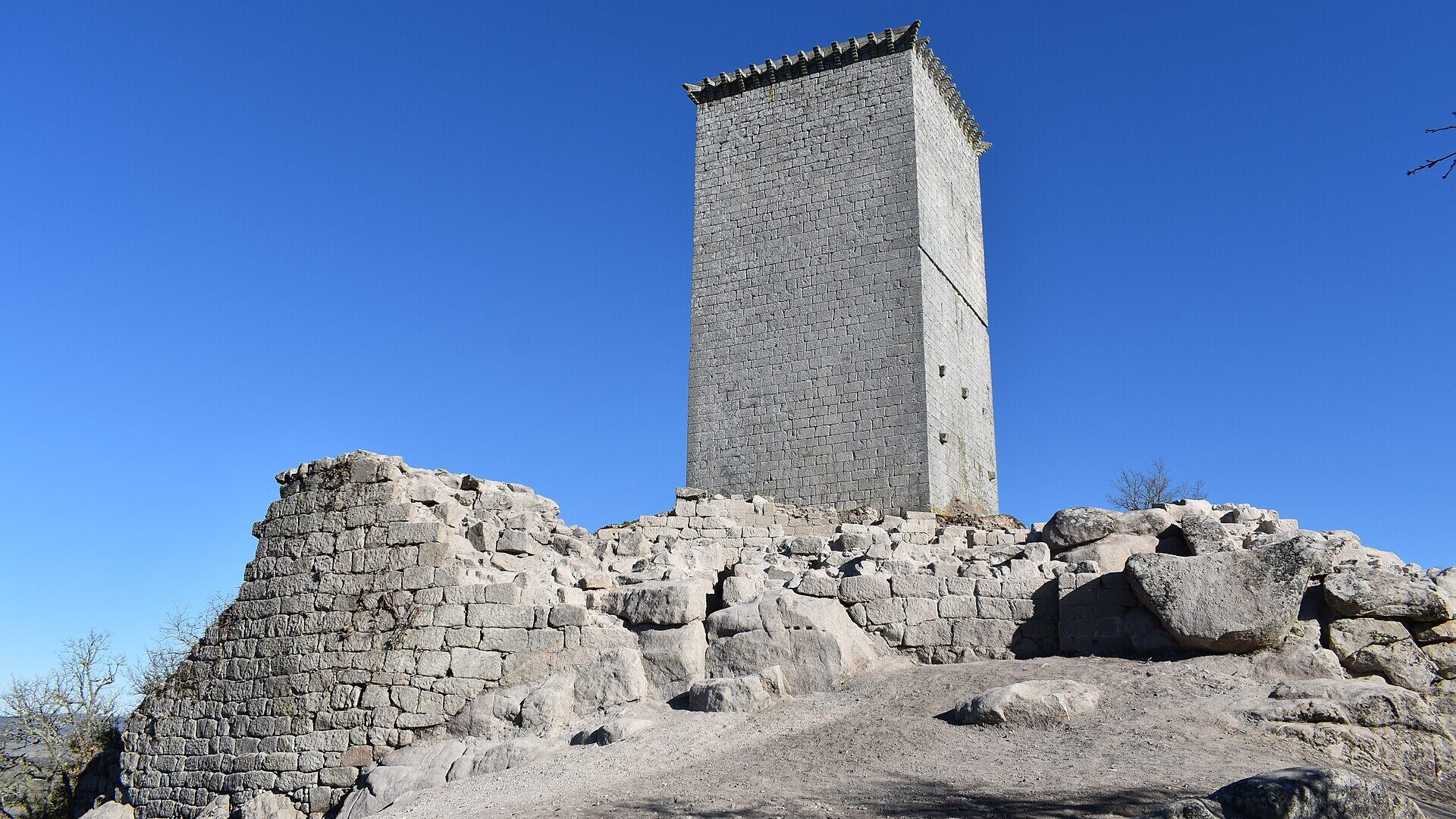
A Limia is ringed by castros. García Valdeiras describes A Cidá of Monte do Viso (Nocelo da Pena, Sarreaus), with walls over 4 m and about 100 m in diameter, which later had a long Roman occupation [1]. The castro of Bóveda (Vilar de Barrio) is one of the largest: in the trial excavations of August and September 2021, directed by Martiño Vázquez (Xeitura), part of the original wall, a Roman amphora and signs of iron and bronze smelting appeared [3]. Gciencia reports that the trial pits by the Xeitura cooperative, directed by the archaeologist Martiño Xosé Vázquez, found in the upper part of Monte do Castelo part of a cyclopean wall and circular castro huts, and at the foot of the castro a monumental enclosure delimited by a small bank; the finds point to a settlement over 2,000 years old and an extent of more than 15 ha, which requires enlarging the protection area in the Galician Cultural Heritage Catalogue, and some material suggests a trade network with the Mediterranean in Roman times [11]. Rebeca Blanco Rotea (USC) and João Fonte (Exeter) had detected in 2018, by geospatial survey around the old lagoon, an enclosure distinct from the castro, and the team is analysing whether the site had late and medieval occupation; Jorge Sanjurjo (University of A Coruña) took samples to date the structures by luminescence (OSL), with work promoted by the Concello and funded by the Deputation [11].
On the northern slope of the Larouco, the Outeiro de Baltar is exceptional: a study published in 2022 identified slag from tin smelting and bronze production with local cassiterite, something very rare in the Iron Age [4]. Near Escornabois (Trasmiras) there is another Gallaeco-Roman castro, which García Valdeiras identifies with the villa Scornaboves of the Celanova cartulary [1].
The Vilar de Santos earring
The most famous piece of Limia castro culture is the gold earring of Vilar de Santos. It was found by chance by Benito Saburido in 1924, about 2 m deep, while a drain was being dug. It is of river gold, has five bell-shaped pendants and a small duck in the round, and passed to the Archaeological Museum of Ourense after the Monuments Commission failed to buy it [5]. The Museo da Limia, in Vilar de Santos, keeps a replica and recalls that its owner may have been an inhabitant of the castro of Saa [9].
The story continues in The Limici and Romanisation; the Pedra Alta and the castros also appear in the historical curiosities and in the chapter on the Middle Ages and towers, which were often raised over old castros.
Sources
- García Valdeiras, Manuel. «O Forum Limicorum». Minius IX, pp. 39–50. https://revistas.uvigo.es/index.php/mns/article/download/2984/2773/5946
- «Pedra Alta de Antela». Galipedia (CC BY-SA 4.0). https://gl.wikipedia.org/wiki/Pedra_Alta_de_Antela
- Fronteira Esquecida. «Castro de Bóveda» (04-10-2021). https://fronteiraesquecida.eu/?p=3549
- Figueiredo, E.; Rodrigues, A.; Fonte, J. et al. «Tin and bronze production at the Outeiro de Baltar hillfort (NW Iberia)». Minerals 12(6):758, 15-06-2022. https://novaresearch.unl.pt/en/publications/tin-and-bronze-production-at-the-outeiro-de-baltar-hillfort-nw-ib/
- Museo Arqueolóxico Provincial de Ourense. «Peza do mes: A arracada de Vilar de Santos», maio de 2004. https://musarqourense.xunta.gal/sites/default/files/doc/peza_mes/2004/5/pm_2004_05_gal96.pdf
- xinzodelimia.eu. «Historia» (captura de 01-01-2008). http://www.xinzodelimia.eu/historia.htm — Wayback: https://web.archive.org/web/20080101052645/http://www.xinzodelimia.eu:80/historia.htm
- Concello de Rairiz de Veiga. «Historia». https://www.rairizdeveiga.es/gl/concello/historia
- Martínez Cerredelo, Edelmiro. «O menhir da Pedra Alta da Antela». Historia de Xinzo, 02-08-2018. https://historiadexinzo.wordpress.com/2018/08/02/o-menhir-da-pedra-alta-da-antela/
- Museo Etnográfico da Limia. «Historia do Museo». https://museodalimia.com/historia-do-museo/
- «[Prehistoria / castrexa] Mámoas e castros: mámoas en Monte Meau e no Forno da Tagurra, e castros na Cidade de San Vitorio, Penas Altas e A Picoña. Fonte: https:». https://gl.wikipedia.org/wiki/Calvos_de_Rand%C3%ADn
- Gciencia, «Como vivían hai 2.000 anos? Atopan o xacemento dun poboado en Vilar de Barrio». https://www.gciencia.com/retro/como-vivian-hai-2-000-anos-atopan-o-xacemento-dun-poboado-en-vilar-de-barrio/
You may also like
 History of A LimiaThe Limici in Roman inscriptions: Celer’s gladiatorial tessera and Corellius LimicusTwo epigraphic pieces outside A Limia that mention a "Limicus": the bronze gladiatorial tessera from Niebla (Huelva), of the 1st century,…
History of A LimiaThe Limici and Romanisation: Civitas, Forum Limicorum and Via NovaWhat is known of the Limici and Roman Limia: the Civitas Limicorum, the debate over where the Forum Limicorum stood (A Cidá of Nocelo da…
 History of A LimiaThe Praza Maior, the Ladeira and the Toural: history of Xinzo’s central placesHistory of the Praza Maior (fairs since the 16th century, the 1907 Espolón, the fountain), the Ladeira and the Toural (the lagoon, the…
History of A LimiaLight, chocolate, fizzy drinks and roads: the industrial and service Xinzo of the 20th centuryHow electricity (1911), the printing press, chocolate and soda factories, the Rubio Cold-Storage Slaughterhouse and buses to Ourense and…
 History of A LimiaCinemas, café, radio, school and library: Xinzo’s cultural life from 1948 to the 1970sThe cinemas Los Molinos (1948) and Antelano (1954), the Café Ideal and the Ideal 6 disco, the 1950 radio, the Colegio Santa Marina, the…
History of A LimiaMemories of the Xinzo of the past: children, taverns, the Riscas, doors and popular figuresMemories of everyday life in postwar Xinzo: children's games, Benito's tavern, Marucho's bar, the Riscas, doors and knockers, old stamps…
