


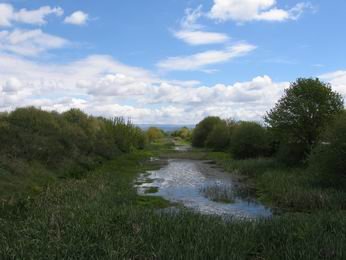
Water, nitrates and irrigation in A Limia: a documented chronology
Since the late 1990s, scientific and environmental bodies have warned of nitrates, eutrophication and low flows in the headwaters of the Limia. This page arranges the data, studies and positions, attributing each claim to its source.
- Legal nitrate limit
- 50 mg/l in drinking water
- Gudín reservoir
- on the Faramontaos river
- Wells in the irrigation project
- 42
- Irrigation project area
- 4,859 ha
The quality and quantity of water in the headwaters of the Limia river have been, for over twenty years, one of the liveliest subjects of debate in the comarca. This page takes no side: it arranges the data, studies and positions published by the sources, always saying who asserts each thing. On the European improvement project and the works of the Miño-Sil Hydrographic Confederation (CHMS) see LIFE Regenera Limia and the CHMS works.
The starting point
The legal limit for nitrates in water for human consumption is 50 mg/l [1][6]. The plain of A Limia is, according to the CHMS, one of the most productive farming territories in Galicia, with numerous intensive cattle, pig and poultry farms [10]. The river flows into the As Conchas reservoir, about 8 km downstream from the plain, built in 1949 [3].
Chronology according to the Sociedade Galega de Historia Natural
The Sociedade Galega de Historia Natural (SGHN) has been documenting the problem for years; this is the chronology it publishes [1]:
- 1998. Applications by Coren to Sarreaus Town Council for a farm of 300,000 broiler chickens and another of 5,000 pigs, to which the SGHN lodged objections over risks of nitrate pollution [1].
- 2007. The "Estudo Hidrolóxico–Ambiental de A Limia" by the then Confederación Hidrográfica del Norte recorded, on the Limia river at Ponteliñares, high levels of faecal coliforms, nitrites and dissolved phosphorus and little oxygen [1].
- 2011. First massive cyanobacteria episode in the As Conchas reservoir; the SGHN attributes its origin to the livestock load and the management of manure upstream [1].
- 2012. It is officially acknowledged that the water of the Gudín reservoir, completed in late 1994 on the Faramontaos river to supply Xinzo, is not drinkable because of toxic cyanobacteria [1].
- 2014. The CHMS publishes the CSIC isotope study (Delgado Huertas): the nitrates are highly enriched in 15N, indicating "an important contribution from livestock waste and/or the presence of poorly treated urban waste" [1][2].
- 2018. According to the official groundwater analyses, nitrates are getting worse and exceed the legal limit even in supply intakes [1].
- 2020. Health Department data on supplies: the 50 mg/l limit was exceeded on 25 % of the dates analysed in Vilariño das Poldras, 33 % in Piñeira de Arcos, 50 % in Cortegada and Sandiás and 71 % in Cardeita (2017–2019) [1]. Researchers at the University of Vigo published samples from 76 private wells and 26 springs: 55–60 % of the wells and 10–14 % of the springs exceeded 50 mg/l, with maxima of 329 and 114 mg/l, and concluded that the most likely source of the nitrates is the application of manure or slurry [1].
- 2021. On 19 November the TSXG annulled, on seven grounds, the environmental impact declaration of a farm in Rairiz de Veiga [1].
- 2022. The 2022–2027 Hydrological Plan acknowledges that the good-status objectives for the plain’s watercourses and for As Conchas were not met in 2015 or 2021, and that the "Xinzo de Limia" groundwater body goes from "good" to "poor" because of nitrates. On 24 May 2022 the MITECO published the map of waters affected by nitrates, which includes the As Conchas reservoir, and the three-year period began for the Xunta to declare a vulnerable zone [1].
- 2024. In autumn the CHMS began demolishing the Gudín reservoir, useless for supply since 2012, for €1.9 million; the SGHN adds up more than €2.5 million spent building and demolishing it [1].
- 2025. Residents of the As Conchas settlement filed on 26 March a lawsuit against the Xunta, the CHMS and five concellos for violation of fundamental rights, and the hearing was held on 13 June [1]. According to the organisations supporting the residents (ClientEarth, Friends of the Earth and CECU), in July 2025 the TSXG declared that the Xunta and the CHMS violated the fundamental rights of the As Conchas community by failing to prevent pollution from industrial livestock farming, and ordered immediate measures to end the reservoir’s degradation and guarantee drinking water; the Supreme Court later upheld the ruling, and the plaintiffs asked the TSXG to enforce it because, they say, only the compensation was paid and a few inspections and samplings were carried out [13].
What the studies say
The CSIC isotope study commissioned by the CHMS concluded that the nitrates come largely from livestock or poorly treated urban waste and that few samples retain a signal of inorganic fertilisers [2]. The SGHN added its own analysis: in the plain’s two sub-basins (Antela and Limia) the human population differs (ratio 2.6 to 1) but the livestock load is almost identical, and the results do not fit a mainly urban origin [1]. According to the SGHN, the livestock load on the plain was 62,547 livestock units in 2009 and the population 19,523 in 2013 [3].
The CHMS official data processed by the SGHN indicate that the concentration of nitrates in groundwater in the 2020–2022 three-year period was 49.2 % higher than in 2014–2016, and that samples exceeding the legal limit rose to 6.3 % [6]. The SGHN says it has warned the Environment Department more than 35 times that the proliferation of industrial farms was affecting the quality and quantity of water, and that its objections were ignored [7].
The positions of the authorities and companies
According to Gciencia, the Xunta and the CHMS acknowledged the existence of the problem in meetings and undertook to look for solutions [8]. The CHMS, at its 2019 closing seminar, stated that the application of the integrated fertiliser control system of the LIFE Regenera Limia project reduced mineral fertiliser by 40 % and that the recovered meander removes more than 85 % of nitrates on average [11]. A Coren statement citing the SGHN says that "there is no report whatsoever demonstrating" that the situation at As Conchas is due to bad practices in the use of livestock waste and that cyanobacteria appear every summer in other reservoirs [3]. Greenpeace, in its report "Coren contra Manuel", cites that over the last twenty years the comarca’s livestock load grew by 114 % while the population fell by 19 % [14]. A 2019 television report on the discharges prompted civil actions by the company against a local farmer, with a conciliation hearing that ended without agreement [8].
Flows and irrigation
The SGHN denounces a "chronic hydrological collapse" in the headwaters of the Limia: over the last ten years, according to the official data it cites, the minimum ecological flow was not met one day in three (1,172 days) and fell as much as ten times below [4]. It attributes the decline in flows since the late 1990s to the increase in irrigation and industrial farms, and calls for limiting new water concessions in the headwaters [4].
The Ministry and the Xunta processed an irrigation modernisation project with 42 wells, pressurised irrigation networks and remote control, covering almost 4,859 hectares, costing €36 million and including reservoirs with a capacity of 76,000 m³; three scientific societies (SEO/BirdLife, the Sociedade Galega de Ornitoloxía and the SGHN) lodged objections over the risk to protected areas and species [5]. The Ministry maintains that the new infrastructure will save 20 % of resources [5]. According to SEO/BirdLife, the "A Limia 2022" project provides for three collective water-transport networks, three 76,000 m³ reservoirs (more than the daily supply capacity of Ourense, 69,000 m³) and about 120 km of ditches; it was modified to move the reservoirs out of the SPA area, but the rest of the infrastructure is wholly or partly inside it [15]. Gciencia presents A Limia as the country’s main potato producer and reports the comparison the SGHN president makes with the situation at Doñana [9]. The CHMS, for its part, created a monitoring committee with irrigation communities to legalise wells as a temporary solution [12].
Links
- Waters of A Limia
- LIFE Regenera Limia and the CHMS works
- Rivers and streams of A Limia
- The Limia river
Sources
- Sociedade Galega de Historia Natural, «Auga na Limia: crónica dunha contaminación anunciada». https://sghn.org/auga-na-limia-cronica-dunha-contaminacion-anunciada/
- Sociedade Galega de Historia Natural, «Nitratos na Limia e testosterona no Tour: isótopos». https://sghn.org/nitratos-a-limia/
- Sociedade Galega de Historia Natural, «Gandería industrial na Limia e eutrofización do encoro das Conchas». https://sghn.org/ganderia-industrial-na-limia-e-eutrofizacion-encoro-das-conchas/
- Sociedade Galega de Historia Natural, «Limia: río do esquecemento na lenda, río esquecido na realidade». https://sghn.org/limia-rio-do-esquecemento-na-lenda-rio-esquecido-na-realidade/
- Gciencia, «A Limia asfíxiase coa instalación de 42 pozos para regadíos». https://gciencia.com/medioambiental/a-limia-asfixiase-instalacion-42-pozos-regadios-auga-secos/
- Gciencia, «A contaminación por nitratos dispárase na Limia». https://www.gciencia.com/medioambiental/contaminacion-nitratos-limia-agua-non-potable/
- Gciencia, «Novos datos constatan a contaminación por nitratos na chaira da Limia». https://www.gciencia.com/medioambiental/contaminacion-nitratos-limia/
- Gciencia, «Coren reclama un millón a un agricultor por denunciar contaminación na Limia». https://www.gciencia.com/medioambiental/coren-agricultor-contaminacion-limia/
- Gciencia, «A Doñana de Galicia: como os regadíos na Limia secan os ríos dende hai 25 anos». https://www.gciencia.com/medioambiental/donana-galicia-regadiosa-limia-rios-dende-hai-25-anos/
- Proxecto LIFE Regenera Limia, «A Limia». https://regeneralimia.chminosil.es/a-limia/?lang=gl
- Confederación Hidrográfica do Miño-Sil, nota de prensa 1859 sobre o balance do LIFE Regenera Limia. https://www.chminosil.es/es/chms/comunicacion/nuestras-notas-de-prensa/1859-el-proyecto-life-regenera-limia-demuestra-que-con-la-implicacion-del-sector-agroganadero-mejorara-la-calidad-de-las-aguas-de-a-limia
- Confederación Hidrográfica do Miño-Sil, nota de prensa 2013 sobre a comisión de seguimento do regadío. https://www.chminosil.es/es/chms/comunicacion/nuestras-notas-de-prensa/2013-el-presidente-de-la-chms-crea-una-comision-de-seguimiento-para-dar-solucion-temporal-a-la-problematica-del-regadio-de-a-limia
- Ecoticias, «La contaminación de A Limia vuelve a los tribunales: exigen frenar las macrogranjas hasta recuperar el agua». https://www.ecoticias.com/medio-ambiente/contaminacion-de-a-limia-demanda-macrogranjas-agua-as-conchas
- Ecoticias, «La comarca de A Limia es un auténtico vertedero en Galicia por los residuos de la ganadería industrial». https://www.ecoticias.com/residuos-reciclaje/206233_comarca-a-limia-autentico-vertedero-galicia-residuos-ganaderia-industrial
- SEO/BirdLife, «Alegamos a un proyecto de regadíos en Ourense». https://seo.org/alegamos-a-un-proyecto-de-regadios-en-ourense/
You may also like
Waters of A LimiaLIFE Regenera Limia and the works of the Miño-Sil ConfederationThe European project LIFE Regenera Limia, led by the CHMS, tested how to reduce nutrients in the water of A Limia: fertiliser control, a…
 A Limia, a district of OurenseNature of A LimiaThe nature of A Limia: the Limia or Lethes river, the plain of the Lagoa de Antela, the limiá cattle breed and the Baixa Limia – Serra do…
Ponds and birds of the Lagoa de Antela: the return of the lagoonThe recovered ponds of the former Lagoa de Antela and the 16 species of birds and amphibians listed by the comarca's website, with the…
Protected natural areas of A LimiaThe Veiga de Ponteliñares (a 160 ha SAC in Porqueira and Rairiz), the Baixa Limia – Serra do Xurés Natural Park, the Serra da Pena in…
 A Limia, a district of OurenseRoutes and trails through A LimiaRoutes and trails through A Limia with sources: Xinzo de Limia in a day, the historic heritage trail, the Roman Via Nova, the Portuguese…
 Springs, washhouses and wells of Xinzo de LimiaInventory of the springs, wells, washhouses and waterfall of the concello of Xinzo de Limia, by parish, according to the collaborative…
