The Limia river: source, course, tributaries and fauna
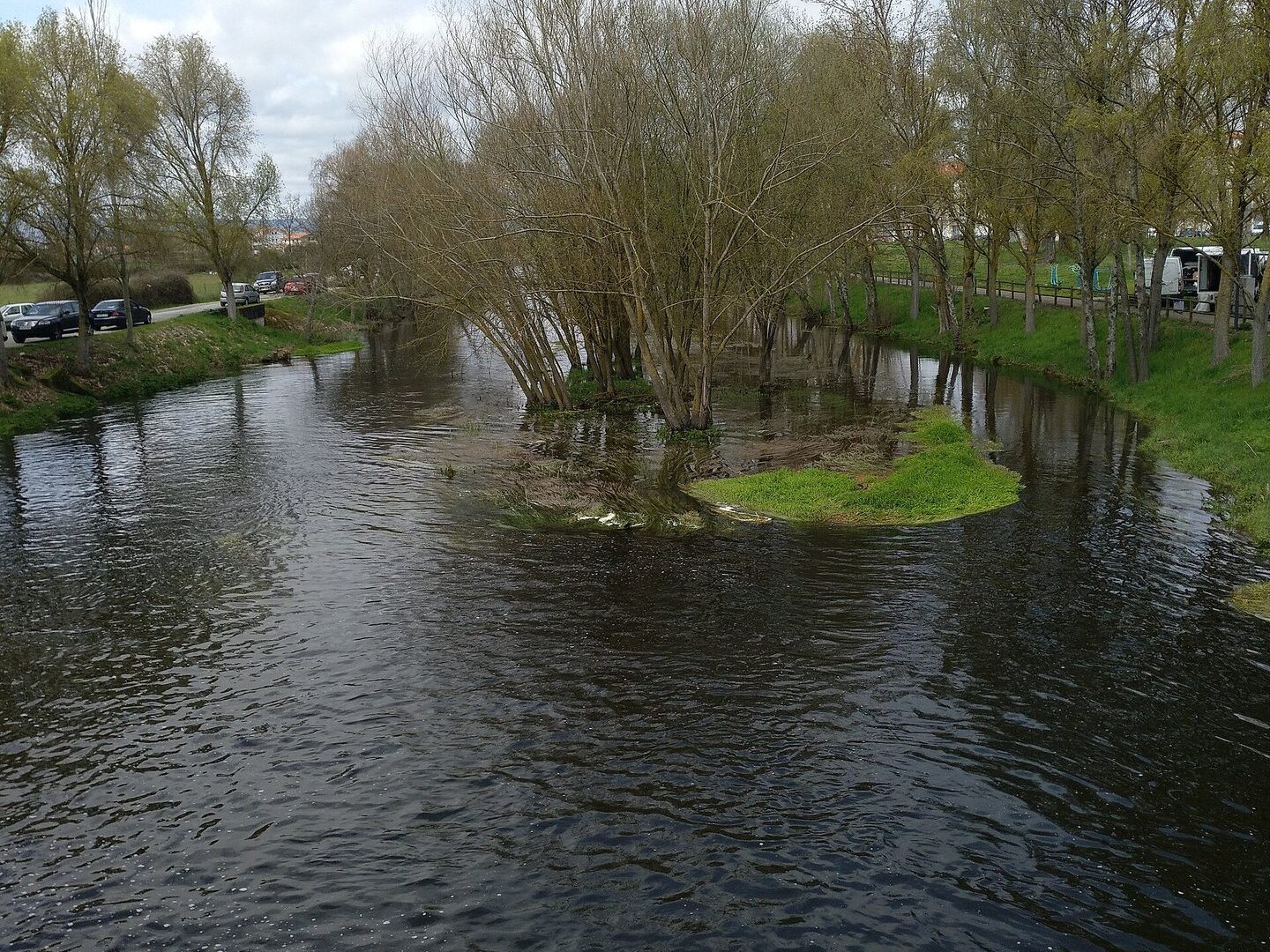
The Limia river rises around Paradiña-Alberguería (Sarreaus), crosses the A Limia depression and the town of Xinzo, passes into the Baixa Limia and enters Portugal at Lindoso; 41 Galician km of an international river of 108 km.
The Limia river is an international river: it rises in Galicia, enters Portugal through the freguesia of Lindoso and flows into the Atlantic at Viana do Castelo. It is about 108 km long in total with a basin of 2,387 km², of which 1,329 are in Spanish territory; the Galician stretch measures 41 km [1][2]. According to Turismo de Galicia, of the river’s 108 km, 41 run through the south of Ourense and 57 through the north of Portugal, where it is called the Lima [4]. The Romans called it Lethes, the river of Forgetting (see The myth of the Lethes).
Source
The sources disagree: the website xinzodelimia.eu says it rises at 900 m altitude, at the confluence of the streams Sas de Pedroso, Valdelobos and Freixo, in the place of Paradiña-Alberguería (Sarreaus) [1]; the Spanish Wikipedia places the source at 975 m on Monte Talariño and says that in the upper course the river has many local names (Talariño, Freixo, Mourenzo), although the official one is Limia [2].
The course
- Upper basin. It runs through the A Limia depression, very horizontal, and receives the waters of Lodoselo, Trasmiras, Faramontaos, Vexa, the Lagoa de Antela river, Lámbeas and Avedul while hardly carving the valley [1]. It passes through the town of Xinzo de Limia (Toural park, Damil bridge, Porto Alto) [1].
- Baixa Limia. To the south-west the bed narrows towards the Portuguese border; it receives the waters of the Salas (a parallel, similar river) and those coming from the Xurés and Larouco ranges, and, in tributaries and places such as Barxa, Ponte Nova, Mao, Cabaleiros, Vilameá, Caldo, Cadós, Currelo and Grou [1]. The Spanish course ends through the arid Peneda range [2].
- In Portugal it enters, hemmed in, the Lindoso dam and passes Ponte da Barca, Ponte de Lima and Viana do Castelo [1][2].
Fish and protection
The species mentioned are trout, eel and cyprinids in the reservoirs [1]. In the Baixa Limia lies the Xurés Natural Park and, in Portugal, the Peneda-Gerês National Park [1]. Since 2000 the management of the river has been regulated by the Albufeira Convention between Spain and Portugal, to protect the waters and make use of cross-border water resources [2].
History
The Romans called it Lethes because they confused it with the legendary river of Forgetting. In 138 BC the general Decimus Junius Brutus tried to dispel the myth: he crossed the river and called his soldiers one by one by name from the other bank. Beside it they built the camp of Aquis Querquennis, of which remains survive [2]. Between 1985 and 2008 six dugout canoes appeared in the Portuguese stretch of the riverbed, vessels made from a hollowed tree trunk, known in Europe since the Neolithic [2].
The floods in Xinzo
The "cheas" were the floods and overflows of the Limia in the town, which happened several times a year in the long, harsh winters of the past. They mainly affected the Baronzás scrub, the Cobos, Barreiros, the Seara, what is now Rosalía de Castro street, Lepanto street, the Ladeira, the Toural and the San Roque square: "Xinzo looked like an island" [3]. Carlos Casares recalled it in an article in La Voz de Galicia (25/11/2000) reproduced by the source: the town is built on marshy ground, on land that was once the Lagoa de Antela, and when the flood came some streets turned into canals where people used boats with poles to get in and out of their houses. The worst affected was the "Calle de Atrás", near the Ladeira, a meadow next to the river that in winter became a large pond, where businesses (the Lola soft-drinks factory, the Estreito house, Euloxio Portela’s carpentry) had to spend hours bailing water. For children, says Casares, the flood was exciting [3].
Links
Sources
- «O río Limia», xinzodelimia.eu (captura de Wayback). http://www.xinzodelimia.eu/rio_limia.htm
- «Río Limia», Wikipedia en castelán (CC BY-SA 4.0). https://es.wikipedia.org/wiki/Río_Limia
- Edelmiro Martínez Cerredelo, «As cheas do río Limia ao seu paso por Xinzo», Historia de Xinzo, 06/12/2016. https://historiadexinzo.wordpress.com/2016/12/06/as-cheas-do-rio-limia-ao-seu-paso-por-xinzo/
- Turismo de Galicia, «Percorrendo o río Limia». https://blog.turismo.gal/percorrendo-o-rio-limia/