

The Entroido of Congostro: the running cockerel, the donkey’s will and the fargalleiro
The Entroido of Congostro (Rairiz de Veiga): the Cockerel Race of Corredoiro Sunday, the donkey's will, the meco stolen between villages, the children's fargalleiro and the pork meals.
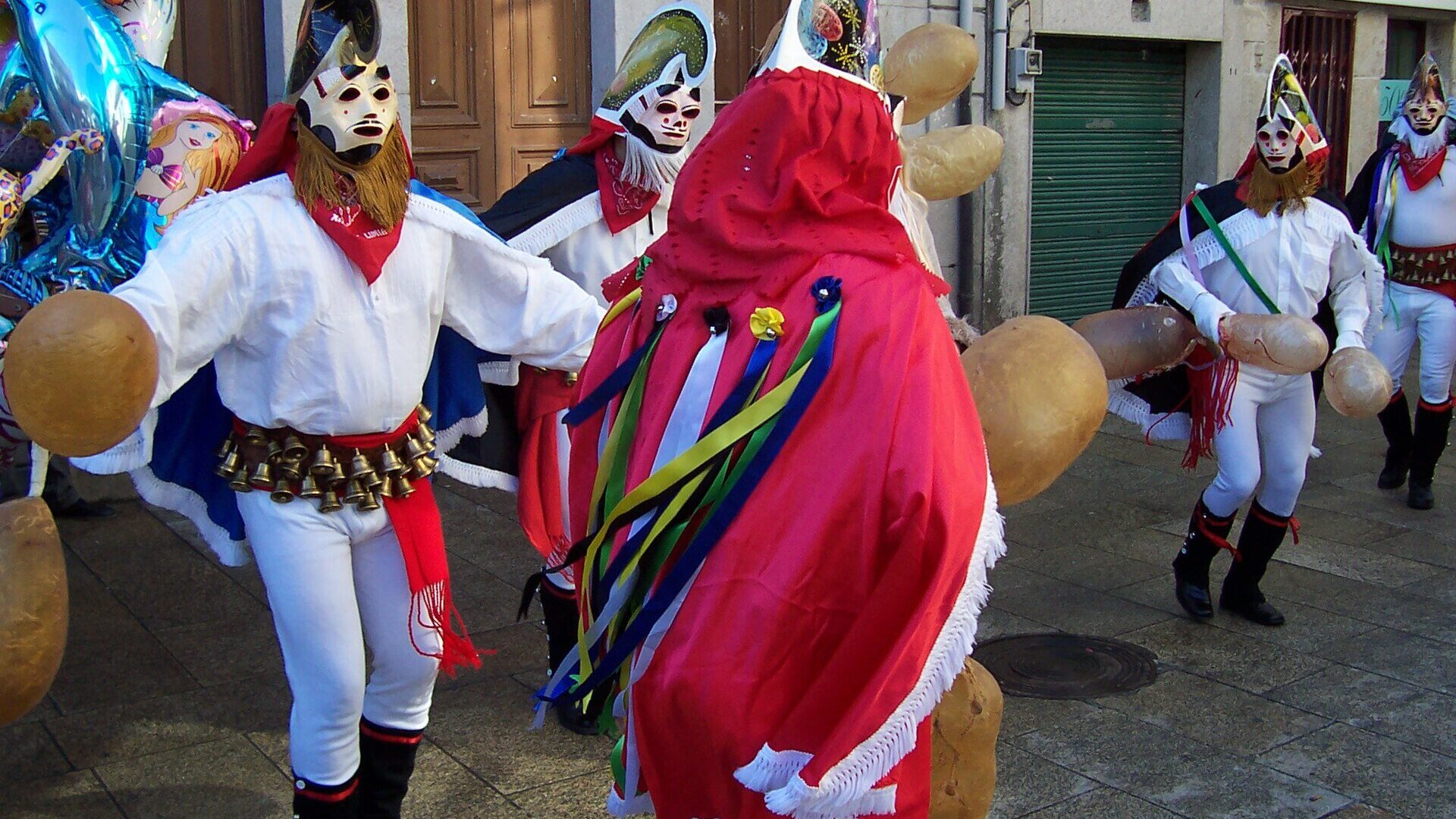
The Entroido of Congostro, in Rairiz de Veiga, has little to do with that of Xinzo, but shares its participatory spirit. The customs below come from a study of the Entroido made by the Cultural Association "A Escola", formed in the village by young people who wanted to highlight their elders’ traditions, which Xosé "Pepe" Calleja López was allowed to photocopy in the 1990s. The text says it was a very participatory Entroido, with the whole village involved, from the grandmothers who cooked to the children [1].
Corredoiro Sunday and the Cockerel Race
The Entroido began on the Sunday before Entroido Sunday, Domingo Corredoiro, with the Corrida do Galo (Cockerel Race). In the morning the young men bought a cockerel from a neighbour by pooling their money and put on their heads a hat of branches and an apron, carrying a wicker rod. The cockerel was released at San Miguel, barely a kilometre away, and they drove it past the hens, striking it with the rod, as far as Congostro, where the race continued through the streets and ended at the Aira da Moa, in the centre of the village. There the cockerel, nearly dead, was hung by the neck from a house balcony and the children played blind man’s buff, blindfolded, to strike it; when it died it was handed to the village teacher. The article comments that today it seems very cruel, but it was a common game in many villages of Galicia and the Peninsula, and that where the term "corredoiro" appears in the Entroido there is usually a cockerel race. In the afternoon the "Mazallada" (the young men) dance to bagpipes at the Aira da Moa [1].
The donkey’s will
On Entroido Sunday the Testamento do Burro (Donkey’s Will) was celebrated. During the year a donkey, so useful for transport, would often die, and the young men prepared a will, supervised by someone who could write verses, mourning the animal and sharing out its parts among the neighbours who stood out, for good or ill. A young man or woman read the will mounted on a donkey, with two companions pulling the halter, surrounded by the whole village [1]. The study transcribes the 1989 one, the "Testamento do famoso burro do Xaime": a satire in verse, in Galician with passages in Spanish, on the death of the old donkey of a couple from San Miguel (with anecdotes such as trimming the animal’s hooves, the children’s emigration and the sharing of the meat among family and neighbours) that ends with the group asking for help to recover forgotten customs [1]. For other wills see Wills of the donkey.
The meco and the fargalleiro
The meco (a straw puppet in an old man’s clothes) was paraded round the whole village and on Entroido Tuesday the young men of Congostro and San Miguel tried to steal it so it would spend the night in their village; that rivalry lasted the whole Entroido, with troupes going from one village to the other. The traditional mask was the fargalleiro, for the children, who dressed in old clothes from home and went out every day, sometimes with masks made from the women’s old stockings. They went from house to house collecting eggs, chorizos or money and, around ten or eleven in the morning, made an omelette at one of their houses; with the money they bought soft drinks and biscuits [1].
The pork meals
In Congostro the Entroido meals revolved around the pig: a María, the thinnest and longest part of the large intestine, on Corredoiro Sunday; o bandullo, the pig’s stomach stuffed with ribs and seasoned with paprika, water, salt and onion, on Entroido Sunday; a cachucha, boiled with potatoes; and filloas, made of milk, flour, eggs, sugar and pig’s blood [1].
Links
Sources
- «O ENTROIDO EN CONGOSTRO. RAIRIZ DE VEIGA. A LIMIA – Tradicións da Limia», As tradicións da Limia. https://tradicionsdalimia.es/o-entroido-en-congostro-rairiz-de-veiga-a-limia/
You may also like
 Anatomy of the Pantalla: what the Xinzo Entroido mask looks like and how it is fittedHow a Xinzo Pantalla is made: face perimeter, beard, mouth, eyes, the horn and its dots, the hat and the traditional cut, and how…
 Anecdotes and memories of the Xinzo Entroido: the 1943 jail, a parody and the 2002 photosThree memories of the Xinzo Entroido collected by Pepe Calleja: the neighbours fined and jailed in 1943 for celebrating it, an improvised…
 Calendar of patron-saint festivals, pilgrimages and magostos of A LimiaCalendar of the patron-saint festivals, pilgrimages, magostos and traditional fairs of the concellos of A Limia (except Os Blancos), with…
Craftspeople and historic pantallas of the Xinzo EntroidoWho made the Xinzo Pantallas and how the trade was passed on: Pepucho, José Santiago Taboada, Julio Villarino, Celso Lorenzo, Pucho,…
FestivalEntroido of Xinzo de LimiaThe Entroido of Xinzo de Limia lasts five weeks, has the Pantalla as its emblematic mask and has been a Festival of International Tourist…
 Fareleiro Sunday: the flour battle that opens the Xinzo EntroidoFareleiro Sunday opens the traditional cycle of the Xinzo Entroido with a bran and flour battle in the Praza Maior; it is a day designed…
