


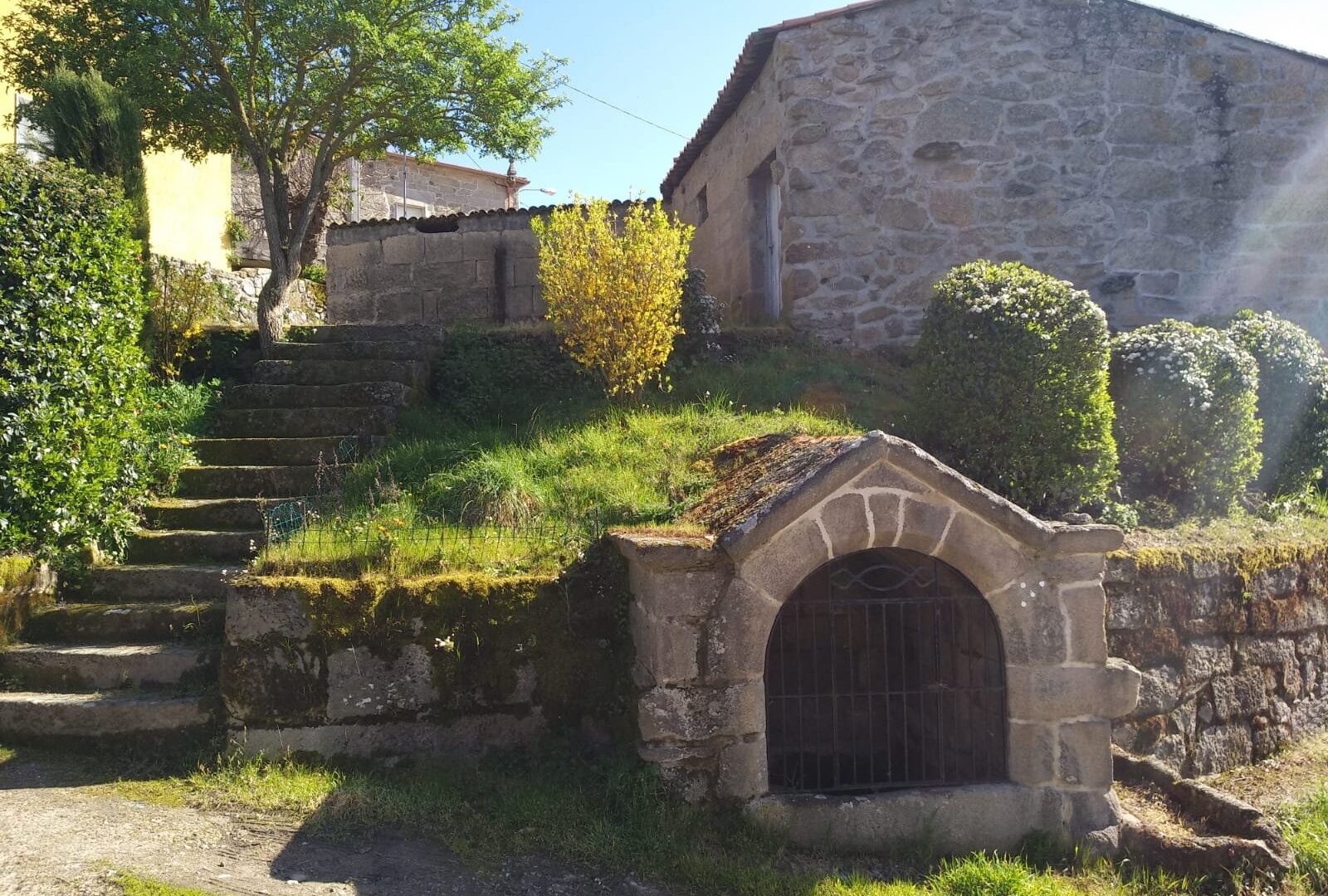
Ethnography of A Limia: canastros, houses, limewash, finger guards, stonemasons, blind singers’ verses and the Gerinaldo
Ethnographic studies by Pepe Calleja on A Limia: the canastros of Fontemoura and Faramiñás, the houses of Xinzo, the limewash of Solbeira and Trandeiras, the reaping finger guards, blind singers' verses and the Gerinaldo.
Xosé "Pepe" Calleja López, on the blog As tradicións da Limia, makes very detailed studies of the material and oral culture of Xinzo and the comarca. This page summarises those that are not about the Entroido.
The canastros
Canastros (wooden granaries for maize) appear only where climate and altitude allow maize, an American cereal that arrived as relief from hunger. Maize needs more drying time than a Galician autumn gives, and the canastro solves that: a ventilated chamber, raised off the ground and free of damp and animals [1]. According to the author, the canastro predates maize (a cantiga of Alfonso X, CLXXXVI, has a miniature of canastros like today’s), the Romans noted the raised granaries (granaria sublimia) and their origin is debated: Suebi, castro-dwellers or lake-dwellers [1].
Those of A Limia are simple, built by farmers with few resources [1]. Calleja studies that of Fontemoura (Porqueira; article published in 2002 in the magazine O Bouzo), with 11 canastros measured and a gabled roof with eaves of 34 to 65 cm; the doors face east to shelter from the western rain and leave a short step so mice cannot climb [1]. In Faramiñás (San Martiño de Porqueira) there are eight wooden canastros on legs; he describes one with six truncated-pyramid granite legs of 88 cm, stone tables of 175 cm, a chamber of 470 × 115 cm and 175 cm high, and a door split in two so the upper part stays open and dries the maize [2].
The houses of Xinzo
Many houses in the Barrio de Abaixo have two floors: on the ground floor, the animals; on the first, the dwelling. The first floor is reached by interior stairs (narrow, wooden, with a door at the top to keep out smells) or exterior ones, ranging from the model leading straight to the door to those with a "patín" or "patamal" (a larger last step) [4]. Calleja also published in Lethes no. 1 (1999) an article on the house and the stonemasons, for which he interviewed the stonemason Antonio, "o Ranita", starting from Xaquín Lorenzo’s book A Casa [3].
Limewash and banding
In Solbeira and Trandeiras there are façades with chalice limewash: under the roof, a lime decoration in the shape of a chalice (half circle and a triangle) with horizontal lime banding between the stones (irregular on rubble, regular on ashlar); on some, the limewash spills inside the chalice or covers the full width of its mouth, with a wavy effect. Many are damaged by roof changes and by the whitewashing [5].
The reaping finger guards
Rye reaping was hard and communal; to avoid cuts when gripping the bunch of straw with the left hand while the right held the sickle, dedís were used, five leather finger guards, one per finger, joined by a lashing that also served to hang them from the belt. Many reapers, once reaping was done at home and at neighbours’, went to Castile to reap, on foot, even from the age of twelve [6].
Blind singers’ verses
In the 1990s Calleja received from a person in Moreiras two blind singers’ verses on original sheets: they were sold by blind men, blind women or companions at fairs, pilgrimages and festivals; the blind singer sang the event with violin or hurdy-gurdy and the companion sold the papers and held the illustrated poster. They were written by teachers, doctors, priests or apothecaries; almost all in Spanish and with a moralising aim. He reproduces "La mujer que dió muerte a su marido por tener amores con su criado" (a crime in Celtizos de Trasparante, A Coruña) [7]. María José Fernández Estévez, from Montreal, contributed those of her grandmother Rosa Jardón Morán, of Vilar de Santos, such as "Los amores de Carolina", a humorous verse; the grandmother always sang, and Calleja warns that by letting the radio sing for us the link of oral transmission is broken [8].
The Gerinaldo in A Limia
The ballad of Gerinaldo, one of the most widespread in the traditional ballad corpus (also Moroccan, Judeo-Spanish and American), tells of the loves of a page of Charlemagne and the emperor’s daughter. Calleja links the character to Eginhard, Charlemagne’s secretary and chronicler, and cites the chronicle of the monastery of Lorsch (Lauresheim) as the oldest source for the episode of the lovers and the footprints in the snow [9]. In A Limia it was sung at gatherings; a version by Remedios Santana of Piñeira Seca survives and another, collected by X. L. Saburido Nóvoa and D. Blanco Salgado in Tradicións da Comarca da Limia. Literatura popular (1998), mixing the Gerinaldo with the Condesita [9].
Links
- Granaries, chests and hay lofts of Xinzo
- Maize in A Limia and the canastros
- Water in the villages: wells, cambóns and irrigation
- Stable doors: latches and cancelóns
- Xinzo’s vanished souls’ box
- History of A Limia
- Entroido: memory and archive
- Xinzo de Limia
Sources
- Xosé Calleja López, «Os canastros de A Limia. A Fontemoura», As tradicións da Limia, 08/08/2019. https://tradicionsdalimia.es/os-canastros-de-a-limia-a-fontemoura/
- «Os canastros de A Limia. Faramiñás», 20/10/2019. https://tradicionsdalimia.es/os-canastros-de-a-limia-faraminas/
- «Artigo no Lethes nº 1. A labor dos canteiros», 28/11/2020. https://tradicionsdalimia.es/artigo-no-lethes-no-1-a-labor-dos-canteiros/
- «Acceso ao primeiro andar nas casas de Xinzo», 03/08/2021. https://tradicionsdalimia.es/aceso-ao-primeiro-andar-nas-casas-de-xinzo/
- «Encalados e encintados en Solveira» (cita), 26/06/2022. https://tradicionsdalimia.es/encalados-e-encintados-en-solveira-a-limia-reportaxe-fotografica/
- «Os dedís», 14/11/2021. https://tradicionsdalimia.es/os-dedis/
- «Unha copla de cego», 06/01/2021. https://tradicionsdalimia.es/unha-copla-de-cego/
- «Unhas coplas de cego que chegan dende Montreal (Canadá)», 22/05/2021. https://tradicionsdalimia.es/unhas-coplas-de-cego-que-chegan-dende-montreal-canada/
- «O Gerinaldo», 02/07/2019. https://tradicionsdalimia.es/o-gerinaldo/
You may also like
 Antela Football Club (1919): the oldest club in OurenseAntela Football Club, founded in Xinzo de Limia in June 1919, is the oldest club in the province of Ourense: the statutes, the Toural…
 Archpriestship of A Limia: parishes and dedicationsThe Archpriestship of A Limia in the diocese of Ourense: 82 villages, 33 chapels and a list of parishes with their dedication, from Santa…
 History of A LimiaCinemas, café, radio, school and library: Xinzo’s cultural life from 1948 to the 1970sThe cinemas Los Molinos (1948) and Antelano (1954), the Café Ideal and the Ideal 6 disco, the 1950 radio, the Colegio Santa Marina, the…
 Emigration of the Limia people: from the 1950s diaspora to personal itinerariesHow the Limia people emigrated: destinations and phases (America from 1920, Venezuela, Brazil, the Basque Country and Catalonia in the…
From the Republic to the coup: Xinzo and A Limia between 1931 and 1936How the proclamation of the Republic (1931), 1 May 1936 and the preparation and success of the military coup of 17 to 20 July 1936 were…
History of A LimiaHistorical memory of A Limia, 1931–1953: Republic, repression and guerrillaGuide to the historical memory of A Limia between the Republic and the guerrilla: the 1936 coup, repression, women victims, the Causa…
