


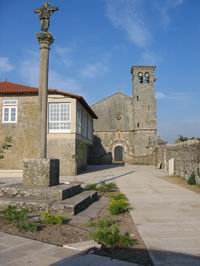
The church of Santo Estevo de Sandiás: late Gothic, Manueline and Moure’s altarpiece
The church of Santo Estevo de Sandiás, built before 1520 by the Portuguese stonemason Bartolomeu de Nosendo, has a Manueline portal and a high altarpiece by Francisco de Moure (1603–1607), among the finest of Ourense Mannerism.
The church of Santo Estevo is the church of the parish of Santo Estevo de Sandiás. It is in the late Gothic style or, according to some authors, «one of the most beautiful of the Galician Renaissance», styles that are rare in Galicia [1].
Construction and architecture
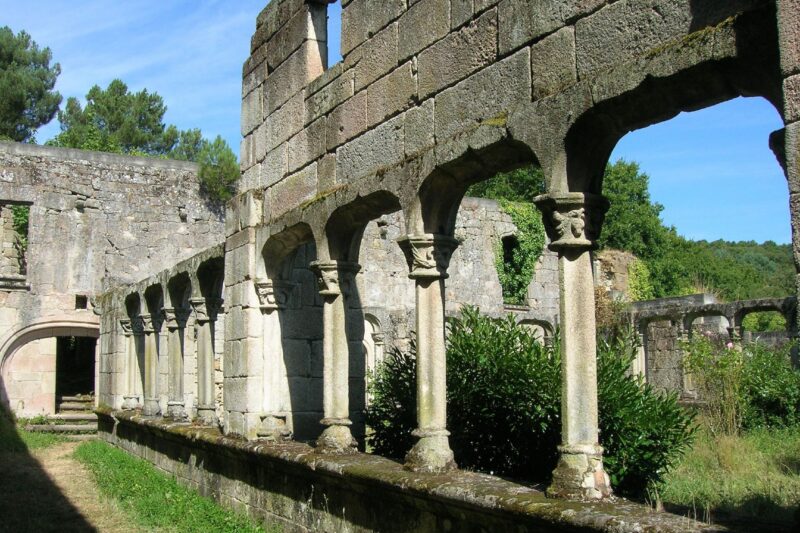
It was built before 1520 by the master stonemason of Portuguese origin Bartolomeu de Nosendo, who also worked at the monastery of Xunqueira de Ambía and at the convent of Bon Xesús de Trandeiras; his origin is betrayed by the Manueline-influenced portals [2]. See Convento do Bon Xesús da Limia.
It has a single nave and a square presbytery. The Manueline portal stands out, recalling the Portuguese churches of Maravilha (Santarém) or the parish church of Batalha. Inside, the arches rest on columns engaged in the walls, with capitals bearing Renaissance motifs [1].
The high altarpiece by Francisco de Moure
The high altarpiece was made between 1603 and 1607, dates visible at the top after the restoration that gave back its original colours and paintings. It is one of the few late Mannerist altarpieces to have survived complete, following the model of the Escorial monastery, and one of the main works of the first period of the sculptor Francisco de Moure, one of the best Galician artists of the first third of the 17th century. The figures have great expressive force and already foreshadow the Baroque [1].
It has two storeys, three bays and an attic. In the first storey Saint Peter and Saint Paul stand out; in the second, Saint Francis, Saint Stephen and Saint Lawrence. Of particular interest are the Mannerist paintings by an unknown painter (the Annunciation, the Visitation, the four Doctors of the Church and several female saints) and others that came to light during the restoration [1].
An ensemble with calvary cross and rectory
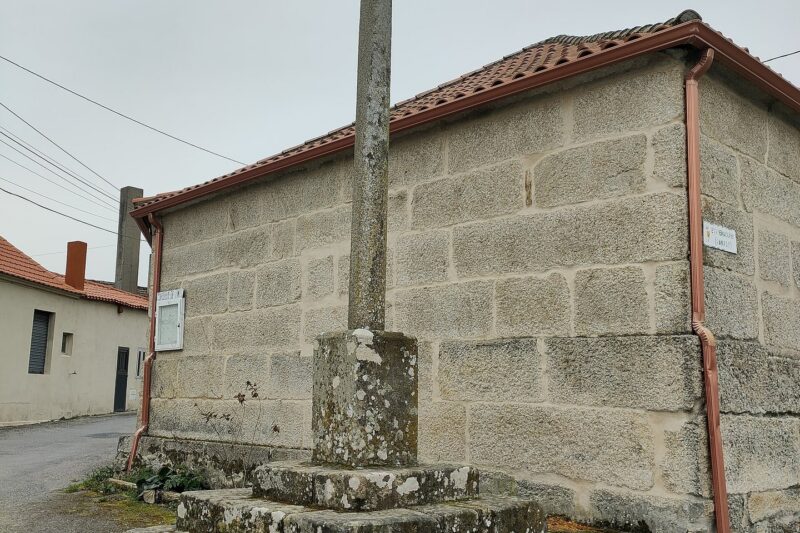
The Galipedia image gallery shows the church together with the cruceiro and the rectory [1]. The church is part of the religious heritage of the municipality of Sandiás, where the Torre do Castro also stands.
Links
Sources
- «Igrexa de Santo Estevo de Sandiás», Galipedia (CC BY-SA 4.0). https://gl.wikipedia.org/wiki/Igrexa_de_Santo_Estevo_de_Sandiás
- «Bartolomeu de Nosendo», Galipedia. https://gl.wikipedia.org/wiki/Bartolomeu_de_Nosendo
You may also like
 HeritageA Pedra Alta or Pedra Grande de Antela: the menhir of the LagoaThe Pedra Alta is a 3.47 m granite menhir in the heart of the former Antela lagoon, a boundary marker between Xunqueira de Ambía, Sarreaus…
 Heritage of A Limia: towers, convents, mills and ethnographic villagesA tour of the historic heritage of the municipality of Xinzo de LimiaA summary of the historic heritage of Xinzo de Limia: the Romanesque old church, the churches of Novás and Morgade, Torre da Pena, the Bon…
 Antón Tovar Literary Competition of the Museo da LimiaSince 2024 the Board of the Museo da Limia has called the Antón Tovar Literary Competition to honour the poet of A Pereira and to demand…
Churches and chapels of the parishes of Xinzo de LimiaIndex of the parish churches and chapels recorded in each of the 20 parishes of Xinzo de Limia, with their dedication, according to…
 Convento do Bon Xesús da Limia (Trandeiras): the BIC fileThe Convento do Bon Xesús da Limia, in Trandeiras (Xinzo de Limia), was built in the early 16th century; the Xunta has opened the procedure…
 Cruceiros and petos de ánimas of A LimiaInventory of the 158 calvary crosses, crosses, calvaries and petos de ánimas of A Limia by municipality and parish, according to Galicia…
