

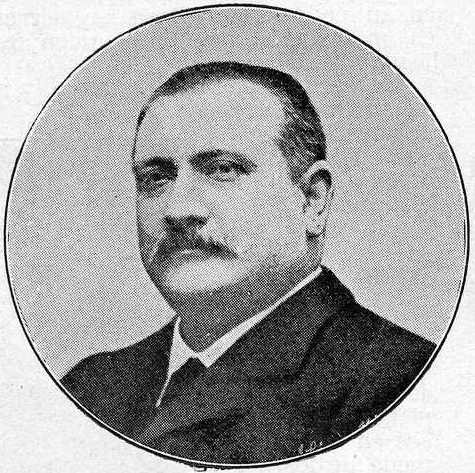
Eduardo Cobián, Deputy for Xinzo de Limia and Minister (1857-1918)
Eduardo Cobián y Roffignac (Pontevedra, 1857 – Madrid, 1918) was deputy for Xinzo de Limia from 1893 until his death, Navy Minister (1903 and 1905), Finance Minister (1910-1911) and governor of the Bank of Spain.
- Born
- Pontevedra, 1857
- Died
- Madrid, 1918
- Constituency
- Xinzo de Limia (deputy from 1893 until his death)
- Minister
- Navy (1903 and 1905) and Finance (1910-1911)
Eduardo Cobián y Roffignac was born in Pontevedra on 19 March 1857 and died in Madrid on 20 April 1918. He was a lawyer and a politician of the Restoration, and his name is linked to Xinzo because for more than twenty years he represented the district of Xinzo de Limia in the Congress of Deputies [1].
A «cunero» deputy
He studied in Pontevedra and Celanova, and law in Santiago and Madrid. He opened a practice in Getafe and then in Madrid, and was deputy for La Cañiza from 1886. In 1893 and 1896 he entered Congress for the district of Xinzo de Limia as a cunero, that is, a candidate with no local ties standing in a district controlled by the parties, a phenomenon typical of the caciquismo of the Restoration. In 1898 he moved to the Senate, where he stood out on defence matters, and in 1901 he returned to Congress, where he was again deputy for Xinzo de Limia until his death [1].
Minister and financier
He was Navy Minister between 20 July and 5 December 1903 and between 6 January and 23 June 1905. After the death of Fernández Villaverde, the Villaverdistas gathered around him, until the group dissolved in 1906 and several of its figures joined the Liberal Party, which made him chairman of the Budget Committee. He was Finance Minister between 9 February 1910 and 3 April 1911, with tax-reform proposals inspired by the economist Flores de Lemus (replacing the consumption tax, raising the sugar tax, reforming the Contribución de Utilidades and introducing a personal income tax); although most were rejected, the amendments that passed increased revenue and advanced the land registry. He later became governor of the Bank of Spain [1].
In 1910 he won the seat for Xinzo, but renounced it because he was simultaneously elected for Santa Cruz de Tenerife, and his secretary, Francisco Barber, took the Xinzo seat. In those elections he also had two sons elected for Getafe and O Barco de Valdeorras [1].
What he means for A Limia
Cobián’s career illustrates how the political system worked in the early twentieth century: rural districts such as Xinzo elected deputies tied to local networks and to the party dominant in Madrid. To see what the town was like in those years, see Xinzo in 1905.
Frequently asked questions
Why was Xinzo’s deputy from Pontevedra? Because the Restoration system allowed cunero candidacies, with no local ties, in controlled districts [1].
What offices did he hold? Navy Minister and Finance Minister, chairman of the Budget Committee and governor of the Bank of Spain [1].
Links
- People of A Limia
- Xinzo de Limia
- Xinzo in 1905 according to Fialho de Almeida
- The Portuguese monarchists in A Limia
Sources
- «Eduardo Cobián», Spanish Wikipedia (CC BY-SA 4.0). https://es.wikipedia.org/wiki/Eduardo_Cobi%C3%A1n
You may also like
 Notable personAiras Vasques, Bishop of Lisbon Born in Xinzo de Limia (13th Century)Airas Vasques (Xinzo de Limia, c. 1170 – Lisbon, 1258) was Bishop of Lisbon from c. 1241, archdeacon of Santiago, founder of the collegiate…
 Notable personAlfredo Nan de Allariz, Poet and Playwright from Xinzo in HavanaAlfredo Fernández, «Nan de Allariz», was born in Xinzo de Limia (1874 or 1875) and died in Madrid in 1927; poet, playwright and composer,…
 Notable personÁlvaro de Oca y Zúñiga, the Jurist from Celme Who Became Viceroy of NavarreÁlvaro de Oca y Zúñiga (Celme, Rairiz de Veiga, 16th century – Pamplona, 1638) was a professor at Salamanca, judge, regent of the Royal…
 Notable personAna Prieto, pharmacist and MP born in Xinzo de LimiaAna Prieto Nieto (Xinzo de Limia, 1965) is a pharmacist, was president of the Lugo Pharmacists' Association (2009-2015), deputy mayor of…
Notable personÁngel Cocho Ferrero, Headmaster of the Colexio Santa Mariña in XinzoÁngel Cocho Ferrero (A Coruña, 1914) ran the Colexio Santa Mariña in Xinzo from 1953, the town's educational landmark of the 1950s–70s. In…
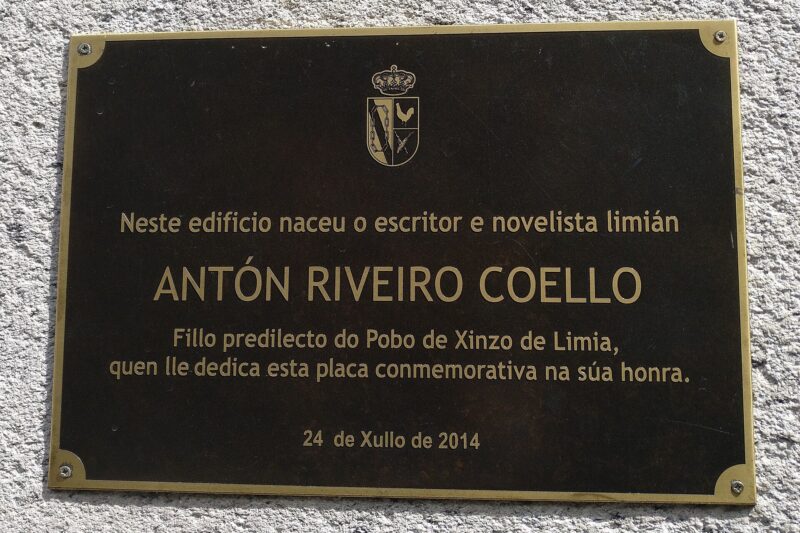 Notable personAntón Riveiro Coello, Writer from Xinzo de LimiaAntón Riveiro Coello (Xinzo de Limia, 1964) is one of the most translated Galician novelists: author of «As rulas de Bakunin», «Laura no…
