


Words of St John, the Couto Mixto, Celme and the tunnels: other legends and beliefs of A Limia
The "Palabras de San Xoán retorneadas", the numerical charm that defeats the devil and its Limia version; the Couto Mixto legend, Celme castle and the nobles of Congostro, the man-eating moura cycle and the tunnels between towers.
The Palabras de San Xoán retorneadas
The "words of St John" are a numerical charm, from 1 to 13, used to scare off the devil or witches when they physically appeared to carry off a person. The oldest version has an introduction: the devil appeared to a young man coming from the mill and said "if you do not tell me the words of St John I will take you with me". If the young man recited them without error, the devil vanished with a great explosion [1].
It is a form of oral literature widespread across Europe: Jewish, Latin and Eastern versions are known. The first Galician one was collected by Bernardo Barreiro in 1885, incomplete. The Galician versions add a number, 13, perhaps through Jewish influence, and in many cases replace the European "God" with the sun and the moon. Choosing St John as protagonist makes sense: St John’s night is the most important date of Galician tradition for scaring off devils and witches, and the summer solstice coincides with the sun worship that the words begin and end by naming [1].
Calleja compares three versions [1]:
| No. | European | Typical Galician | Limia |
|---|---|---|---|
| 1 | God | The sun and the moon | The sun and the moon |
| 2 | The two tablets of Moses | The two tablets of Moses | "Taboíña do meu ser" |
| 3 | The three Patriarchs or the Trinity | The three Patriarchs | The three Patriarchs |
| 4 | Four Evangelists | Four Evangelists | Four Evangelists |
| 5 | The five wounds | The five wounds | The five wounds |
| 6 | Six candles or candelabra | Six candles | Six candles |
| 7 | Seven sacraments | The seven lamps | The seven lamps |
| 8 | Eight beatitudes | The eight gates of paradise | The eight gates of paradise |
| 9 | Nine choirs of angels | Nine choirs of angels | Nine choirs of angels |
| 10 | Ten commandments | Ten commandments | Ten commandments |
| 11 | Eleven thousand Virgins | Eleven thousand Virgins | Eleven thousand Virgins |
| 12 | Twelve Apostles | Twelve Apostles | Twelve Apostles |
| 13 | (does not exist) | The thirteen queens of the sun | The thirteen queens of the sun |
In the Limia version the devil addresses a girl, whom he calls "my wife", and she replies "not yours, but God’s"; "taboíña do meu ser" is probably an oral corruption of "tablets of Moses". The charm begins "A la una el sol más claro que la luna" and ends, after each number, by repeating the formula "por onde Cristo vai e vén, a súa casa santa de Jerusalén" (where Christ comes and goes, his holy house of Jerusalem) [1]. It is also a memory exercise: it was recited many times so listeners would learn the words and test the memory of whoever said them, who risked ridicule if he failed [1].
The founding legend of the Couto Mixto
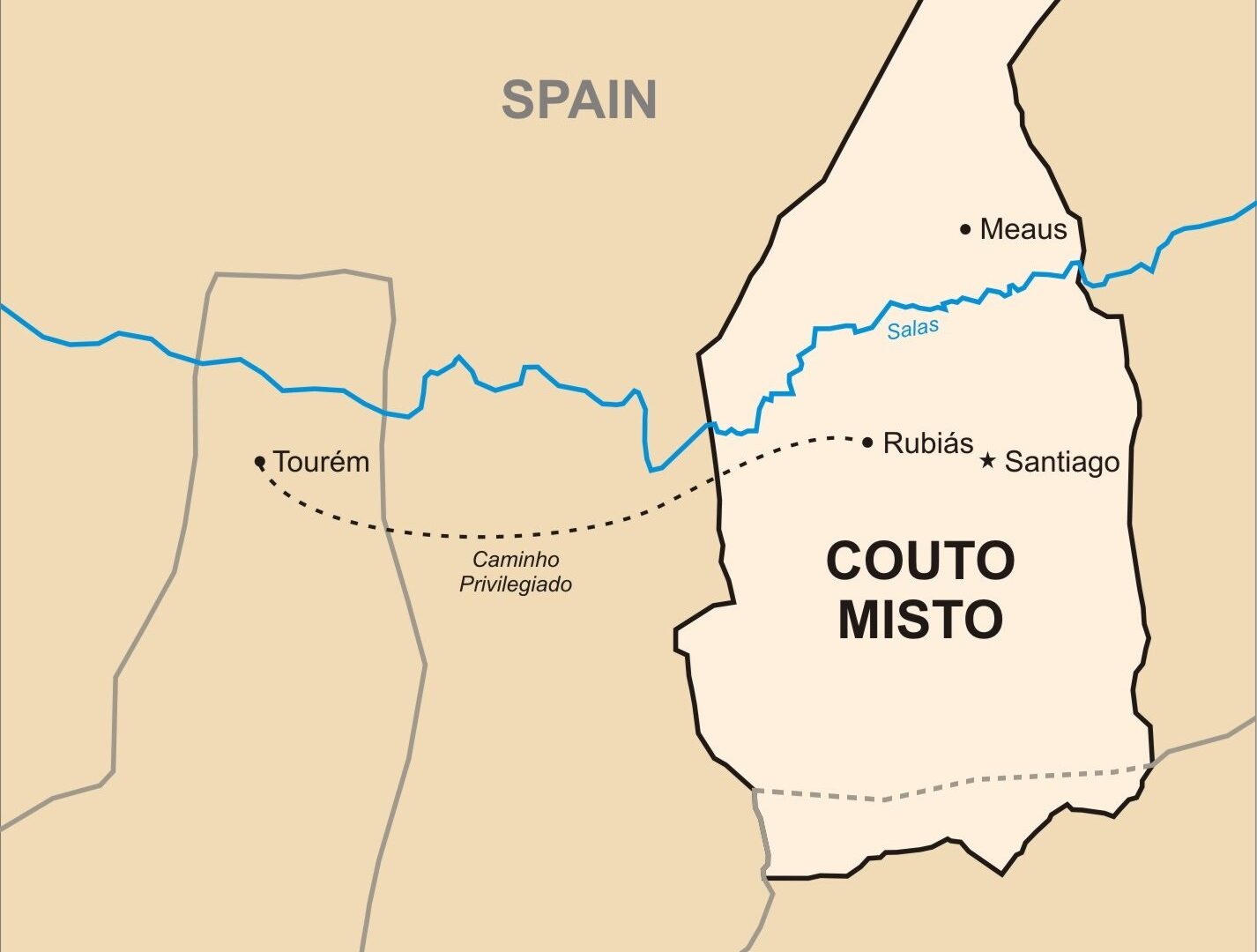
The Couto Mixto (Santiago de Rubiás and Rubiás dos Mistos, in Calvos de Randín, and Meaus, in Baltar) was a small historic "republic" between Galicia and Portugal. The legend says that a fugitive, pregnant queen of Portugal was taken in by the Couto’s neighbours when her labour pains began; in gratitude, when Portugal won the war, they were granted independence [2]. The bibliography cited by the source is L. M. García Mañá, Couto Mixto, unha república esquecida (Xerais, 2005) [2].
Celme castle and the nobles of Congostro
It is said that some noble families of Congostro, the village at the foot of Celme castle (Rairiz de Veiga), rose against royal power and used the castle’s stones for their houses. The viewpoint at Celme castle gives views over Congostro [3].
The man-eating moura cycle
According to Rafael Quintía Pereira (Análise estrutural e simbólica do mito da Moura, 2015), there are four Galician tales of a moura who eats a girl, and three are from A Limia: the Castro de Cerdeira (collected by Aparicio Casado), the monte Cantariña (Risco) and the Penedo da Moura of Trandeiras (Taboada Chivite). The structure repeats: the shepherd girl, the gift, the secret, the mother who forces a confession, the disappearance and the answer in verse from the depths of the earth or well. In A Limia there are variants at Treboal (Covelas), Monte do Castelo (Os Blancos), Moreira (Xinzo), Picos (Sandiás), Cantariñas (Laioso) and Trandeiras; the Castro de Cerdeira could not be identified [2]. See Moors of A Limia.
The tunnels between towers
In a 2010 comment, Víctor Pérez summed up the comarca’s imaginary: "What would A Limia be without the drowned cities, the tunnels linking the towers, the Raíña Loba…?" [4]. See The Torre do Castro, Xinzo de Limia and Vilar de Barrio.
Links
Sources
- Xosé Calleja López, «As palabras de San Xoán retorneadas», As tradicións da Limia, 01/03/2019. https://tradicionsdalimia.es/as-palabras-de-san-xoan-retorneadas/
- «Couto Mixto, Santiago e Rubiás», Fronteira Esquecida Limia-Lima; «Tres contos de mouras e mouros», As tradicións da Limia, 12/05/2021. https://fronteiraesquecida.eu/gl/fichas/couto-mixto-santiago-e-rubias/
- «Miradoiro do Castelo de Celme», Fronteira Esquecida Limia-Lima; cita C. Ramírez, «Celme, enclave casi portugués», La Voz de Galicia, 20/05/2011. https://fronteiraesquecida.eu/gl/fichas/miradoiro-do-castelo-de-celme/
- Comentario de Víctor Pérez (2010) a «A traizón da torre de Sandiás», Galicia Encantada. https://galiciaencantada.com/lenda.asp?cat=12&id=1038
You may also like
 LegendThe Raíña Loba and her castle on the crags of Covas (Os Blancos)On the crags of Covas, at about 1,150 metres, there was a rocky castle where a cruel queen lived who charged a calf, a sheep and a pig…
 LegendMoors of A Limia: treasures, broken secrets and enchantmentsThe legends of Moorish men and women in A Limia: the mouras of Treboal, the Covelas mine, the gold cart of A Touza, the Moors' girl, the…
 LegendLegends of the Torre do Castro and SandiásThe legends of the Torre do Castro and Sandiás: the Moors' tower and the hammer that made the Lagoa de Antela, the treasure in the well,…
 LegendLegends of Vilar de Barrio: xianas, Moors’ holes and the Lagoa de AntelaLegends and tales of Vilar de Barrio: the xianas of Arnuíde, the Moors' holes at Bóveda with the twelve chicks, the Pozo dos Mouros at…
 LegendLegends of Vilar de Santos: the Mariquiña, Santa Marta and the St John’s snakeLegends of Vilar de Santos: the moura Mariquiña of Monte das Cantariñas (Laioso), Santa Marta and the Castelaos serpent, St John, the…
LegendLegends of Xinzo de Limia: the Lethes, Trandeiras, the Torre da Pena and the river mourasLegends of Xinzo de Limia: the river of oblivion, the Virgin and Xoán Folgoso at Trandeiras, the moura of the sieve at Lamas, the moura of…
