


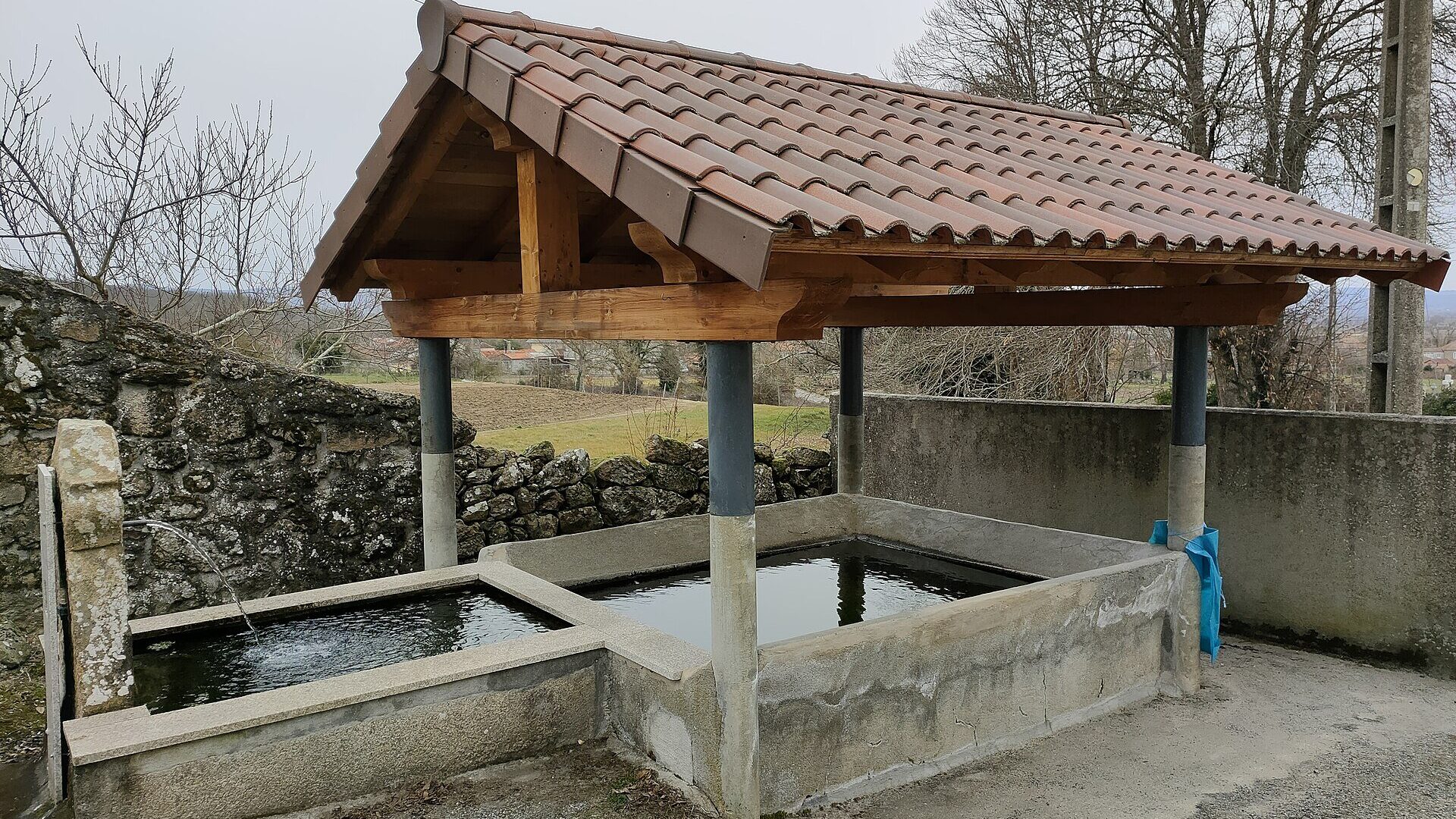
Water in the villages of A Limia: wells and cambóns of As Pegas and the Pexeiros irrigation shares
How Limia villages were supplied and irrigated without running water: the wells of As Pegas (Sandiás), the pulley and cambón for drawing water, and the turn-based sharing of water brought to Pexeiros (Os Blancos) in 1946.
Although it may seem that A Limia has water to spare, the soils are sandy and do not retain it, and in summer it runs short when most needed. Two pieces by Xosé "Pepe" Calleja López in As tradicións da Limia show how the villages solved it: with wells and devices to draw it in As Pegas and with irrigation-sharing books in Pexeiros.
The wells of As Pegas (Sandiás)
A small stream runs through As Pegas, rising on the monte de San Bieito and formerly ending in the Lagoa de Antela; today it ends in the fields and dries up in summer. The neighbours dug wells to solve the shortage [1].
- Round well, in houses and yards. Water was drawn with zinc buckets tied to a rope; a sideways flick of the wrist tipped the bucket so it would fill. To lift it full the roldana (pulley) is used: three iron bars resting on the well mouth holding a grooved wheel [1].
- Cambón or bimbastro, for watering gardens. It is a lever device: a thick branch stuck in the ground with a fork-shaped tip, a long branch that swings pierced by an iron bar and carries on its short end a counterweight (a stone half the weight of the full bucket), and a thin rod that carries the bucket and makes it enter the water without a knock. One person lowered the counterweight end to sink the bucket; another emptied the full one into a channel. The pole has holes to adjust the height according to the water level. In 1998 the author photographed one that no longer exists and in 2019 another still standing, with a trough and a stone for washing clothes. In Feces de Abaixo it was called a balde [1].
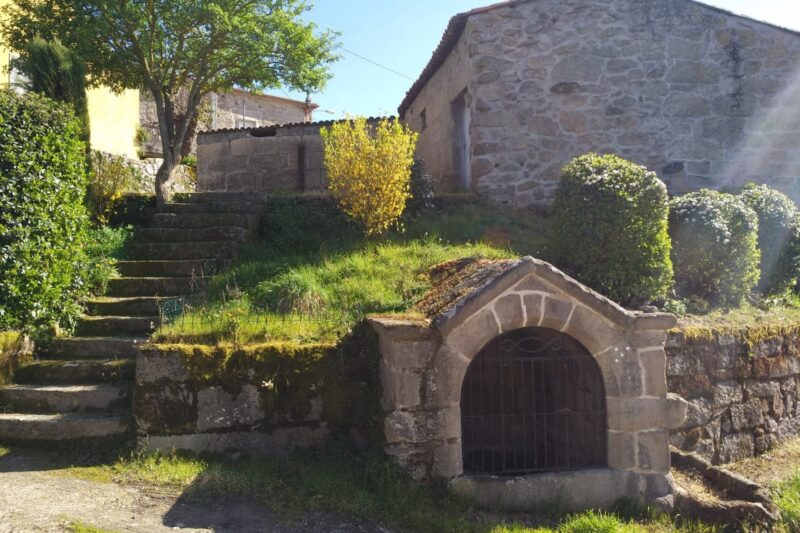
- Stone well, for domestic use near the kitchen: three in the village, one in ruins (its owner was credited with healing powers, especially for stomach ache) and the other two in use, with water even in summer. One is in the yard, almost at ground level, with a stone cover, stone steps too, and a niche to set pots; another is above ground level, with a sloping stone roof and a plank door [1].
The irrigation book of Pexeiros (Os Blancos)
The second text studies a 1946 document, "the book" as it was called, a sheet in Spanish that orders the sharing of the communal water brought from the A Rabea pool, which supplied Pexeiros. The shares were highly respected and the book had the esteem of a sacred book, kept by an honest person who defended the neighbours’ agreement from opportunists and caciques [2].
The sheet, written on both sides, lists by irrigator, with full name, the start and end time of irrigation in two turns: the first with thirteen irrigators (from five hours to thirty-eight) from Monday to Thursday and the second, from Thursday to Monday, with as many again. It ends with the signatures of those who accepted it and validity "for years" from 3 March 1946 in Pexeiros. The highest villages are the first to irrigate and the channel continues to the lowest: there had to be enough for all [2]. The author cites as bibliography Vellos traballos comunitarios do mundo labrego, by Ángel Cerrato, and the article by Edelmiro Martínez Cerredelo on irrigation water rights [2].
Links
- History of A Limia
- Ethnography of A Limia
- Springs, sources and washing places of A Limia
- Sandiás
- Os Blancos
Sources
- «A AUGA EN AS PEGAS – Tradicións da Limia», As tradicións da Limia. https://tradicionsdalimia.es/a-auga-en-as-pegas/
- «REPARTO DAS AUGAS EN PEXEIROOS (O BLANCOS) – Tradicións da Limia», As tradicións da Limia. https://tradicionsdalimia.es/reparto-das-augas-en-pexeiroos-o-blancos/
You may also like
 Antela Football Club (1919): the oldest club in OurenseAntela Football Club, founded in Xinzo de Limia in June 1919, is the oldest club in the province of Ourense: the statutes, the Toural…
 Archpriestship of A Limia: parishes and dedicationsThe Archpriestship of A Limia in the diocese of Ourense: 82 villages, 33 chapels and a list of parishes with their dedication, from Santa…
 History of A LimiaCinemas, café, radio, school and library: Xinzo’s cultural life from 1948 to the 1970sThe cinemas Los Molinos (1948) and Antelano (1954), the Café Ideal and the Ideal 6 disco, the 1950 radio, the Colegio Santa Marina, the…
 Emigration of the Limia people: from the 1950s diaspora to personal itinerariesHow the Limia people emigrated: destinations and phases (America from 1920, Venezuela, Brazil, the Basque Country and Catalonia in the…
 Ethnography of A Limia: canastros, houses, limewash, finger guards, stonemasons, blind singers’ verses and the GerinaldoEthnographic studies by Pepe Calleja on A Limia: the canastros of Fontemoura and Faramiñás, the houses of Xinzo, the limewash of Solbeira…
From the Republic to the coup: Xinzo and A Limia between 1931 and 1936How the proclamation of the Republic (1931), 1 May 1936 and the preparation and success of the military coup of 17 to 20 July 1936 were…
