

The Apparition at Trandeiras and the Army of King Arthur
The founding legend of the Bon Xesús of Trandeiras: the Virgin appears to Xoán Folgoso, the white and black knights and King Arthur's enchanted army in Antela.
The apparition at Trandeiras is the legend that explains the origin of the Franciscan convent of the Bon Xesús, in the parish of A Pena (Xinzo de Limia). It is known in detail thanks to an anonymous manuscript on the founding of the convent that Antonio Couceiro Freijomil studied in 1938 and that the historian Edelmiro Martínez Cerredelo summarised [1][2]. The same document preserves the strangest belief of A Limia: that of King Arthur’s enchanted army [3].
Xoán Folgoso and the Lady of the crags
One October, Xoán Folgoso, a Trandeiras man of about fifty, told that he had seen at night, and also in dreams, a very radiant Lady above some crags on the hill, on the spot where the main chapel of the church would later stand. She carried a child in her arms, and so he understood she was the Virgin Mary; on waking he was trembling [1].
Another neighbour, Alonso Díaz, the richest in the place, laughed at him and told him he must be drunk. Folgoso fell silent. A few days later, returning from Solbeira, he saw two men on horseback come down from the crags, one on a white horse and the other on a black one. The one on the white horse asked him why he was not building the church that the Lady had commanded. Folgoso answered that he had no means, and they told him to begin it, that she would provide someone to finish it [1].
The demolished hermitage and the prisoners
Folgoso began a little hermitage of 12 by 15 feet at the foot of the crags. Alonso Díaz went to Ourense to denounce him to the cantor and provisor, lord of the place, saying he was a foolish man. The provisor came to Trandeiras, heard some explanations that seemed to him the stuff of dreams and ordered what had been built to be pulled down [1].
Then it was the mocker’s turn. One night, returning from Xinzo, Alonso Díaz saw with his own eyes the Lady and her company, with so great a radiance that he fell to the ground. He spent three days in bed and, reconciled with Folgoso, the two finished the hermitage and set a wooden cross on the height, where people left candles, wine and grain [1]. The Fronteira esquecida summarises this episode as two identical visions that unite the two neighbours [2].
The cantor returned indignant and took the two to the prison of the monastery of Xunqueira de Ambía. They were defended by the widow of Álvaro de Trandeiras, who recalled what her husband had said as he died, eleven years earlier: that there would be pilgrimages there as great as those of Santiago, which he would not see but his descendants would. The cantor freed them and charged a canon of Xunqueira with collecting the offerings, which soon became a heap of wax, linen, hams, grain and money: more than fifty thousand maravedís [1].
The Bon Xesús who appeared on the hill
Many Portuguese came to the pilgrimage asking for the Bon Xesús, according to the text cited by Couceiro Freijomil [2]. One day the alms box was stolen; Folgoso and other neighbours went out to look for it on the hill and what they found was the image later venerated in the temple, without anyone knowing who had brought it there. Then came cures of the crippled, the mute and the possessed [1].
There is another version, recorded by Martínez Cerredelo in a note: in the early 16th century some Portuguese knights arrived asking for the place where the Bon Xesús was worshipped. As there was none there, they went into the oak wood and vanished. The next day, in their place, the neighbours found an image of the Bon Xesús [1]. The old website xinzodelimia.eu also tells this version: the Portuguese knights find the image of the Child Jesus and build a chapel for it [4].
The Count of Monterrei and the 400 men
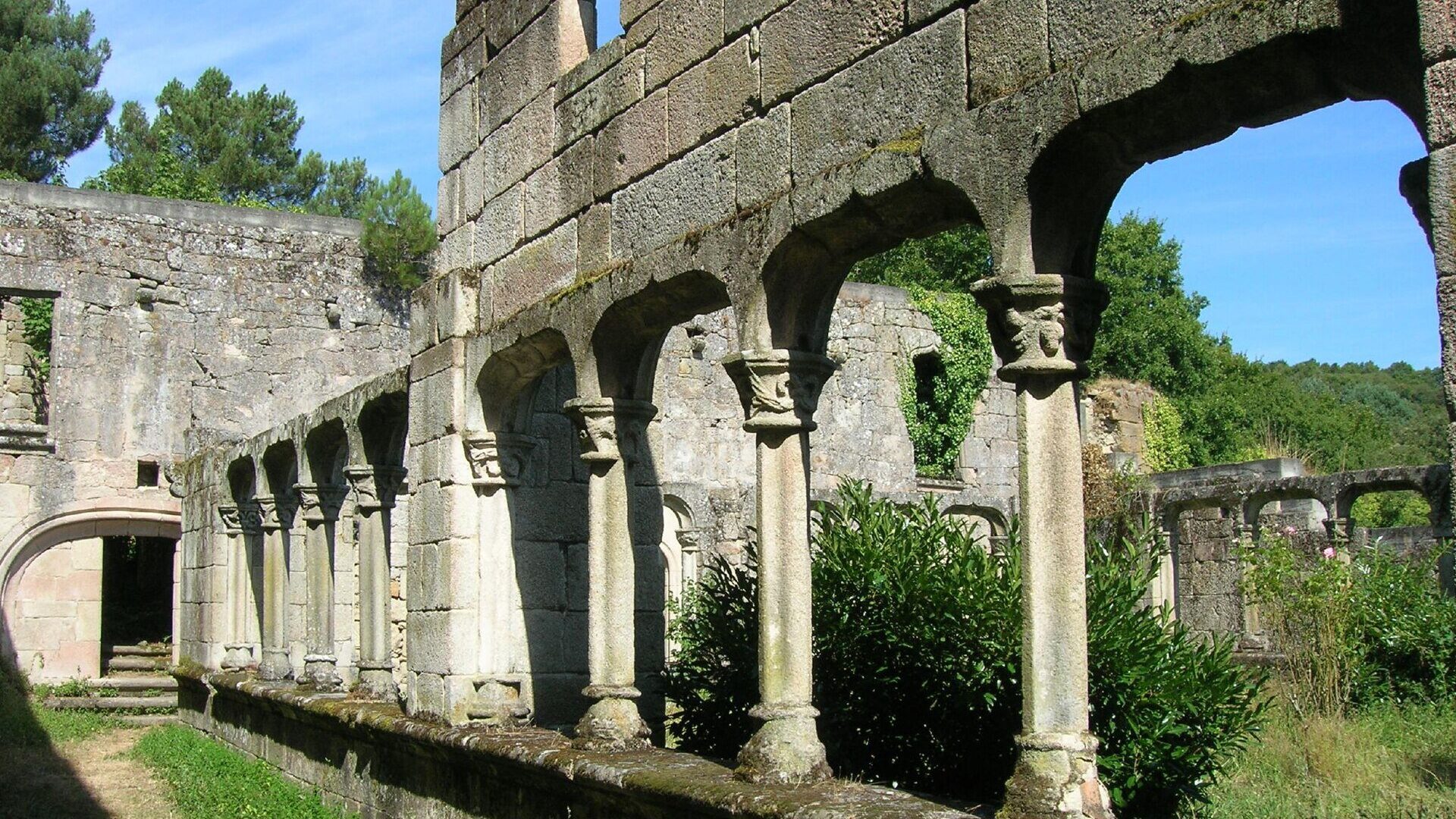
With the offerings, the cantor Alonso de Piña summoned the master stonemason Bartolomé de Nosendo and decided to build a friary there. The Count of Monterrei, suspecting it was to be a castle, arrived with armed men to demolish the work. The cantor awaited him with about 400 armed neighbours against more than a thousand of the count’s, and the bailiffs of the comarca ended up quarrelling among themselves and gave up. Work began in February 1520 and in December 1523 the convent was handed over to the Franciscans [1]. The building’s story is told in Monastery of Trandeiras.
King Arthur’s enchanted army
The same manuscript, transcribed by Couceiro Freijomil and translated into Galician by Xavier Feixoo, describes the meadow before the convent. As there were many pools and wet meadows, in summer clouds of mosquitoes rose which, flying at dusk, made their wings gleam like weapons. The local people said it was King Arthur, enchanted with his army in that meadow, because their parents and grandparents had told it so. The author adds that these «malices, follies and sins» were banished with the new building [3].
Centuries later, J. M. Bedoya wrote in his report on the drainage of the lagoon that this chivalric belief had replaced the ancient one of the forgetfulness of the Lethe and that it still lasted in the early 16th century [3]. A modern version says that the Arthurian knights, turned into mosquitoes, guard the tunnel between the Torre da Pena and that of Sandiás (see the legends of the Sandiás Tower).
Other legends of Trandeiras
- The stone of Antioquía. In Cardeita (Sandiás) it was told that the man turned to stone for looking back when Antioquía was flooded ended up taken to the convent of Trandeiras [5]. See Antioquía.
- The Penedo da Moura. Xesús Taboada Chivite collected in Trandeiras a tale of a Moorish woman who eats a girl, one of the few Galician cases of this type according to Rafael Quintía [6]. The text has not been found published online.
Read more
Sources
- Edelmiro Martínez Cerredelo, «A fundación do convento do Bon Xesús de Trandeiras», Historia de Xinzo, 24-09-2018 (a partir de A. Couceiro Freijomil e do seu libro Historia de Xinzo e Limia). https://historiadexinzo.wordpress.com/2018/09/24/a-fundacion-do-convento-do-bon-xesus-de-trandeiras/
- «Mosteiro do Bon Xesús de Trandeiras», Fronteira esquecida Limia-Lima, que cita a A. Couceiro Freijomil, «Origen, fundación y primeros tiempos del Monasterio del Buen Jesús de Trandeiras», Boletín da Comisión Provincial de Monumentos de Ourense XI, nº 242 (1938), pp. 503–511. https://fronteiraesquecida.eu/gl/fichas/mosteiro-do-bon-xesus-de-trandeiras/
- «Os exércitos de Rei Artús na Lagoa de Antela», Galicia Encantada (texto 1: manuscrito do s. XVI transcrito por Couceiro Freijomil; texto 2: J. M. Bedoya, Memoria sobre o desaugadoiro da lagoa de Antela; remitido por Xavier Feixoo). https://galiciaencantada.com/lenda.asp?cat=4&id=325
- «Mosteiro do Bon Xesús», xinzodelimia.eu. Wayback (01-01-2008): https://web.archive.org/web/20080101043106/http://www.xinzodelimia.eu:80/mosteiro_de_trandeiras.htm
- Urbano Santana, «Resume xeneral de folk-lore de Sandiás», Nós (1931), en «Antioquía (1)», Galicia Encantada. https://galiciaencantada.com/lenda.asp?cat=4&id=1015
- Xosé Calleja López, «Tres contos de mouras e mouros», As tradicións da Limia, 12-05-2021 (cita a R. Quintía Pereira, Análise estrutural e simbólica do mito da Moura, 2015). https://tradicionsdalimia.es/tres-contos-de-mouras-e-mouros/
You may also like
 LegendAntioquía, the Drowned City beneath the Lagoa de AntelaBeneath the waters of the Lagoa de Antela would sleep Antioquía, the proud city that God flooded for refusing alms to a beggar. All the…
 Archive stories: the trees of 1755, the three-key chest, the union of 1061 and the 1932 revoltFour documented episodes from A Limia: the royal order to plant trees on common land (1755), the three-key chest of the Xinzo jurisdiction,…
Blind singers’ songs, Ermelinda do Muíño, the pot game and drowned citiesOral and popular traditions of A Limia in the Galipedia: blind singers' songs and ballads, the singer Ermelinda do Muíño (Sas, Sarreaus),…
 LegendCrags, healing stones and humorous tales of A LimiaThe Arangaño rock for curing children, the stones of the moura of Nocelo da Pena, the ears of Monte de Rubiás, the crags of Meaus and…
A Limia, a district of OurenseCuriosities of A LimiaTrue and curious stories of A Limia told with sources: the miser of Xinzo, the Escornabois plague, the Randín fire, the 1878 Paris…
 Fair traders, cinzarradas and proxy weddings: customs of old XinzoThree customs of 20th-century Xinzo told by Edelmiro Martínez Cerredelo: the traders at the fairs of the 14th and 27th and Remy of the…
