


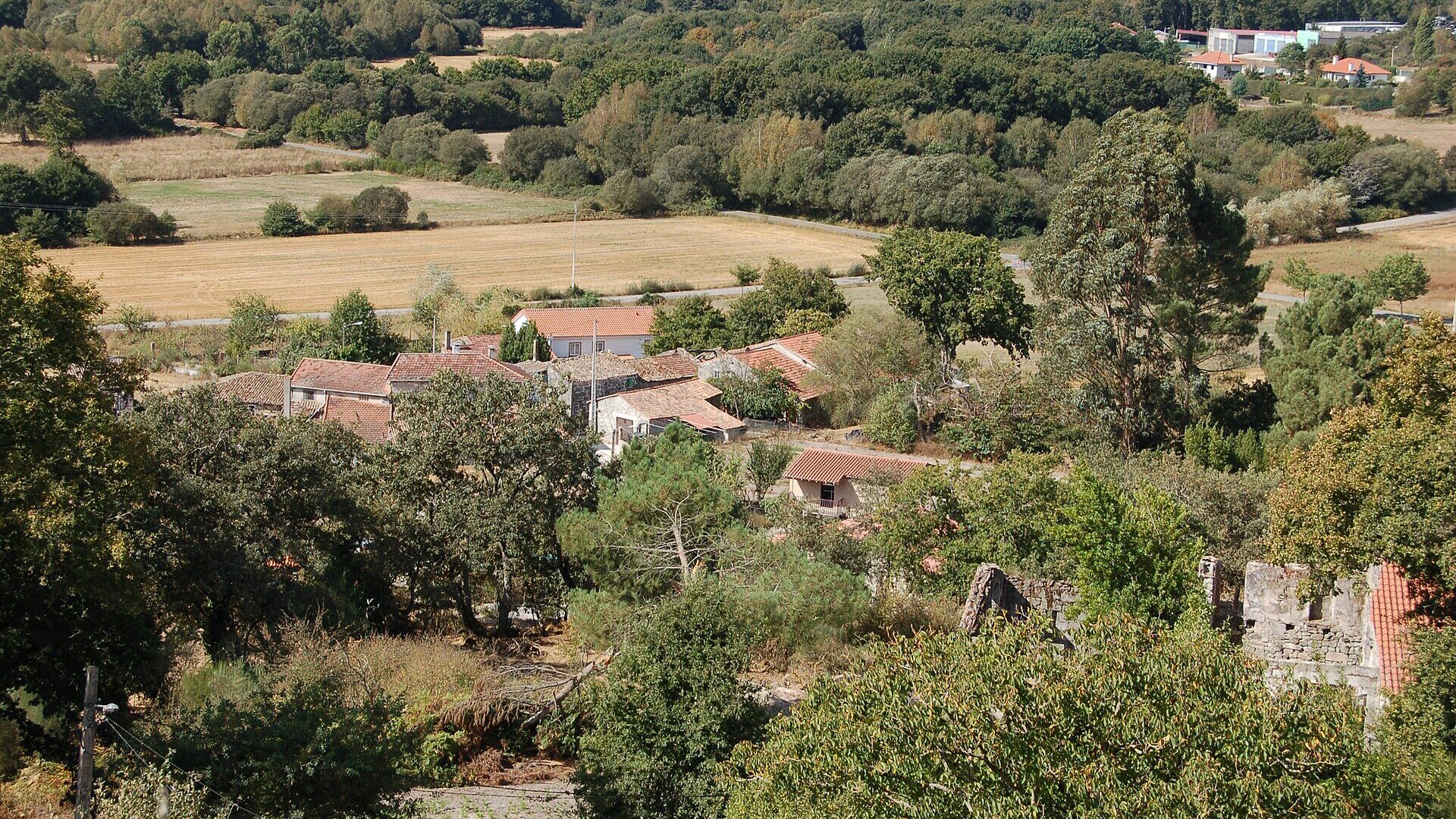
Legends of the Torre do Castro and Sandiás
The legends of the Torre do Castro and Sandiás: the Moors' tower and the hammer that made the Lagoa de Antela, the treasure in the well, the servant's betrayal, the Fonte do Mouro, the St John's snake, San Bieito and the souls.
The Torre do Castro (the castle of Sandiás), on the Castro hill over an old hillfort, is the great legendary place of the concello of Sandiás. Many legends were collected in 1931 by Urbano Santana in his "Resume xeral de folk-lore de Sandiás" (journal Nós) and later by Xavier Feixoo for Galicia Encantada [1]. All are retold here, with the source of each.
The Moors’ tower and the lagoon’s hammer
According to the old people, the tower was built by the Moors when they also built the one at Pena, which is almost opposite, about seven kilometres away, with the plain between. Beneath the ground they opened a path from one tower to the other, and along it the Moors go back and forth. While they worked, the blacksmiths of Pena and the Castro, to sharpen the picks, had only one hammer for both, and managed by throwing it from one tower to the other when they needed it. One day, during one of these throws, one of them lost his strength and the hammer fell in the middle of the path, opening a great hole from which water began to spring: so the Lagoa de Antela was born [1].
The treasure in the well
Inside the castle there is a well with several metres of water, very dark, and through it one enters a hall with a great deal of gold. To disenchant it one must bring an egg from a black hen and the hen; the hen is released in the hall and the egg smashes against the forehead of a giant who guards the treasure with an axe raised to kill anyone who enters unless hit with the egg [2]. The children of CEIP Sandiás told the shorter version: you must bail out all the water with buckets, throw the black hen’s egg at the giant’s forehead and you have only ten minutes to take the gold, or you drown [3].
Many years ago, neighbours from the Castro and As Pegas, spurred by greed and by the book of treasures, the Ciprianillo, kept digging holes in the hill until they discovered the well by chance. They only brought up a few jugs; since they were empty, they threw them away or gave them away, and one was seen in the Museum [4].
The tower’s betrayal
A neighbour from the Castro told the author, as a child, that long ago an army of men from afar surrounded the tower, but those living in it defended themselves bravely and could not be overcome. One night a servant opened the door to them in secret; they entered and put all the inhabitants to the sword and then burned the tower and tore it down. The author later found in a book (Cid Rumbao’s Historia de Allariz, 1984) that the army was the irmandiños, which makes him think legends often have a real basis [5].
The Moor who steals shoes
It is said that when the grandparents of the old people were young they put several ladders together to climb the tower. One of them, "Uncle Curcumba", was walking along the top when a Moor took one of his shoes without anyone seeing [6].
Bernaldo del Carpio
An epic legend, spread by pilgrims to Compostela, says that in the time of Alfonso II the Chaste the tower belonged to Sancho Díaz de Saldaña, who had with the king’s sister, Doña Jimena, a bastard son, Bernaldo del Carpio [7].
The Fonte do Mouro
The Fonte do Mouro is at the foot of the Picos hill, on the east side. According to one version, it arose from a dig made by the old folk looking for a gold beam; as they dug, a Moor on a horse appeared and told them not to go deeper, that before the gold beam they would hit a tar one, and they dug no more [8].
In another version, in the spring there is an enchanted moura sitting on a golden chair. A girl who took the sheep to the Picos hill met the moura, who combed her hair with a golden comb, on condition she told no one. The girl told her mother and the moura ate her; the mother called "oh my María!" and the moura replied: "María, Mariola, fried in oil, goes into my belly". The moura had four enchanted daughters in the spring. When a man from Couso went to harvest in Castile, the old woman gave him four ears of wheat with four grains each to throw into the spring and disenchant them. His wife, seeing the ears, fancied the wheat and ate a grain from one; the man threw the other three and out came three very fat horses with three beautiful girls, who rode away. When he threw the fourth, the horse came out missing a leg, and the girl riding it could not leave and remained enchanted. She gave the wife a red silk scarf as a present which, tied to an oak on the road, turned the oak to charcoal: the same would have happened to the wife [8].
The St John’s snake at Cardeita
At the exit of Cardeita, in a vegetable garden at A Cruz, there is a spring covered with slabs where, on St John’s day before sunrise, a very large snake comes out that is an enchanted person. It carries a jingle in its mouth; whoever takes it with their mouth will have a great deal of money and, if a man, the snake becomes a woman (and vice versa). If someone is there and does not take it, the snake eats them. The area was land-consolidated and it is not known whether the spring still exists [9]. In Laioso (Vilar de Santos) there is a similar legend [10]. Also in Piñeira de Arcos, at the Castiñeira spring, a very beautiful, enchanted lady, surrounded by serpents, emerges at night or on the morning of St John’s [10].
Antioquía according to Cardeita
The people of Cardeita, the village closest to the plain, dug in search of riches because it was said that there had been a city there, Antioquía, which God punished because only one family gave him alms. That family left without looking back, but one of its members looked and turned to stone. The cattle lowed when passing where the stone stood, which the Trandeiras convent later took in. In the digs they found a beam, an old pot and a well with steps [11]. See Antioquía, the drowned city.
San Bieito da Uceira
At the chapel of San Bieito, on the Uceira hill (around Pico Costoira), it is said that the saint was taken in procession to the church but escaped at night to the hill, which is why a chapel was built for him there. He is very miraculous for warts; in the chapel are left the crutches of those who climbed up with them and came down without. Some oxen hauled a cart with a large stone up the people’s steps, and a man carrying the chapel’s lamp left the cart to look for a way and, on returning, found the cart beside the chapel and the lamp already in place [12].
The devil in the shape of a beast
One night, fourteen or fifteen young men returning from the tuna found a beast. They mounted it and its back kept lengthening so that all could fit. In the middle of a river, the one in front exclaimed "Oh, Jesus, what a trandeira!". The beast, which was the devil, vanished and they all ended up in the water [13]. It is the same motif as the devil’s white horse of Porqueira.
The procession of souls
According to Urbano Santana, it used to be much talked about and by 1931 few still believed in it. The souls go in procession like at a funeral, carrying a corpse between four, some weep and others sing responsories; on Fridays they visit the house where someone is about to die. Whoever is made to carry the cross or the candle must walk in the procession and make the visits, though afterwards they do not know where they went; not even going abroad frees them, and if they resist, their toenails are pulled. Three tales [14]:
- A young man who walked in the procession marked with a tile the door it entered; the next day he found the mark on his aunt’s door and knew that someone there would die, as happened.
- Another young man took the candle from a soul and, on confessing, the priest told him to wait for her at the same spot and the one who went without it put it in his hand; the one who came last of all and without a candle said: "suerte tuveches" ("you were lucky").
- A young man coming from the tuna saw the procession approach and lay down, because that way they cannot do anything to him; on reaching him they said, making much wind, "it smells of the living here, it smells", and he replied: "it smells of walnut-wood bread".
Links
Cerredelo published in 2016 a literary version of the legend, told as the tale of a pilgrim to Compostela who sees from O Viso the Antela and the four towers of the plain and hears the story of Count Sancho Díaz, of Doña Jimena and of the boy born in the Sandiás tower who later became Bernardo del Carpio [15].
Sources
- «A construcción do castelo de Sandiás e o nacemento da Lagoa de Antela», Xavier Feixoo, Galicia Encantada. https://galiciaencantada.com/lenda.asp?cat=17&id=320
- «O tesouro do castelo de Sandiás», Xavier Feixoo, Galicia Encantada. https://galiciaencantada.com/lenda.asp?cat=7&id=321
- «O pozo da torre do Castro», texto de alumnado do CEIP de Sandiás (O recuncho da Lagoa, 2009-2010), Galicia Encantada. https://galiciaencantada.com/lenda.asp?cat=4&id=1725
- «Na procura do tesouro do Castelo de Sandiás», Xavier Feixoo, Galicia Encantada. https://galiciaencantada.com/lenda.asp?cat=2&id=1156
- «A traizón da torre de Sandiás», Galicia Encantada; cita A. Cid Rumbao, Historia de Allariz, Vila y Corte Románica (1984). https://galiciaencantada.com/lenda.asp?cat=12&id=1038
- «O mouro rouba os zapatos», Urbano Santana, Nós, 1931. https://galiciaencantada.com/lenda.asp?cat=17&id=1011
- «Torre de Sandiás-Torre do Castro», Fronteira Esquecida (cita Martínez Cerredelo, «O peregrino e a lenda da torre do Castro», 05/04/2016). https://fronteiraesquecida.eu/gl/fichas/torre-de-sandias-torre-do-castro-2/
- «A fonte do mouro de Sandiás (1) e (2)», Xavier Feixoo. https://galiciaencantada.com/lenda.asp?cat=4&id=315
- «A Fonte da Cruz de Cardeita», Xavier Feixoo. https://galiciaencantada.com/lenda.asp?cat=4&id=308
- Rafael José Adalid Rodríguez, «Contos, lendas e mitos da auga na Limia», Revista Galicia Encantada 16 (2020). https://galiciaencantada.com/lenda.asp?cat=11&id=2886
- «Antioquía (1)», Urbano Santana, Nós, 1931. https://galiciaencantada.com/lenda.asp?cat=4&id=1015
- «San Bieito da Uceira», Galicia Encantada (https://galiciaencantada.com/lenda.asp?cat=14&id=309, 310, 311) e Fronteira Esquecida «Miradoiro de Costoira».
- «O Demo en Sandiás», Urbano Santana, Nós, 1931. https://galiciaencantada.com/lenda.asp?cat=6&id=1303
- «A procesión das ánimas (1) a (3)», Urbano Santana, Nós, 1931. https://galiciaencantada.com/lenda.asp?cat=1&id=1317 (e id=1341, cat=15&id=1346)
- «O peregrino e a lenda da torre do Castro». https://historiadexinzo.wordpress.com/2016/04/05/o-peregrino-e-a-lenda-da-torre-do-castro/
You may also like
 LegendThe Raíña Loba and her castle on the crags of Covas (Os Blancos)On the crags of Covas, at about 1,150 metres, there was a rocky castle where a cruel queen lived who charged a calf, a sheep and a pig…
 LegendMoors of A Limia: treasures, broken secrets and enchantmentsThe legends of Moorish men and women in A Limia: the mouras of Treboal, the Covelas mine, the gold cart of A Touza, the Moors' girl, the…
 LegendLegends of Vilar de Barrio: xianas, Moors’ holes and the Lagoa de AntelaLegends and tales of Vilar de Barrio: the xianas of Arnuíde, the Moors' holes at Bóveda with the twelve chicks, the Pozo dos Mouros at…
 LegendLegends of Vilar de Santos: the Mariquiña, Santa Marta and the St John’s snakeLegends of Vilar de Santos: the moura Mariquiña of Monte das Cantariñas (Laioso), Santa Marta and the Castelaos serpent, St John, the…
LegendLegends of Xinzo de Limia: the Lethes, Trandeiras, the Torre da Pena and the river mourasLegends of Xinzo de Limia: the river of oblivion, the Virgin and Xoán Folgoso at Trandeiras, the moura of the sieve at Lamas, the moura of…
 LegendCrags, healing stones and humorous tales of A LimiaThe Arangaño rock for curing children, the stones of the moura of Nocelo da Pena, the ears of Monte de Rubiás, the crags of Meaus and…
