


The Praza Maior, the Ladeira and the Toural: history of Xinzo’s central places
History of the Praza Maior (fairs since the 16th century, the 1907 Espolón, the fountain), the Ladeira and the Toural (the lagoon, the livestock fair, football), Constitución street and the Pedra and Poldras bridges.
Edelmiro Martínez Cerredelo reconstructed, in his works and on his blog, the history of Xinzo de Limia’s meeting places: the square where the fairs were held, the fields that flooded with the river and the livestock toural. This page summarises those pieces [1][2].
The Praza Maior
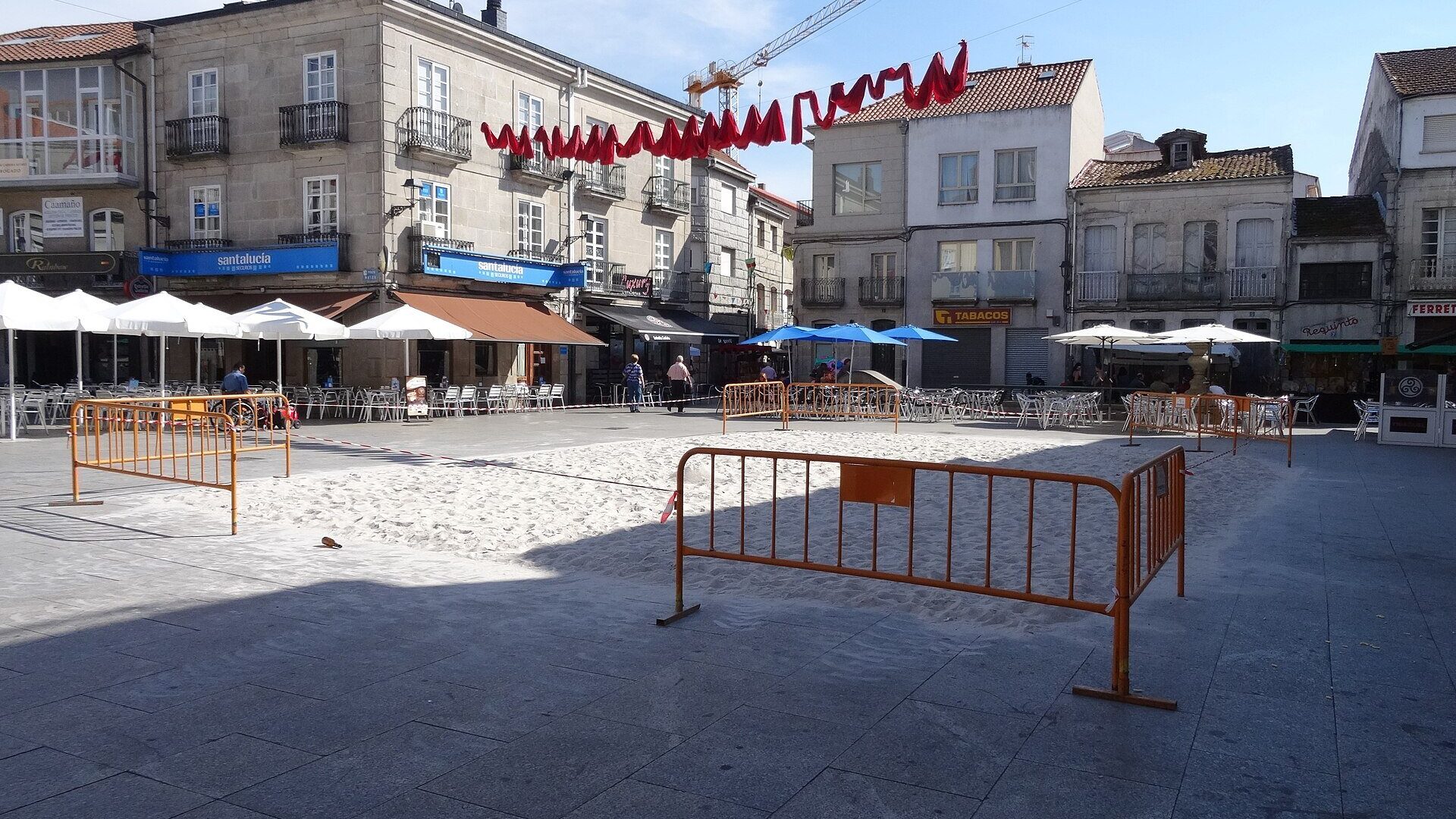
The Praza Maior was always the town’s commercial and social centre. The houses of the hidalgo families stood there and two of the town’s few heraldic carvings survive on the old properties of the Velasco family. Fairs were held in that irregular square since at least the 16th century, when only the fair of the 14th of each month existed and there were markets on Tuesdays and Saturdays [1].
- 1579. The stewardship book of the Count of Monterrei, lord of the land, records the "count of the cloth merchants’ shops and stone seats" of the fair: there were covered arcades with at least two gates (one entering from Monterrei, with six rows of stalls, and the "Xinzo gate", with three), forty selling stalls, six silversmiths’ shops and eleven haberdasheries, all awarded at auction by the count’s administrator; the rents later passed to the hospital of Monterrei [1].
- 19th century. The arcades probably disappeared when they were demolished to make the main road, in what seems the work of the magistrate Julián Toubes (1826-1834), who designed the present square and paved it with stone slabs [1].
- 1880. The tallest building in Xinzo, of two storeys, was built and later bought by the Gelpi Asorey family for their grocery shop. The other buildings of two or more floors on the main road do not appear until the 1930s [1].
- 1906-1907. The Concello closed the square’s front with a stone wall and a cast-iron railing, the famous Espolón, inaugurated in December 1907, emblem of the town’s urban image [1].
- 1911-1912. Mayor Recaredo Morenza reported a letter from Emilio Morenza asking to move the fountain, the "pilón", to the centre of the square at his own expense; the Deputation contributed 987.75 pesetas [1].
- 1950s. Shops on the square: footwear of Alfonso Villarino, groceries of Manuel Cerredelo, the girls’ school of Doña Teolinda, fabrics of Antonio Nieto, haberdashery of Emilita Carballo, fabrics of Xulio Costa, clothing of Lolita Sirgo and the kiosk of Federico Andrés [1].
- 1959. The council approved selling a strip of the Toural to pay for paving the square and Lepanto street (263,986 pesetas of costs, financed by that sale). The four trees of the Espolón were cut down and the fountain was replaced by a star-shaped concrete one [1].
- 1981 and after. Mayor Isaac Vila proposed removing the fountain, benches and street lamp; the square was left empty and paved with sawn stone. In the 21st century, under Mayor Gonzalo Iglesias, a stone espolón was installed on the Constitución street façade and trees were planted next to the cast-iron one [1].
The square was called Isabel II in the 19th century, Constitución in the first quarter of the 20th and, during the Civil War, according to the press, Calvo Sotelo. From it begins the fairs’ route, which via San Roque street leads to the Toural [1].
Constitución street
Its oldest name was Camino Real; later Peace street, Luís de Usera Bugallal in the 1920s, Alcalá Zamora when the Republic was established, again Luis Usera under Francoism and, in democracy, Constitución street. In the house with a gallery on the corner lived the magistrate Julián Toubes in 1825. Luís de Usera was a Conservative deputy for Xinzo: in 1919 he won in a controversial election, and in 1923 won again with 5,054 votes [3].
The Ladeira and the Toural
The Ladeira was a small lagoon running from Dous de Maio street almost to the Seara football field, 50 to 100 metres long, which formed part of the Seara site according to the Ensenada Cadastre (1753). In winter it was between 50 cm and a metre deep, there were boats and children skated on the ice; in summer a small lagoon remained between today’s Museo do Entroido and the courthouse. In the 1960s and until the mid-1970s it was a rubbish dump [2].
The Toural was from time immemorial the livestock-fair field. Pedro González de Ulloa described in 1777 the field "watered on the western side of the town" and the fairs as "the best in the province"; in winter floods reached the San Roque square [2]. On the field there was an earth fill, a stone wall of 60-70 cm, awnings where meals were served, octopus stalls and bread stands; a small bridge crossed the Ladeira stream. Xinzo’s football began there at the start of the 20th century [2]. During the Civil War it was the drill ground for conscripts [2]. In the 1960s mobile classrooms were set up to train emigrants in trades before leaving for Europe, and in 1964, 1965 and 1966 the Regional Country Fair was held; in the late 1960s and early 1970s, with the construction of the park, the fair moved to the Toural promenade and in late 1979 to the new fairground. Today, with hardly any livestock, it is, according to the author, "a vulgar feirón" [2].
The bridges
- Pedra bridge. On the cards of a chocolate brand of the 1920s and 1930s appears the "Stone Bridge" on the Xinzo–Lucenza road, swept away by the storms of December 1909; today it is known as the Damil bridge or the Baltar road bridge [5].
- Ponte das Poldras (Sandiás), on the Vilariño–Xinzo road over the lagoon’s river, kept eighteen arches and part of the Roman masonry until its destruction in 1962; it was a Roman work restored at different times, next to Via XVIII. The draining of the lagoon and land consolidation made the bridge disappear along with a milestone beside it, cited by González de Ulloa in the 18th century; a concrete bridge was built on the site and the stones ended up in walls or crushed for the road [4].
Links
Sources
- Edelmiro Martínez Cerredelo, «Historia da Praza Maior de Xinzo», Historia de Xinzo, 05/08/2019. https://historiadexinzo.wordpress.com/2019/08/05/historia-da-praza-maior-de-xinzo/
- Edelmiro Martínez Cerredelo, «Pequena historia da Ladeira e o Toural de Xinzo», Historia de Xinzo, 30/04/2020. https://historiadexinzo.wordpress.com/2020/04/30/pequena-historia-da-ladeira-e-o-toural-de-xinzo/
- Edelmiro Martínez Cerredelo, «Rúas con historia. A rúa Constitución», Historia de Xinzo, 22/02/2014. https://historiadexinzo.wordpress.com/2014/02/22/ruas-con-historia-a-rua-constitucion/
- «A ponte das Poldras na estrada de Xinzo a Celanova», Historia de Xinzo, 17/03/2022. https://historiadexinzo.wordpress.com/2022/03/17/a-ponte-das-poldras-na-estrada-de-xinzo-a-celanova/
- «A antiga Ponte de Pedra», Historia de Xinzo, 14/07/2018. https://historiadexinzo.wordpress.com/2018/07/14/a-antiga-ponte-de-pedra/
You may also like
 History of A LimiaPrehistory and castros of A LimiaFrom the Pedra Alta de Antela to the castro of Bóveda: megaliths, the Roufeiro weapons, the Outeiro de Baltar and the gold earring of Vilar…
 History of A LimiaThe Limici in Roman inscriptions: Celer’s gladiatorial tessera and Corellius LimicusTwo epigraphic pieces outside A Limia that mention a "Limicus": the bronze gladiatorial tessera from Niebla (Huelva), of the 1st century,…
History of A LimiaThe Limici and Romanisation: Civitas, Forum Limicorum and Via NovaWhat is known of the Limici and Roman Limia: the Civitas Limicorum, the debate over where the Forum Limicorum stood (A Cidá of Nocelo da…
 History of A LimiaLight, chocolate, fizzy drinks and roads: the industrial and service Xinzo of the 20th centuryHow electricity (1911), the printing press, chocolate and soda factories, the Rubio Cold-Storage Slaughterhouse and buses to Ourense and…
 History of A LimiaCinemas, café, radio, school and library: Xinzo’s cultural life from 1948 to the 1970sThe cinemas Los Molinos (1948) and Antelano (1954), the Café Ideal and the Ideal 6 disco, the 1950 radio, the Colegio Santa Marina, the…
History of A LimiaMemories of the Xinzo of the past: children, taverns, the Riscas, doors and popular figuresMemories of everyday life in postwar Xinzo: children's games, Benito's tavern, Marucho's bar, the Riscas, doors and knockers, old stamps…
