


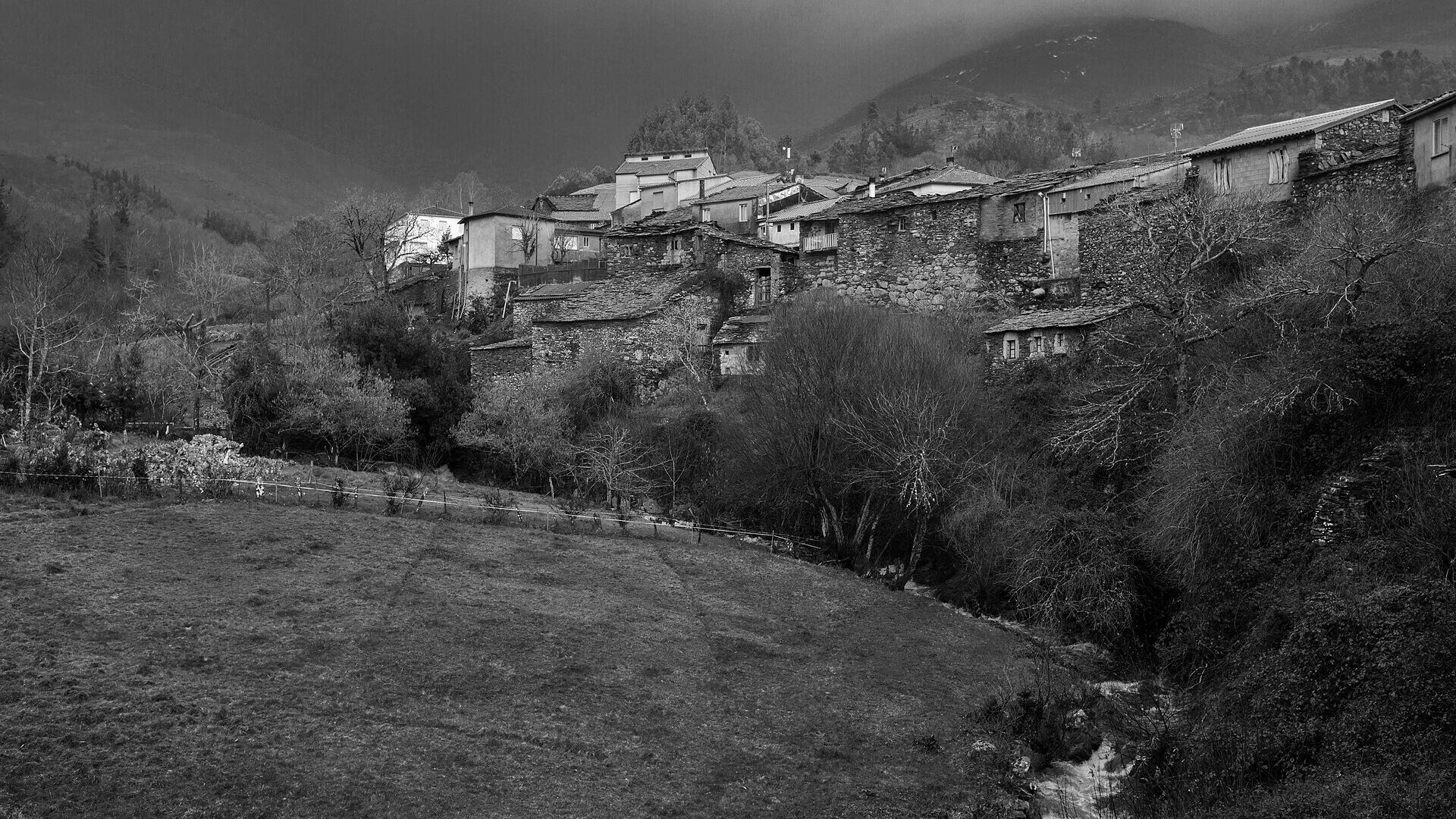
The anti-Francoist guerrilla in A Limia (1946–1950)
History of the anti-Francoist guerrilla in A Limia between 1946 and 1950: the Estivadas ambush, the II Group of the Galician Guerrilla Army, the 1948 hold-ups, Pazos de Codosedo, the Sabucedo house and the death of Perfecto Dios.
- Period
- 1946–1950
- Group
- Galician Guerrilla Army, II Group
- Base
- the A Edreira farmstead, in the Serra de San Mamede
- Group leader
- Saúl Mayo Méndez
The anti-Francoist guerrilla operated in A Limia after the Civil War, when fugitives and former Republican militants organised armed bands. The main source is Edelmiro Martínez Cerredelo, who gathers Civil Guard reports, military cases and oral testimonies; his reading makes clear that the same group received different names depending on who was speaking: the Civil Guard called them "bandits", for the farmers they were "robbers" and for anti-Francoism "guerrillas of the Republic" [2]. Here the chronology of events is given and each version is attributed to its source.
A new instrument of the regime: the Somatén
Worried by the fugitives, the regime revived in 1945 the Somatén, a body of armed civilians, and in Xinzo it was officially constituted on 30 April 1946; it was dissolved, at the request of the Civil Guard command, on 30 May 1977 [9].
1946: the Estivadas bend
On 9 December 1946, at 19:30, a scheduled bus from Ourense and Xinzo towards Verín was shot at by an armed group on the Atás bend, at the Estivadas (km 498); the conductor, Manuel López, was gravely wounded and died next day in Ourense, and another passenger was also wounded. One of the attackers, Xesús Girón Bazán, was found wounded in the ditch and died on the 11th. The Civil Guard identified a certain Demetrio García as the group’s leader and investigated the guerrilla’s supporters in the village of Atás [1].
1948: the II Group of the Galician Guerrilla Army
According to Cerredelo, the guerrilla operated in A Limia from 1948 under the name Galician Guerrilla Army, II Group. Over time twenty-one guerrillas belonged to the group, with Saúl Mayo Méndez as leader, and their base camp was the A Edreira farmstead, in the Serra de San Mamede [3]. According to the statement of a guerrilla arrested in 1950, they numbered eighteen and looted houses of Falangists and of people who had harmed leftists, imposing cash fines; of those who formed the group about eight died in clashes with the Civil Guard [3]. On their visits they said: "Manos arriba, somos las fuerzas de la resistencia de la república" (quoted) [3][4].
Specific cases:
- 18 August 1948, Vilar de Santos: seven guerrillas entered the business of Francisco Lama Ferreiro, fined 50,000 pesetas, took clothes, food and two Somatén rifles and freed the hostages outside the village; the Civil Guard arrested the owner for losing the rifles [4].
- 13 September 1948, As Pegas (Sandiás): five guerrillas demanded money at two houses and took a ham; a neighbour suspected of being a contact was arrested and released for lack of evidence [4].
- 13–14 August 1948, Pazos de Codosedo (Sarreaus): Xoán Sorga, who had acted as a contact, was arrested in Ourense by the Civil Guard squad and led the guards to the village; there was a shoot-out in which a sergeant and two guards were wounded, a neighbour woman was wounded and a guerrilla, Xoán Selas, broke a leg. The neighbours’ version and that of Lieutenant Colonel Camilo Montes Valdés, head of the Ourense Civil Guard command, differ in details [5][6].
1949: Sabucedo and Couso de Salas
In February 1949, some guerrillas of the II Group took refuge at Quintás de Sabucedo (Porqueira) in the house of Epifanio Feijoo Gándara; they were discovered by the Civil Guard, broke out of the encirclement and the force set fire to the house. The owners and other neighbours were arrested for contact with the robbers and, in military case 62/1949, three of them were sentenced to six months and a day of minor prison. Later, on 22 February, another group set fire to the rectory of Couso de Salas (Muíños) in revenge against the priest who had encouraged burning the house, and the parish archives of Couso de Salas and Golpellás burned [7].
1950: the end of the group
The group’s survivors, among them Carmen Fernández Seguín, her son Perfecto Dios and Xoán Sorga, fled towards Castile. On 16 May 1950, a Civil Guard pair surprised them at Chaherrero (Ávila); Perfecto Dios Fernández, aged nineteen, died in the shoot-out and his mother was arrested and sentenced to thirty years [8][10]. The Association for the Recovery of Historical Memory announced in 2014 the exhumation of his remains, which were moved to Ourense on 19 July that year, 64 years after his death [8].
Collaborators
Cerredelo observes that many collaborators were shopkeepers and tavern keepers, often former members of agrarian societies or councillors of the Republic; the guerrillas paid between twenty-five and thirty pesetas per person for board and lodging, a significant sum in times of hardship [3]. Several women were prosecuted for this help: see Women victims of repression in A Limia.
Frequently asked questions
Who made up the II Group? According to Cerredelo, twenty-one guerrillas over time, with Saúl Mayo Méndez as leader and a base at A Edreira [3].
How did it end? With arrests, deaths and the flight of several members to Castile; Perfecto Dios died at Chaherrero (Ávila) on 16 May 1950 [8].
What was the Somatén? A body of armed civilians that the regime revived in 1945 against the fugitives; in Xinzo it was constituted in 1946 [9].
Links
- History of A Limia
- Historical memory of A Limia, 1931–1953
- The repression of 1936 in A Limia
- Sandiás
- Vilar de Santos
Sources
- Edelmiro Martínez Cerredelo, «Historia e memoria. Acción guerrilleira nas Estivadas (1946). A curva do atraco», Historia de Xinzo, 27-04-2014. https://historiadexinzo.wordpress.com/2014/04/27/historia-e-memoria-accion-guerrilleira-nas-estivadas-1946-a-curva-do-atraco/
- Edelmiro Martínez Cerredelo, «Accións na Limia do Exército Guerrilleiro de Galicia. II Agrupación», Historia de Xinzo, 08-05-2014. https://historiadexinzo.wordpress.com/2014/05/08/accions-na-limia-do-exercito-guerrilleiro-de-galicia-ii-agrupacion/
- Edelmiro Martínez Cerredelo, ibidem (declaracións dos guerrilleiros Manuel Rodríguez González e Carmen Fernández Seguín, 1950).
- Edelmiro Martínez Cerredelo, «Golpes da guerrilla antifranquista en Vilar de Santos e as Pegas (Sandiás)», Historia de Xinzo, 29-01-2019. https://historiadexinzo.wordpress.com/2019/01/29/golpes-da-guerrilla-antifranquista-en-vilar-de-santos-e-as-pegas-sandias/
- Edelmiro Martínez Cerredelo, «Os maquis na Limia (1948): os sucesos de Pazos de Codosedo (Sarreaus)», Historia de Xinzo, 07-08-2014. https://historiadexinzo.wordpress.com/2014/08/07/os-maquis-na-limia-1948-os-sucesos-de-pazos-de-codosedo-sarreaus/
- Edelmiro Martínez Cerredelo, «O maquis na Limia. Pazos de Codosedo 2ª parte: a versión da Garda Civil», Historia de Xinzo, 26-08-2014. https://historiadexinzo.wordpress.com/2014/08/26/o-maquis-na-limia-pazos-de-codosedo-2a-parte-a-version-da-garda-civil/
- Edelmiro Martínez Cerredelo, «O maquis na Limia: queima da casa de Epifanio Feijoo en Sabucedo (Porqueira) e a reitoral de Couso de Salas (Muíños)», Historia de Xinzo, 18-05-2020. https://historiadexinzo.wordpress.com/2020/05/18/o-maquis-na-limia-queima-da-casa-de-epifanio-feijoo-en-sabucedo-porqueira-e-a-reitoral-de-couso-de-salas-muinos/
- Edelmiro Martínez Cerredelo, «A morte do guerrilleiro Perfecto Dios en Chaherrero (Ávila) e nova fuga de Xoán Sorga», Historia de Xinzo, 17-07-2014. https://historiadexinzo.wordpress.com/2014/07/17/a-morte-do-guerrilleiro-perfecto-dios-en-chaherrero-avila-e-nova-fuga-de-xoan-sorga/
- Edelmiro Martínez Cerredelo, «O Somatén Armado do réxime franquista na Limia», Historia de Xinzo, 26-01-2019. https://historiadexinzo.wordpress.com/2019/01/26/o-somaten-armado-do-rexime-franquista-na-limia/
- «Perfecto de Dios Fernández», Galipedia (CC BY-SA 4.0). https://gl.wikipedia.org/wiki/Perfecto_de_Dios_Fernández
You may also like
 Antela Football Club (1919): the oldest club in OurenseAntela Football Club, founded in Xinzo de Limia in June 1919, is the oldest club in the province of Ourense: the statutes, the Toural…
 Archpriestship of A Limia: parishes and dedicationsThe Archpriestship of A Limia in the diocese of Ourense: 82 villages, 33 chapels and a list of parishes with their dedication, from Santa…
 History of A LimiaCinemas, café, radio, school and library: Xinzo’s cultural life from 1948 to the 1970sThe cinemas Los Molinos (1948) and Antelano (1954), the Café Ideal and the Ideal 6 disco, the 1950 radio, the Colegio Santa Marina, the…
 Emigration of the Limia people: from the 1950s diaspora to personal itinerariesHow the Limia people emigrated: destinations and phases (America from 1920, Venezuela, Brazil, the Basque Country and Catalonia in the…
 Ethnography of A Limia: canastros, houses, limewash, finger guards, stonemasons, blind singers’ verses and the GerinaldoEthnographic studies by Pepe Calleja on A Limia: the canastros of Fontemoura and Faramiñás, the houses of Xinzo, the limewash of Solbeira…
From the Republic to the coup: Xinzo and A Limia between 1931 and 1936How the proclamation of the Republic (1931), 1 May 1936 and the preparation and success of the military coup of 17 to 20 July 1936 were…
