


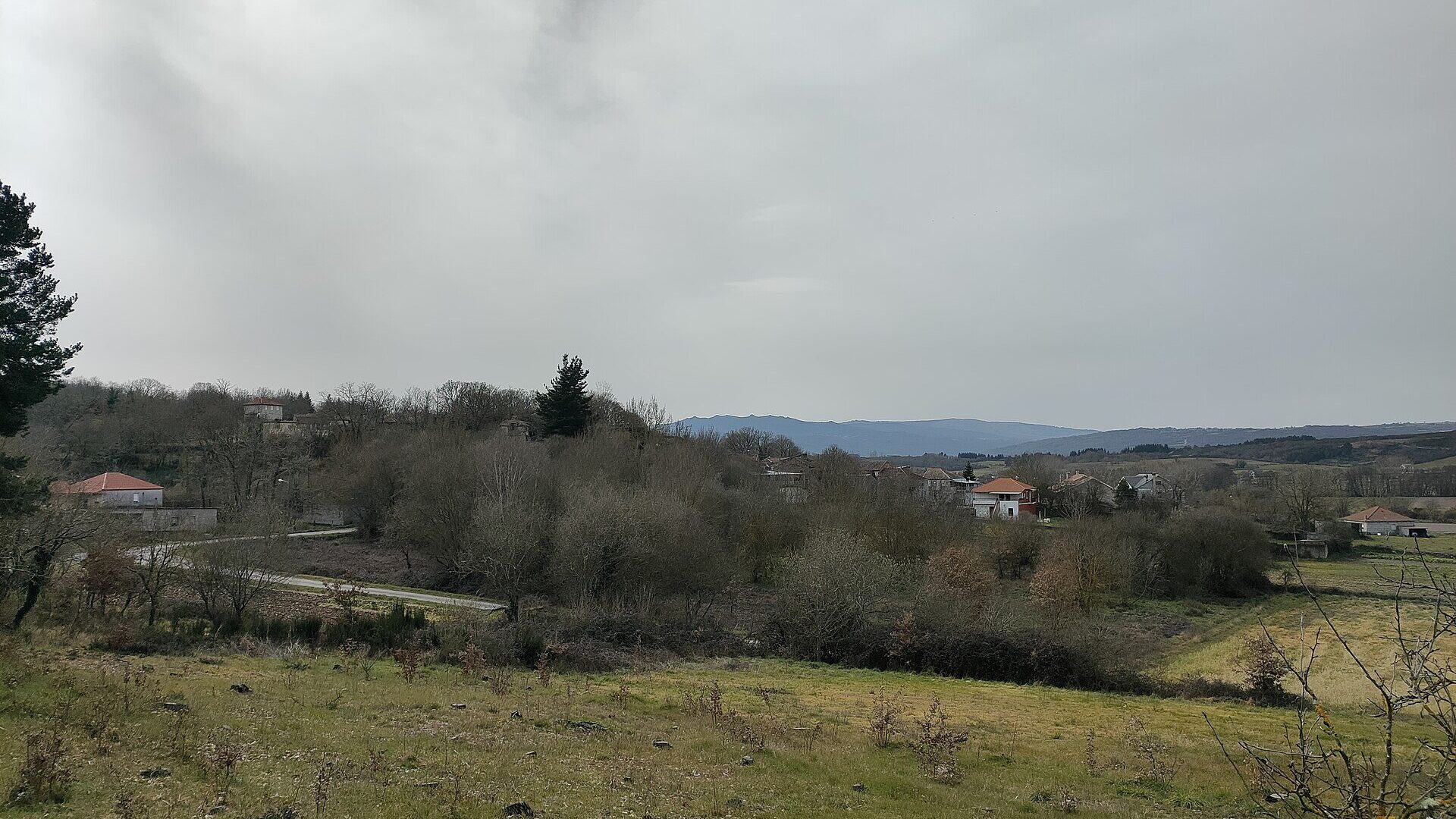
Flax in A Limia in the 18th and 19th centuries: land, weavers and trade
Flax growing and industry in A Limia according to the Ensenada Cadastre and Madoz: the best land, rotations, weavers by concello, the linen trade with Castile, Xinzo's xibós and flax's decline in the 19th century.
- Main source
- González Caíña, Minius VI (1997)
- Centuries
- 18th and 19th
- Concello with most weavers (Ensenada)
- Xinzo de Limia (122)
- Characteristic product
- Xinzo's xibós
Flax was for centuries one of the great crops and manufactures of A Limia. This is shown by the study of Juan José González Caíña, of the University of Vigo, which reconstructs its weight from the Ensenada Cadastre (18th century) and Pascual Madoz’s dictionary (19th century) [1]. This page summarises his data; for one of the peaks of that tradition, see Xinzo at the 1878 Paris Universal Exhibition.
Why A Limia was good flax land
The author places flax on the lands of the Limia valley surrounding the former Lagoa de Antela and in the Salas valley, up to an altitude of nearly 1,200 m. By Papadakis’s climatic criteria, the comarca largely meets the crop’s requirements (winter without excessive cold, a sufficiently warm summer and moisture or irrigation), except for the summer aridity of July and August, so it was grown near watercourses and on irrigated land [1]. Flax occupied the best land: in the Cadastre’s General Answers it is grown, if not always, almost always on first-quality irrigated land, on the best-tended plots of the houses, called cortiñas. There were exceptions on first and even second-quality dry land in Coto (Vilar de Santos), Sobreganade (Porqueira), practically all of the present concello of Xinzo de Limia, Golpellás (Calvos de Randín) and Garabelos, where the author sees the crop’s importance and the coincidence with the places of greatest manufacturing output [1].
The rotations
The Cadastre describes two types of rotation: a two-year one (winter cereal, then flax and then turnips and fodder, then meadow), typical of mountain areas, and a three-year one (wheat, linseed and then maize), in mid-mountain areas and valleys. The climate even allowed two harvests a year, reflected in the parishes of Parada, Barouzos and Trandeiras. In the 18th century, a time of population growth, these lands were extended toward the hill by clearings [1].
The weavers of the 18th century
Question 32 of the Cadastre records trades. There is no parish in the Limia basin without at least one weaver, and the norm is one loom per neighbour: the author, from fieldwork, checked that even today almost all Limia houses have a loom or parts of one. Weavers by concello, according to the Cadastre, were [1]:
| Present-day concello | Weavers |
|---|---|
| Xinzo de Limia | 122 |
| Sandiás | 57 |
| Rairiz de Veiga | 24 |
| Vilar de Santos | 19 |
| Porqueira | 19 |
| Os Blancos | 19 |
| Trasmiras | 7 |
| Calvos de Randín | 4 |
| Bande | 2 |
The parishes with most weavers were Piñeira and Couso da Limia (21 each), followed by Laroá, Parada de Outeiro, Sandiás and Sobreganade. In some, like Sobreganade, weavers earned nearly 300 reales de vellón a year each, which for the author indicates production destined for wholesale rather than just family consumption. Based on Carmona Badía, Alta Limia appears as one of the great textile comarcas of Ourense and Galicia [1]. They made mainly ordinary linens and cloths, and in the Xinzo area the xibós stood out, jackets made of linen and wool cloth [1].
Trade with Castile
The Cadastre mentions cloth merchants in only two parishes of Alta Limia: in Ganade (Xinzo de Limia) there are three retail merchants and one wholesaler, Fernando Gaion, who bought cloth in Galicia to sell in Castile and whose annual profit is estimated at 4,000 reales de vellón; in Escornabois (Trasmiras) Francisco Barreada and Pedro Freiría, with 180 reales each. The documentation also recalls a "famous fair" in Xinzo on the 16th of each month, which peasant women attended with many lengths of cloth and sold them to merchants from Sanabria and other towns who took them to Castile; the author deduces trade toward Castile and, probably, toward Portugal through smuggling [1]. See The Xinzo fairs through time.
The 19th century
Madoz recognises flax growing in all the villages of A Limia, but more scattered than in the previous century: "some" or "abundant" depending on the place. Good flax appeared in Bande, Castelaus and Sobreganade, and was "abundant" and of "very good quality" in Barxeles, Escornabois and Guntín. Xinzo’s xibós production persisted. Trade with Castile and Portugal continued, now declining, carried by the parishes of Os Blancos, Covelas, Cobas, Sandiás and others. For the province of Ourense Madoz counts about 5,000 looms and 23,178,228 varas of cloth [1].
The arrival of cheaper textile fibres and the gradual end of tithes paid in flax or linseed caused a marked decline; on mountain land flax was replaced by the potato. The article ends noting that in October 1997 there was an aim in Vilar de Santos to recover production with new varieties [1].
Links
- Economy of A Limia
- Xinzo at the 1878 Paris Universal Exhibition
- The Xinzo fairs through time
- Granaries, chests and barns of Xinzo
- Ethnographic Museum of A Limia
Sources
- González Caíña, Juan José: «Evolución del cultivo del lino en la cuenca del Limia (Ourense, Galicia). Condiciones ambientales y socioeconómicas», Minius, VI, 1997, pp. 151-163. https://revistas.uvigo.es/index.php/mns/article/view/2938
You may also like
 Economy of A LimiaPropasi, AGA and the Feculera of Xinzo: the potato industry in the 20th centuryThe history of Propasi and Agrícola Ganadera Antelana (seed potatoes, from the late 1940s) and the Feculera of Xinzo (starch, c.…
 Economy of A LimiaGastronomy of A LimiaThe gastronomy of A Limia: the potato as the star product and its designation, the bread from Xinzo's ovens, the pig slaughter and the…
