

History of the Entroido of Xinzo de Limia: from the name to the international designation
From the name "entroido" (documented in Galician since 1251) to the 1889 chronicle, the A Pantalla Association of 1996, the Museo Galego do Entroido and the tourist-interest designations of 1997 and 2019.
The history of the Entroido of Xinzo de Limia has little written documentation before the 20th century, as befits a popular festival opposed to abuses of power, but it leaves some very clear traces: the name, a chronicle of 1889, the founding in 1996 of the association that defends the Pantalla and two tourist-interest designations, the national one of 1997 and the international one of 2019.
The name: entroido, carnival and carnestolendas
The word entroido derives from the Latin introitus, "entrance" or beginning, and the form documented in Galician goes back to 1251 [1]. According to the Atlas Lingüístico Galego there are variants such as antroido (north), entrudio (east, the lands of Viana do Bolo) or entroiro, and entroido is the form given by the norm of the Real Academia Galega [1]. Carnaval, from Italian carnevale, and carnestolendas are more modern or foreign synonyms [1]; the author at Vía Lethes recalls that Entroido was already an "antiquated word" in 18th-century Spanish and therefore considers it the most fitting term for Xinzo’s ancestral festival [3].
The first known chronicle: 1889
The Entroido left few traces before the 20th century. The exception is an article published in March 1889 in the Lugo newspaper El Eco de Galicia on the "Carnestolendas" in Xinzo [3]. The chronicle does not mention pantallas, but describes a farmer who walked the streets covered in official paper and a sign reading «Fruta del tiempo en Ginzo» (quote), and a troupe that parodied opportunistic politics. It was, the author interprets, the only moment of the year when farmers could mock local bosses and mayors in public [3]. The detail is in Entroido: memory and archive.
The Pantalla and the cycle as it is known today
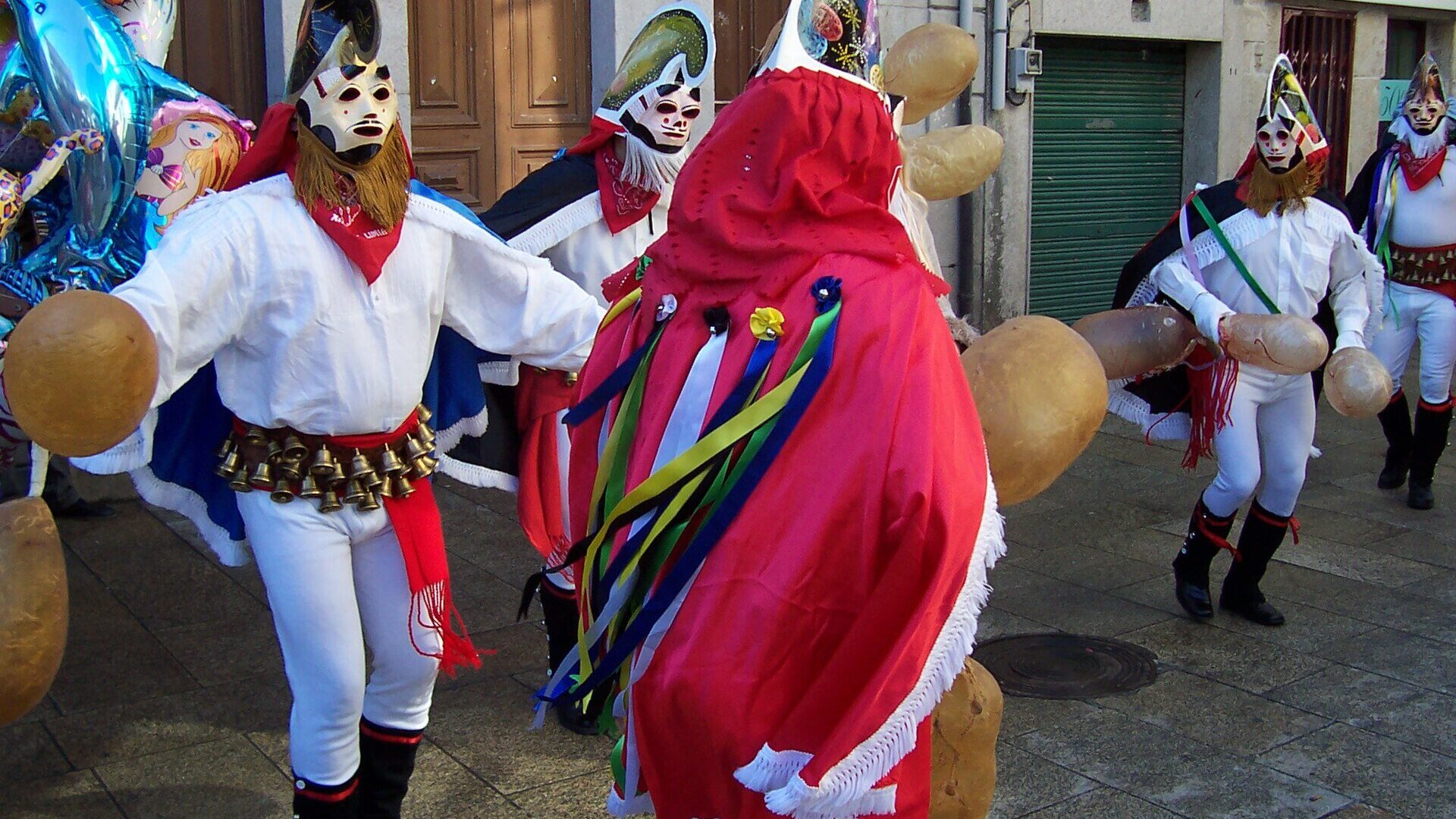
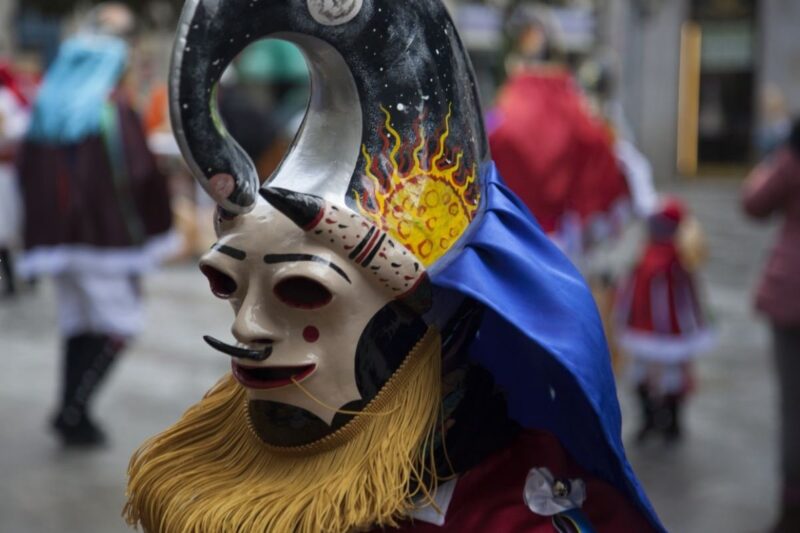
The Pantalla is the town’s emblematic mask, and the five-week cycle (Fareleiro, Oleiro, Corredoiro, Meco, Tuesday and Piñata) is today what identifies the Xinzo Entroido. Wikipedia cites Xinzo as the reference cycle among Galician entroidos, although it cautions that it is not always the longest: Laza’s begins at the chimes on New Year’s Day and those of Verín and Vilariño de Conso may begin earlier depending on when the Entroido falls [1]. For the current description of each day see the Entroido cycle, day by day.
1943: a dismissal for celebrating the Entroido
According to Edelmiro Martínez Cerredelo, the mayor Honorio Peleteiro was abruptly dismissed in 1943 for celebrating the Entroido, with fines and neighbours jailed; the civil governor appointed José Antonio Nieto Luis in his place, who served from April to September of that year [9]. See José Antonio Nieto Luis.
1996: the Cultural Association A Pantalla is born
The association was born at the 1996 Entroido, with minutes drawn up that summer and signed by Jesús Fariñas Diz, Daniel Rodríguez Enríquez and Jorge Gómez Fidalgo, who formed the first board. It was born from the festival’s overcrowding and the deterioration of the Pantalla’s behaviour, and since then it has promoted its protection through talks, workshops to make masks, an archive of old materials and instructions on how a Pantalla dresses and behaves [5]. See Anatomy of the Pantalla.
1997 and 2019: Tourist Interest
The Entroido was declared a Festival of National Tourist Interest in 1997 and a Festival of International Tourist Interest on 14 January 2019, after a process begun in 2013 by the Culture Department; it was the first festival in Ourense with that recognition [4]. The Galician Wikipedia also gives 2019 for the international designation [2], and the Town Council’s official website repeats the date [8].
The Museo Galego do Entroido
The idea of reusing the former Praza de Abastos as an Entroido Museum goes back to 1997, when Carlos Gómez was Culture councillor; the project stalled for years [7]. The museum (MUGAE) was opened in 2015, closed in 2017 and reopened in 2019 under the management of the Ourense Provincial Council [6]. It has an exhibition on the Galician Entroido, with a room devoted to the Pantalla, and another on Carlos Casares. More in the entry for the Museo Galego do Entroido.
Frequently asked questions
Since when is the word entroido documented? The form entroido is documented in Galician since 1251 [1].
What is the first chronicle of the Xinzo Entroido? An article of March 1889 in El Eco de Galicia [3].
When was it declared of International Tourist Interest? On 14 January 2019, after being of National Tourist Interest since 1997 [4].
Links
Sources
- «Entroido de Galicia», Wikipedia en galego (CC BY-SA 4.0). https://gl.wikipedia.org/wiki/Entroido_de_Galicia
- «Entroido de Xinzo de Limia», Wikipedia en galego (CC BY-SA 4.0). https://gl.wikipedia.org/wiki/Entroido_de_Xinzo_de_Limia
- Alexander de los Ríos Conde, «Un Entroido en Xinzo de Limia a finales del siglo XIX», Vía Lethes, 05/02/2017 (cita El Eco de Galicia, marzo de 1889). https://vialethes.es/entroido-xinzo-finales-xix
- «El Entroido de Xinzo ya es oficialmente Fiesta de Interés Turístico Internacional», Vía Lethes, 22/01/2019. https://vialethes.es/entroido-xinzo-fiesta-interes-turistico-internacional
- «En defensa da Asociación Cultural A Pantalla», Historia de Xinzo, 16/04/2026. https://historiadexinzo.wordpress.com/2026/04/16/en-defensa-da-asociacion-cultural-a-pantalla/
- «Museo Galego do Entroido», Wikipedia en galego (CC BY-SA 4.0). https://gl.wikipedia.org/wiki/Museo_Galego_do_Entroido
- Concello de Xinzo de Limia, «El Museo do Entroido se activa con ayuda de 150.000 euros». http://www.xinzodelimia.es/index.php?option=com_content&view=article&id=127:el-museo-do-entroido-se-activa-con-ayuda-de-150000-euros&catid=78:novidades&Itemid=465
- Concello de Xinzo de Limia, «Entroido de Xinzo, un sentimento». http://xinzo.gal/entroido/
- Edelmiro Martínez Cerredelo, «José Antonio Nieto Luis, (Xinzo de Limia, 1894-1983). Médico e político local», Historia de Xinzo, 31-07-2025. https://historiadexinzo.wordpress.com/2025/07/31/jose-antonio-nieto-luis-xinzo-de-limia-1894-1983-medico-e-politico-local/
You may also like
 Anatomy of the Pantalla: what the Xinzo Entroido mask looks like and how it is fittedHow a Xinzo Pantalla is made: face perimeter, beard, mouth, eyes, the horn and its dots, the hat and the traditional cut, and how…
 Anecdotes and memories of the Xinzo Entroido: the 1943 jail, a parody and the 2002 photosThree memories of the Xinzo Entroido collected by Pepe Calleja: the neighbours fined and jailed in 1943 for celebrating it, an improvised…
 Calendar of patron-saint festivals, pilgrimages and magostos of A LimiaCalendar of the patron-saint festivals, pilgrimages, magostos and traditional fairs of the concellos of A Limia (except Os Blancos), with…
Craftspeople and historic pantallas of the Xinzo EntroidoWho made the Xinzo Pantallas and how the trade was passed on: Pepucho, José Santiago Taboada, Julio Villarino, Celso Lorenzo, Pucho,…
FestivalEntroido of Xinzo de LimiaThe Entroido of Xinzo de Limia lasts five weeks, has the Pantalla as its emblematic mask and has been a Festival of International Tourist…
 Fareleiro Sunday: the flour battle that opens the Xinzo EntroidoFareleiro Sunday opens the traditional cycle of the Xinzo Entroido with a bran and flour battle in the Praza Maior; it is a day designed…
