


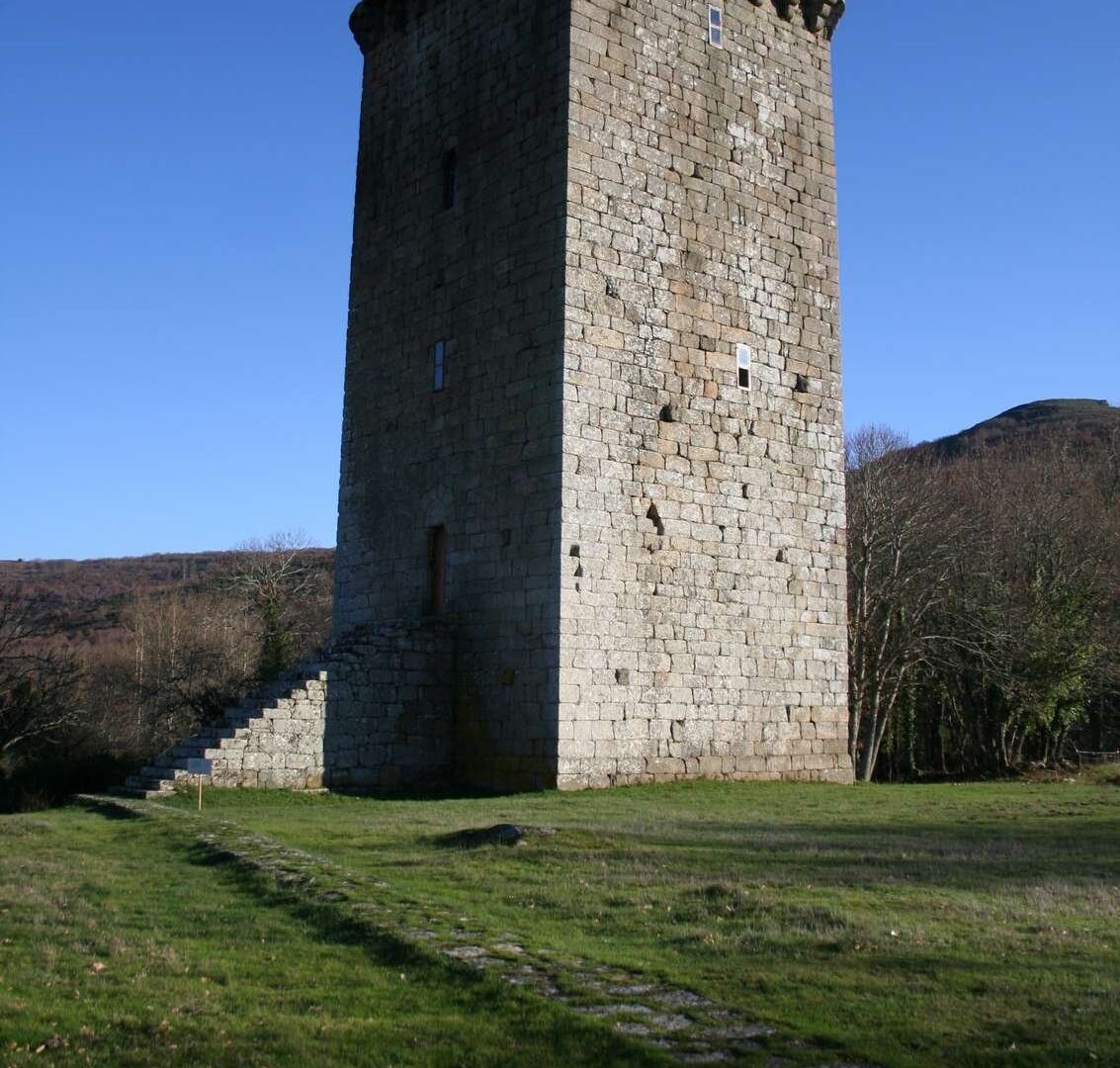
The Torre da Forxa (Porqueira): castle, monastery and Irmandiños
The Torre da Forxa, also called de Fírbeda or de Porqueira, is what remains of a 12th-century castle: ceded to the bishopric of Ourense in 1157, occupied by the Duke of Lancaster in 1387, town hall in 1837 and a Bien de Interés Cultural.
- Place
- A Torre, A Forxa (Porqueira)
- Construction
- 12th century, to defend the border with Portugal
- Height
- 23 m, square-plan keep
- Protection
- Bien de Interés Cultural
- Other names
- Torre de Fírbeda, Torre de Porqueira
The Torre da Forxa, also called the Torre de Fírbeda or Torre de Porqueira, is the only surviving standing part of a 12th-century medieval castle at the place called A Torre, in the village of A Forxa, capital of the municipality of Porqueira. It was one of the four fortresses that watched over the Lagoa de Antela and the border with Portugal, along with those of Sandiás, Celme and A Pena [1][3]. It is declared a Bien de Interés Cultural [1].
A border castle
The tower was raised in the valley, a place chosen to control the frontier with neighbouring Portugal better, in the struggles between Alfonso VII and his cousin Afonso Henriques [1][2]. The old xinzodelimia.eu page speaks of between the 11th and 12th centuries; the Galipedia and Fronteira Esquecida give the 12th century [1][2][3].
In 1157 Alfonso VII ceded the castle to the bishopric of Ourense, and in May 1204 Alfonso IX, at Troncoso, sold to Bishop Alfonso for 2,500 sueldos everything he held in Porqueira [1].
The Hieronymite monastery
Beside the tower a monastery was established, first of canons regular and later of Hieronymite monks, the only ones ever in what is now the province of Ourense. Its first prior, Jordán, had a church and cloister built alongside, which have now disappeared; the prior exercised jurisdiction over the town of A Forxa [2][3][4]. The stones of the church were reused in other buildings, but the prior’s house, turned into a pazo, still survives shortly before reaching the tower [3].
Lancaster and the Irmandiños
In the spring of 1387, in the Castilian war of succession, the Duke of Lancaster occupied the castle for a short time [1]. In the second half of the 15th century it suffered a siege by the Irmandiños, who did not manage to bring it down [1][2].
The sources disagree on who the lord was in that century: the Galipedia article on the tower says it belonged to the house of Monterrei and Fronteira Esquecida says to the Count of Benavente [1][2].
Town hall
When the municipality of Porqueira was created in 1837, the tower became the town hall, which helped preserve it; afterwards it passed into private hands [1][2]. Locals say it was close to disappearing because the ashlar blocks it is built from were once put up for sale [2].
The architecture
It is a keep 23 metres high with a square plan, built of granite ashlars in regular courses. The Romanesque door opens on the second floor, reached by a stone staircase of twenty flights, and the openings were reduced to arrow-slits and small windows. A projecting machicolation on simple corbels crowned the wall; the battlements do not survive. Inside it has three floors plus a basement, formerly covered with wooden ceilings [1][2].
It is protected by the generic declaration of 1949 on Spanish historic heritage and later by its status as a Bien de Interés Cultural [1]. According to the Galipedia, it houses an interpretation centre for Vía Nova XVIII of the Antonine Itinerary as it passes through A Limia [1].
King García in the tower
A tradition, collected by González de Ulloa and cited by Xesús Taboada Chivite, says that King García of Galicia was imprisoned here, pursued by his brother, before going over to the Moors of Portugal [2]. The old xinzodelimia.eu page states there is no documentary support [3]. More local legends, such as the beams of A Forxa, are on the page for Porqueira.
How to visit
The outside can be visited freely. To go in you must ask permission at the Concello de Porqueira (telephone 988 466 102) [2].
Frequently asked questions
Who built the Torre da Forxa?
It is not known who raised it. The sources place it in the 12th century, in the context of the struggles between Alfonso VII and Afonso Henriques, and by 1157 it had already passed to the bishopric of Ourense [1][2].
What is it called: da Forxa, de Fírbeda or de Porqueira?
They are three names for the same tower: Forxa after the place, Porqueira after the municipality and Fírbeda after the river that runs nearby [1][3].
Can it be visited?
From outside, yes, freely. Inside, with the permission of the Concello de Porqueira [2].
Was King García imprisoned here?
It is a tradition with no documentary support [2][3].
Links
- Patrimonio da Limia
- Porqueira
- A Torre da Pena
- A Torre do Castro de Sandiás
- A Torre de Celme
- O castelo da Picoña
- Idade Media e torres da Limia
Sources
- «Torre de Fírbeda», Galipedia (CC BY-SA 4.0). https://gl.wikipedia.org/wiki/Torre_de_Fírbeda
- «Torre da Forxa», Fronteira Esquecida Limia-Lima. https://fronteiraesquecida.eu/gl/fichas/torre-da-forxa-2/
- «Torre da Forxa», xinzodelimia.eu. http://www.xinzodelimia.eu/a_forxa.htm (Wayback: https://web.archive.org/web/20120305063306/http://www.xinzodelimia.eu/a_forxa.htm)
- «Porqueira», Galipedia (CC BY-SA 4.0). https://gl.wikipedia.org/wiki/Porqueira
© OpenStreetMap contributors
You may also like
 Heritage of A Limia: towers, convents, mills and ethnographic villagesA tour of the historic heritage of the municipality of Xinzo de LimiaA summary of the historic heritage of Xinzo de Limia: the Romanesque old church, the churches of Novás and Morgade, Torre da Pena, the Bon…
 Heritage of A Limia: towers, convents, mills and ethnographic villagesEthnographic heritage of Rairiz de Veiga: Congostro, mills, ovens and springsThe ethnographic heritage of Rairiz de Veiga: the restored village of Congostro, the San Miguel mills route, 17 mills, 5 communal ovens and…
 Heritage of A Limia: towers, convents, mills and ethnographic villagesXinzo de Limia in a day: a route through heritage, water and the lagoonA suggested one-day visit to Xinzo de Limia: Museo Galego do Entroido, the church and square of the town, Torre da Pena, the Bon Xesús…
 Heritage of A Limia: towers, convents, mills and ethnographic villagesMills and ethnographic heritage of Calvos de RandínCalvos de Randín has 18 mills catalogued in Galicia Nomeada, plus the Oratorio, tied to the rivers and streams of the Salas valley and the…
 Heritage of A Limia: towers, convents, mills and ethnographic villagesThe Torre do Castro of Sandiás: history, visits and activitiesThe Torre do Castro, in Sandiás, is a 12th-century castle torn down by the Irmandiños in 1467 and now consolidated: its history, the 2024…
 Heritage of A Limia: towers, convents, mills and ethnographic villagesThe Torre da Pena (Portela): history of a fortress of A LimiaThe Torre da Pena or Portela tower, in Xinzo de Limia, is a 14th-century military tower and a Bien de Interés Cultural since 1994: the…
