

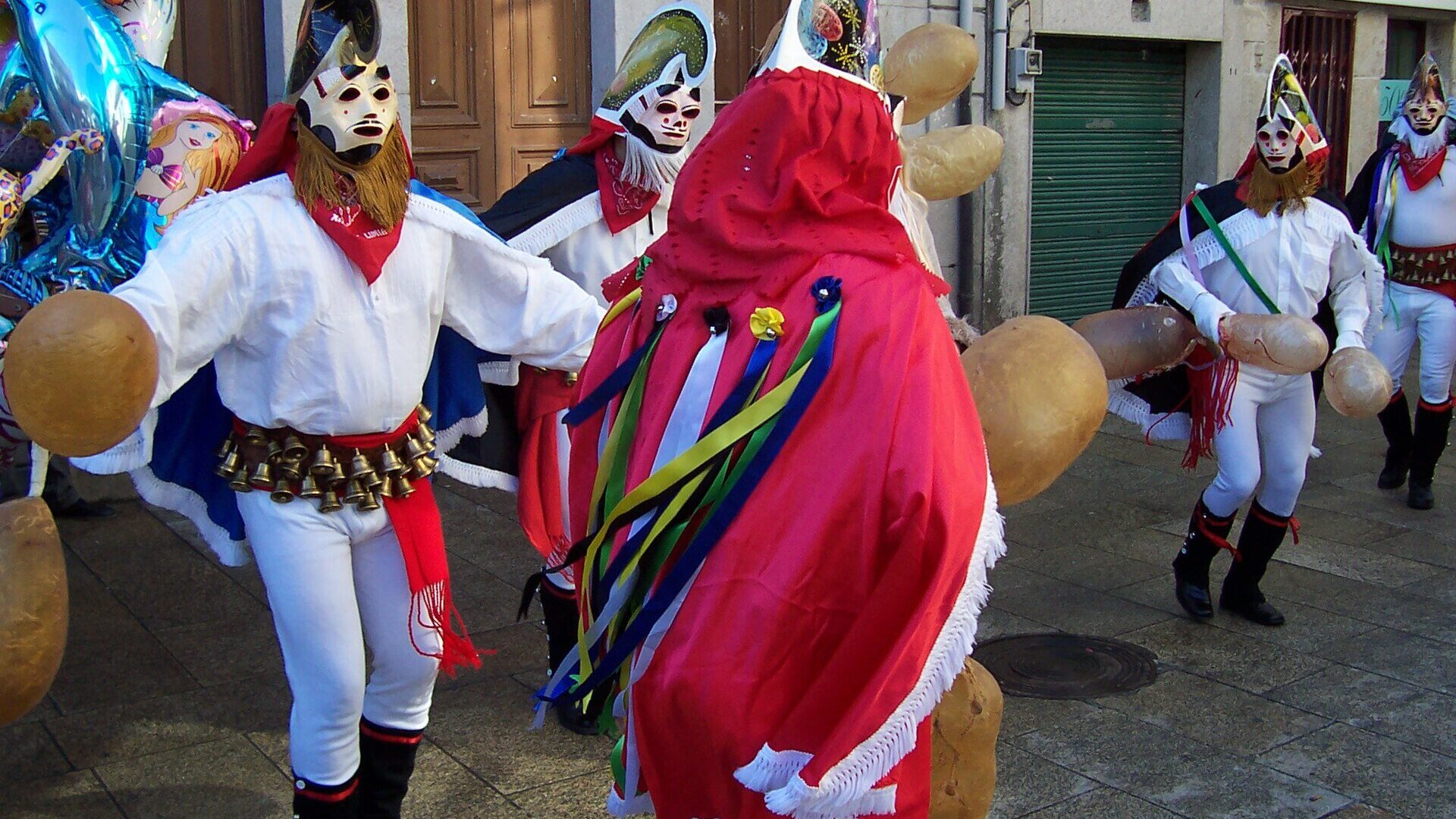
The manturreiro in the Entroido of Boado (Camilo Vila García, 2010): full text
Full reproduction, with the author's permission, of the paper "O manturreiro no entroido de Boado" by Camilo Vila García (3rd Congress of Galician Ethnographic Heritage, 2010): history, cycle, costumes and the manturreiro.
- Author
- Camilo Vila García
- Publication
- Proceedings of the 3rd Congress of Galician Ethnographic Heritage (Ourense, 2010)
- Pages
- 65–72
- Status
- Text reproduced with the author's permission
This page preserves the complete text of the paper "O manturreiro no entroido de Boado", by Camilo Vila García, published in the proceedings of the 3rd Congress of Galician Ethnographic Heritage. O ciclo do entroido: de práctica social comunitaria a obxecto de estudo etnolóxico (Ourense, Deputación de Ourense, 2010, pp. 65–72, ISBN 978-84-693-0140-1) [1][2]. The author gave permission to reproduce it in full, so that this knowledge is not lost. What follows is the English translation of the original Galician text, faithful to its content and expressions; the photographs are omitted (with their captions "Pantalla de Xinzo" and "O Manturreiro. O Cesto: a palla e máis o pau"). Terms proper to the Entroido are kept in Galician. For a summary and context, see The manturreiro and the Entroido of Boado.
INTRODUCTION
This contribution is a selection of the work of a collective of people concerned about the situation of rural society as well as the population’s own cultural expressions.
The experience is part of a set of activities carried out by the Rural Development Association "Tras-la-Xas", which arose from the convergence of forces of the different sectors of the population of a small Limia village, as will be explained below.
It is necessary to introduce the reader to the reality of the Ourense comarca of A Limia, to understand the real magnitude of this project, where the most outstanding manifestation of lay culture is the Entroido, in each of the aspects or possibilities in which it appears.
Likewise, it is fitting to give an introduction to the specific context of study in this work, Boado, a village that emerges to the east of the concello’s capital, Xinzo, some 3 kilometres away.
It is very probable that the place name ‘Boado’ comes from the Celtic word bed/bud, meaning "still water, pond, spring". This hypothesis is highly reliable since the village has around 20 springs and sources.
The current population is around a hundred people, of whom more than fifty per cent are over 65, a worrying fact, common to all rural Galicia.
It was clearly an emigrant village, like so many; besides the circumstantial factors common to the whole Nation, factors such as its proximity to Xinzo and Ourense should be cited, which made it easy to leave the land. The most important problem of emigration in Boado came once it ended, since very few chose to return to the motherland, and they remained scattered across Galicia, above all in Vigo, Ourense and Xinzo, which is why the population is ageing at great speed.
The lands are watered by two important rivers of the area, the Río da Bea, which in Boado lands flows into the Río Limia, which gives its name to the comarca.
Being in the setting of the Limia land, it is easy to find wide flat areas, although the village core is sheltered by a hill.
Currently the agrarian vocation is evident and almost exclusive among the scarce economic activities of the Limia village. Despite the existence of a small herd of cattle, the village lives from its land, as extensive cultivation of both potatoes and cereal takes place, with some pulse plantations.
Historically it must be mentioned that there are no notable differences from the common history of the area, although in more recent history we will underline the mark left by the Civil War in Boado, with more than a dozen dead, as well as confrontations between members of the same family and similar barbarities, so the village remained divided in two for many years.
It is also necessary to speak of the third of May 1945, which brought the most important frost in Limia history and left the area without economic possibilities; it was the so-called "year of hunger", from which people would not recover until five years later.
Boado appears as a sleeping village, but a series of movements promoted by the inhabitants themselves keeps the spirit of the land from fading.
In this sense, we must speak of the Cultural, Rural Development and Camino de Santiago Promotion Association "Tras-la-Xas", which arose unofficially in the spring of 2007, to be officially constituted in 2008, and to be the reference for the village’s joint work. The lines of action are diverse: on the one hand, taking advantage of the Portuguese Way passing towards Santiago, the Association is working to promote knowledge and use of it; on the other, the association’s activity is directed towards the conservation and use of the ethnographic resources the village presents, so we find a centuries-old oven, which went from four decades of oblivion to being the axis that structures the village’s social life, hosting the celebration of various events throughout the winter (Magosto, the Noiteboa dos Mozos, Epiphany Eve, the Annual "Biggest Potato" Contest, and recently, the Entroido), an Aira renovated as the village Square and seat of the festival, the twenty or so monuments related to water, etc.
The ideal that underpins the Association, and which is also its motto, is the development of an active, productive and real life in Boado.
Turning to the Entroido, the subject of this work, mention should be made of the joint labour of old and young in favour of a real recovery of the Boado Entroido, as well as of its figure par excellence, the Manturrieiro.
The first activities were the gathering of the village for the Entroido celebration, collaboration in making snacks for everyone, the reappearance of the Maturrieiro at the festival, and the reading of the Entroido verses, points that will be explained later.
I consider it necessary to give a short introduction regarding the Xinzo Entroido, partly to blame for the disappearance of the many other entroidos celebrated in the villages.
The meaning, traditions and costumes of the Xinzo Entroido are well known to the general public, but surely very few reflect on the fact that today’s Entroido is no more than an inheritance acquired as a witness of the Galician festival and cultures, once so valued.
Thus, we can analyse, by way of context, some of the phenomena the Xinzo Entroido brings: the representative mask is the Pantalla, reflection of a virile being, which has hindered, up to our days, the incorporation of women into the Entroido; on the other hand, we can also note the centralising phenomenon it had, since it gradually finished off the villages’ entroidos; the current dimension of the Entroido makes it the reference festival in the country, which brings an excessive number of entroideiros, a point by which the Entroido lost a certain local mockery character; the transgressive invasion of public space is one of the festival’s own characteristics, although nowadays the spaces are delimited beforehand quite rigidly; the less refined rural customs were also discarded (the fareladas are reduced to an innocent children’s battle and Xinzo does not want firecrackers nor does it encourage the "water squirters").
HISTORY OF THE BOADO ENTROIDO
A historical view of the Boado Entroido over the last hundred years follows, marked to a high degree by the most important event of 20th-century Spain.
Focusing now on the socio-historical study of the Boado Entroido, it must be said that all the material gathered was thanks to the invaluable collaboration of the village’s neighbours, delighted at the project of studying the Entroido and the possibility of its recovery.
There are concrete data, lying in the memory of those who lived it, that the Entroido in Boado has existed since before the Civil War (1936-1939) and already then festivities were held on the two Sundays before the start of Lent, called Entroido, or, through the influence of the language of Cervantes, Carnaval, and in the heart of every Boado person, Antroido.
Once the conflict ended, it was not until 1942 that the Entroido was reborn in Boado, as a mostly rural festival, without major economic expense, since there was nothing to pay for it with. The Entroido was made at home, both the costumes and the entertainment itself.
From the Civil War until 1955 it was banned by the Franco regime, but the villages bet on not falling into uprootedness and fought so the festival would not die.
The oldest remember with nostalgia that Entroido of 1950, which was known throughout the comarca, given the spectacular festival it produced.
In 1955 the slab of prohibition on entroidos was lifted, and Boado’s went into an important decline, which would take it to its disappearance. The offer was much bigger, and people’s support concentrated on more massive Entroidos.
The person who until then had borne the weight of the Entroido, Mr Silvestre, stopped playing at the "Aira dos Moitos", nerve centre of the village and true epicentre of the Entroido, situated beside the Cruceiro, which represents the village centre; the "Aira dos Moitos" stands as a majestic flat surface of two levels, perfectly suited to events such as the Entroido or the San Pedro festival. Silvestre fell silent, and in his place record players appear, which tried to enliven the Boado people’s festivities; the bagpipers and the lateiras, who played vigorously on the pepper tins that came from the fair, also fell silent.
The return of emigrants to their native homes can be dated to the second half of the 1960s, and they prefer a more massive Entroido such as Xinzo’s.
The Entroido also served as a shelter and for enjoying the best food of the year. This is the last legacy the Entroido leaves us, and it lasts today.
Since the Entroido coincided two months after the pig slaughters, it was used to taste the best delicacies, very caloric dishes, centred on pork and garden vegetables. An example is the well-known lacón, chorizo and turnip greens. It was accompanied by a spectacular dessert, in which the queens were always the orellas de Entroido, escorted by tasty fritters or "chulas", or even filloas. Everything was well washed down with wine and glasses of aguardiente, coffee liqueur or chupitos de mezclado (aguardiente plus coffee liqueur).
But within this uniformity, there was an attempt to change the menus of the two big days, Sunday and Tuesday; it was even possible, backed by popular awareness, to set differences between the two days, thus:
- On Sunday it was traditional to eat pedro or thick chorizo, and cachucha, besides cachelos, of course, and greens (turnip greens or cabbage).
- On Tuesday, to vary things a little, it was customary to serve lacón or the pig’s jaw, with the corresponding greens and boiled potatoes.
THE COSTUMES
A detailed study of the most important part of the Entroido is needed: the costumes, which give the complicity necessary to enjoy the festival.
It is without doubt here that the greatest particularity of the Boado Entroido lies, since it acts as a subculture within the Galician culture of the Entroido, because common elements of the Entroido are mixed with Boado’s own particularities.
This section is also where a clear differentiation is sought between the Boado Entroido and Xinzo’s.
Xinzo, and its pantalla, understood by all as a symbol of the festival, is besides that symbol a continuous absurdity towards the Entroido, since the authority they have is ever smaller, and current behaviours do not help the situation change.
The Pantalla expropriated the Entroido from the villages, not in an evident and explicit way, but succinctly, and in a personal appreciation, if I may, I believe it was not worth trampling the weakest, if he was happy, in order to seek a massification that makes only a few happy.
With the differentiation according to the day, a list of costumes can be set out, differentiated by who wore them, because the Entroido did establish different roles for men and women. Thus:
For men:
- Espantallo (scarecrow): A man took straw and covered his body, as an elaborate dress, trying to cover most of the body; thus, besides getting the laughter of the adult attendees, he hid and aimed to scare the smallest children of the village, who saw in the Entroido a nightmare of monsters and ugly faces. At some point it was called pantalla.
- Civil Guard (or any other authority): There was little originality, but it lent itself perfectly to mockery and fun. If there was a relative in the corps, it was perfect, and if not, no matter, as it was done as originally as possible.
- Cow or mule: Two men, one behind the other, resembling Chinese dragons, covered themselves with a blanket or cover, and made two horns, when they were cows, to pick on people.
- Woman: The Entroido was the best occasion to bring out the finery of the women of the house, but on men’s bodies. The Entroido gives the right to cross-dress, and none of the men fled the temptation to put on a skirt, a shawl, stockings and petticoat.
- Coroza: A garment made from the rushes easily found in the many areas damp enough for them to grow. The rushes underwent a process in which they were beaten, then used to make the most diverse garments. The first purpose of the carozas was to protect oneself in irrigation season and to serve as a common garment for going out with the cattle. Generally waistcoats and gaiters were made. At the Entroido they delighted attendees thanks to their showiness.
- Carucho: It is the coroza itself with a hood, that is, one more accessory that covered the head, which helped keep unknown the identity of the wearer. Both in carozas and caruchos, those made by Camilo Vila and Tío Soutelo were famous.
- Vellos das chocas (old men of the cowbells): The veterans of the festival liked to scare people, above all the week before the Entroido. For this they put cowbells or chocallas around their backs and ran through the village in search of possible victims of their mischief.
- Manturrieiros: (subject of study later).
For women:
- Feas (ugly ones): On Sunday, coinciding with the arrival of visitors from the neighbouring villages of Pena, Soutelo and above all Pidre, tradition dictated that the costume was that of an ugly woman, as this was the gift offered to visitors. They were not exactly ugly; the women went as little old women, as sick women or as deformed beings. They put straw stuffing on the hump and the belly, accompanied by the oldest and most worn finery they had at home. They also tried to cover the face, with a cloth with two holes for the eyes plus a stocking or a mask made at home or at school.
- Bonitas (pretty ones): Tuesday was the most important day for the Boado people, as it was the day they generally "took the alternative" and went to Pidre to trade verses. To give the best image, the women dressed as bonitas. It was no more than a polka-dot dress, if possible with fringes and flounces; it was also called andaluzas or gitanas.
- Española: It is a variant of bonita, but the showiest variant, since in the most hand-made way possible, thousands of papers were hung for ornamentation; moreover, their own jewellery and accessories were created.
- Period: A current, no less important or curious for being less widespread, is the one kept by some of the local girls, who openly rejected the española dress and chose to use garments from the early century of the Galician rural society they belonged to.
THE ENTROIDO CYCLE
The Entroido in Boado, bar some detail, followed the general scheme of the comarca, that is, the prelude to the Entroido, its own Sunday and Tuesday, and Ash Wednesday or cinsa.
By way of an Entroido almanac, we could cite the most important moments, without forgetting that the Entroido is the festival of improvisation par excellence, so the festival was not governed by a pre-established script, although common features are found every year. Thus:
Corredoiro, Fareleiro or chirnas Sunday: On this Sunday before the Entroido the day began with a communal mass, then moved to the custom of lighting a big bonfire in a strategic area, between the Cruceiro and the Aira dos Moitos, where there is a stone wall, which was the refuge of whoever did not want to be dirtied by the other participants in the festival. The aim of the games was, on the one hand, with the chirnas (remains of wood or similar left half-burnt, so they stain a lot), to stain people, and on the other, to try to come out of the festival clean. Besides the aforementioned chirnas, materials such as ash or bran were used, hence the name fareleiro or chirnas Sunday.
Besides the game mentioned, the atmosphere was enlivened by the rhythm of the lateiras, such as the incomparable Tía Lucinda, who from a simple pepper tin that came to Boado from the fair drew the most captivating melodies.
Throughout the whole week from the corredoiro Sunday until the arrival of the Entroido, it was the week of scaring people; the vellos das chocas were there for that, forming large groups. Others, not being vellos das chocas, that is, the youngest of Boado, also scared people (above all marriageable girls) at night, sheltered by darkness, or even going as far as pretending to be thieves.
From these events arose numerous legends and tales, like the famous year when the spinning-party was assaulted, without being able to recognise any of the robbers.
Entroido Sunday: The day began with a mass, whose end gave the licence needed to start the fun.
Tradition dictated that on Entroido Sunday the Boado people were visited by the neighbours of nearby villages (Pena, Soutelo and potentially Pidre, about a kilometre away); they came very well dressed; on the contrary, the Boado people awaited the visit in the worst possible finery, going as ugly as they could.
The order was not fixed, but generally the Pidre people were the ones who came on Sunday to Boado, and then on Tuesday the order was reversed.
The aim of the Pidre people was to satirise the customs and events of the Boado people, and for that they came equipped with previously written texts, in which, without ill intent, a tour is made of the dark side of the life of each of the neighbours in the next village.
But without doubt, the greatest attraction was when a rope was stretched across the path towards the adversary village. When the Pidre people reached the outskirts of Boado, they were already awaited with a rope that symbolised they could not cross it, and therefore, in the manner of a regueifa, they began to trade verses. One took the floor on one side, and the reply was not long in coming. Losing this dialectical fight meant being a laughing stock for a whole year, so there were people who specialised in the matter, and when the invading village arrived they were sought by all to counter the others’ attacks; remembered for their mental speed as much as their spontaneity are Tío Soutelo (the king of the Boado Entroido) and Antonio Furela.
In this section I was greatly helped by the close collaboration I maintained during the work with Ángela Iglesias, who is the last figure of the genuine Boado Entroido. She recited to me (as can be seen in the attached graphic files) the following stanza, in a moment of panic before the attacks of the Pidre people, and playing for time until the real specialists arrived, for the verses go like this:
(Peghilla de Pidre)
Se me facedes o favor retirades a cordela porque se non a quitades chega o sangre a Pontecela*
*communal area of Boado, found in the lowest part of the village.
(Ángela Iglesias de Boado)
Ei de vos dicir unha cousa e non me digades que non pra arrebater ós de Pidre chegan os cas do Simón
(Verses in Galician, as the author records them. Approximate translation of the first: "If you do me the favour, take away the little rope, because if you don’t remove it, blood will reach Pontecela". Of the second: "I have to tell you something and don’t tell me no: to take on the Pidre folk come those from Simón’s house".)
This is a clear example of the rivalry experienced in these verbal confrontations, in which both the educated and those who could not even read took part, because only the art of improvisation counted on these occasions.
When the confrontations ended, the festival was enlivened by the bagpipers and lateiras, who managed, with their songs and rhythms, to make the villages friends for a moment.
Entroido Monday: It was a quiet day, since the previous day’s tiredness still lingered and another equal festival awaited the next day. Only at dusk did the boldest dress up and go out to the street to play tricks on the people there. They also had the licence to enter the looms, where the girls were, and the kitchens.
The costumes of the previous week were used, of farrumeiros, characterised by their careless making.
Entroido Tuesday: Sunday is a day resembling Tuesday, but with the peculiarity that the roles are reversed as to which village visits the other. Generally, on Tuesday the Boado people arrived as bonitos at Pidre’s territory, where they faced each other in dialectical battles, and where the Boado people read them the testament, in which they tried to ridicule all the Pidre people. There is a memory that there was even mass on Tuesdays.
There was also music, almost always from bagpipers, although it was gradually replaced by record players.
The passing of time brought a series of important variations, a product of the circumstances of the moment. The festival became ever more private, which on one side enriched the Boado people’s affective ties, but also made people believe that the tradition was ending and take refuge in the Xinzo Entroido.
Among the clear advantages, in my view, was the possibility that the testaments were written by and for Boado people, which multiplied their humour, as everyone knew each person’s doings.
The last testament staged in Boado dates from 1981, the date on which agony seized so beneficial a tradition for the village.
Ash Wednesday: The festival comes to its end; religion, omnipresent in Galician society, bans the festival for a season, a year. It is time for Lent, religion, passion. The most solemn mass of the year is celebrated, in which there was no singing; wearing a black veil was strictly obligatory (although its use was already frequent throughout the year, except on the Immaculate Conception, when unmarried women wore the white veil), nor could the band play inside the church, a privilege exclusive to San Pedro’s day.
THE CHILDREN’S ENTROIDO
Children were less children than they are now. That is why one cannot establish at what age one stopped being a child; one simply stopped, whether through merit at school, at work, through having a younger brother, or whatever, but the truth is that not just any child could access the adults’ Entroido, and this borders on a contradiction, since children are those who can potentially make the most mischief in the homage to don Carnal.
Another function was reserved for the little ones, a different festival, in which I can say I took part.
On the night of the Entroido Saturday, or Monday failing that, the boys dressed in the oldest rags of the house, and thus managed to go as gypsies or mazarocos, although they were also included in the adults’ custom of calling them "farrumeiros", meaning everyone who had no defined costume but wanted to have fun and enjoy themselves.
The little ones’ game consisted of going from door to door asking for alms, which were gladly given in all the houses, although in some they waited for the boys to scare them. The children generally received eggs, chorizo, tinned food, bread… that is, what was essential for a good supper, which they prepared in the house of one of them.
THE MANTURRIEIRO
I now proceed to make a study of the most important and feared character of the Boado Entroido.
These were the true protagonists of the Boado Entroido, when they entered people’s houses (and more recently taverns) to scare everyone present, focusing their wrath on the women, whom they tried to undress, and on the children, who showed fear at the possibility of the much-feared Manturrieiros arriving.
Their actions centred on two clearly distinct fields: one, in the street, since anyone who dared to frequent the village streets on such marked days would get their just deserts in the form of a fright and fun; and two, in the houses, where they burst into people’s lareiras, where they generally were, and offered an immense repertoire of mischief and festivities.
Their dress features:
- The "manturria": made from leftovers of other garments, or even old rags, and covering the whole body of the person wearing it. Its parts were the carapucho, on the head, the back, on the back, and the chest, on the front.
- The rope: with which the knot forming the head’s carapucho is made, into which the head is put, to hide the face.
- The belt: generally leather, to tie the manturria to the body at the waist, trying to cover it with the manturria itself.
- The shawl: they covered their backs with it; it could be a black rag, or totally coloured.
- The muck: it was common to impregnate the costume with excrement or mud to achieve a more macabre look.
- The basket: the Manturrieiros carried a basket, in which ash, flour or dry straw was carried, to dirty people.
- The stick: it was the main tool for scaring, preferably ending in a point to do more harm.
- Cowbells (optional): there are two currents in popular wisdom: some say they could not wear them in order to keep silence, while others say they did wear them, because the important thing was to be noticed.
They usually went out at night, or at most at dusk, but never in daylight, which played the role of an enemy, since the most important thing was that the days of the Entroido passed and people did not know who had been through the houses, and thus argue whether it was one person or another.
Links
Sources
- O manturreiro no entroido de Boado, en Actas do III Congreso de Patrimonio Etnográfico Galego: O ciclo do entroido (Deputación de Ourense, 2010), pp. 65-72. http://revistas.biblioteca.uvigo.es/libros/ACTAS_III_CONGRESO_ETNOGRAFIA.pdf
- O manturreiro no entroido en Boado (Dialnet, rexistro bibliográfico). https://dialnet.unirioja.es/servlet/articulo?codigo=7238588
You may also like
 Entroido of Xinzo de LimiaThe Pantalla among the masks of the Galician Entroido: peliqueiros, cigarrones, felos and vergalleirosThe Xinzo Pantalla shares a family with the Ourense masks: the peliqueiro of Laza, the cigarrón of Verín, the felo of Maceda and, in A…
 Entroido of Xinzo de LimiaThe FESMOU Entroido Gathering in Xinzo: traditional masks from all over GaliciaThe Xuntanza de Entroidos, known as FESMOU, brings together in Xinzo de Limia more than 30 traditional entroido groups from all over…
 Entroido of Xinzo de LimiaVocabulary of the Pantalla: parts, curls and making processesThe names of the parts of the Xinzo Pantalla (corno, rizo, faldón, barba, fleco, pano picado) and of the making processes (empapelar,…
Entroido of Xinzo de LimiaWills and shares of the donkey: Cortegada, Gudes and CongostroThe Entroido wills of A Limia: that of Cortegada (1947), the sharing out of the donkey of Gudes and the will of the Brea family's donkey…
Entroido of Xinzo de LimiaThe vergallo and the bell belt of the PantallaThe lost vergallo of the Xinzo mask, the belt of bells and jingles that announces the Pantallas and the belt-makers who made it, with…
Entroido of Xinzo de LimiaThe sounds of the Pantalla and Vicente Risco’s riddle about the cigarrones in XinzoWhat a Xinzo Pantalla sounds like: the belt of bells and jingles, the guttural "O" sound and the hunt for an acquaintance as far as the…
