


The Couto Mixto in the sources: from the documents of 1258 and 1540 to historiography
What the sources say about the Couto Mixto: the Inquirições of 1258, the conflicts of 1517-1540 with Montalegre and A Piconha, the house-building ritual, Madoz, Brandón and García Mañá, and why its medieval origin remains unclear.
- Main source
- Galiña Lorenzo, Minius no. 28 (2023)
- Oldest document
- Inquirições of Afonso III (1258)
- Delimitation records
- 1540
- Treaty
- 29 September 1864
The Couto Mixto is one of the most cited subjects in the history of A Limia, but its medieval origin remains poorly documented. Juan Manuel Galiña Lorenzo (University of Vigo) reviewed in 2023 the published sources and the bibliography on the territory, and this page gathers what is most useful for understanding what we know and where it comes from. The general history is in History of the Couto Mixto [1].
The territory, according to the study
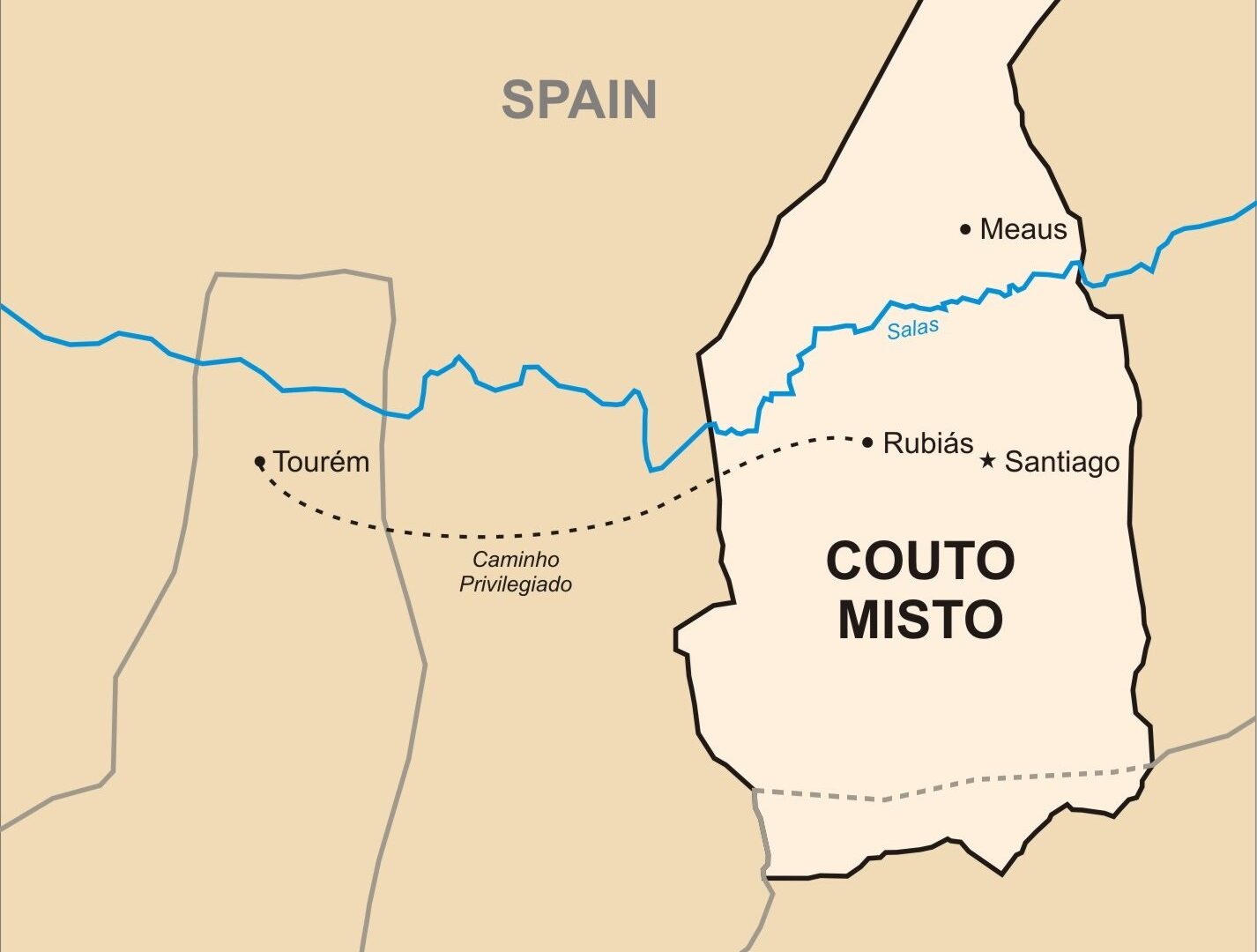
The Couto lay in the Salas valley and was made up of three villages of the Xinzo de Limia judicial district: Rubiás and Santiago (concello of Calvos de Randín) and Meaus (Baltar), with an area of 2,695 hectares and, when Madoz wrote, about 200 households. To the south it bordered Montalegre (Vila Real district). The Ensenada Cadastre already calls Meaus "mixed, indivisible between the two crowns, Spain and Portugal". Among the privileges were tax exemption, not providing soldiers, travelling and trading without identification and choosing nationality; the Camiño Privilexiado linked the Couto with the Portuguese freguesia of Tourém. The judge of honour, whose origin is unknown, in the last years was elected every three years by the representatives of the three villages and could try civil offences; serious ones went to Galicia or Portugal according to the offender’s nationality. The archive was kept in a chest in the church of Santiago de Rubiás, which, according to García Mañá, was burned in 1809 when Soult’s troops passed [1].
The first document: the Inquirições of 1258
Among the oldest published sources are the Inquiriçoes geraes of Afonso III of 1258, which name several places in the Salas valley, among them Meaus and Rubiás, together with Requiás and San Paio, said to lie "in the middle" of the kingdoms of Portugal and León. The study’s surprising conclusion is that the name "Couto Mixto" does not appear in any source before the 19th century, although the term "mixto" does appear in the Ensenada Cadastre [1].
The records of 1517-1540
Between 1517 and 1518 there were conflicts between the Portuguese governors of Montalegre (Lançarote Gonçalves) and of Piconha (Antonio de Araújo) and the merino of the Salas valley, Pedro Sinval, over seigneurial control of the border, in which the mixed villages were caught up; they were not fully resolved until 1540. The records, published in the Gavetas da Torre do Tombo and in Tratados internacionales de España (Charles V), make clear that Meaus, Rubiás and Santiago, with their lands, are mixed, under the jurisdiction of both the Duke of Braganza and the Count of Monterrei. The agreements forbade the governor of Piconha and the merino of the Salas valley from applying justice on their own authority there, recruiting people from the three villages or raising a call to arms against the other side, and established that authorities could only seize prohibited goods obtained in their own jurisdiction. For the author, these items are fundamental for the later naming of the territory as Couto Mixto and for the emergence of its privileges. Shortly afterwards, in 1538, John III’s emissaries described the border and the mixed villages, which depended on the vanished castle of Piconha, with two judges of honour, one Galician and one Portuguese, a register of inhabitants and mixed pastures [1].
The ritual for building a mixed house
In his Descripción de los estados de la Casa de Monterrey en Galicia (1777, published in 1950), Pedro González de Ulloa visited Meaus and recorded the ritual neighbours followed to begin a house: the owner declared that he would build it "for the King of Castile" on one part of the plot and "for the King of Portugal" on another, dividing the ground into pieces, and the witnesses shouted "Vivan los dos reyes, por moitos anos…" (long live both kings, for many years); then an agreement was drawn up ending with the Latin "Ad perpetuam rei memoriam" [1].
Madoz, Brandón and the great bibliography
The study reviews the works that dealt with the Couto [1]:
- In the 19th century, the dictionaries of Miñano (1852) and Madoz (1849), Fulgosio (1866) and legal writers such as Riquelme (1849), who considers that the Couto should disappear. Madoz says the documents explaining the privileges were burned by Napoleonic troops in 1809 and speaks of the conflicts over tobacco, a crop permitted only for own consumption.
- The Treaty of Limits of 29 September 1864 (article VII: Portugal renounces in favour of Spain all rights over the Couto; article XVII: Portuguese may keep their nationality).
- «La curiosa Historieta del Coto Mixto» (quote) (1907), by Delfín Modesto Brandón, the penultimate judge of honour, who describes life, privileges, smuggling, the Camiño Privilexiado and the choice of nationality; according to him, doors were marked with a "P" (Portuguese) or a "G" (Galician), and Santiago and Rubiás tended to opt for Portugal. For Brandón, the Couto’s disappearance was an injustice, since it was not respected as Andorra was.
- Vicente Risco, in the Geografía General del Reino de Galicia of the 1930s; and, since the 1980s, authors such as Gonçalves da Costa (1987), Días Baptista (1991), Salinas Valencia (2002), Paula Godinho (2011) and Rodríguez Cruz (2018).
- Luís Manuel García Mañá, the great Galician forerunner, with La frontera Hispano-Lusa en la Provincia de Ourense (1988), Couto Mixto, unha república esquecida (2000) and a chapter in Lingua e identidade na fronteira galego-portuguesa (2014). The author values his work as a reference but criticises that it cites few concrete sources.
García Mañá also records the founding legend: a princess exiled for love, trapped in the snow of the Pena range in labour pains, was brought down by the neighbours of Santiago, Rubiás and Meaus to the Couto’s villages, where she was cared for by the midwives of the Salas valley; when she was crowned queen, she thanked the favour with privileges, among them not giving men for war to Spain or Portugal [1]. See Legends: other legends and beliefs.
What remains to be clarified
The study concludes that the historiography largely repeats the same content, that the Couto’s medieval origin remains unproven and that most hypotheses (its birth together with Portugal, border indefinitions, dependence on Braganza and Monterrei) rest on late documents, while the oldest do not use the name "Couto Mixto" [1].
Links
- History of A Limia
- History of the Couto Mixto
- The handover of the Couto Mixto to Spain (1868)
- The Honorary Judges of the Couto Mixto
- Middle Ages and towers
Sources
- Galiña Lorenzo, Juan Manuel: «El Couto Mixto, una aproximación historiográfica», Minius, n.º 28, 2023, pp. 75-99. https://revistas.uvigo.es/index.php/mns/article/view/4892
You may also like
 Antela Football Club (1919): the oldest club in OurenseAntela Football Club, founded in Xinzo de Limia in June 1919, is the oldest club in the province of Ourense: the statutes, the Toural…
 Archpriestship of A Limia: parishes and dedicationsThe Archpriestship of A Limia in the diocese of Ourense: 82 villages, 33 chapels and a list of parishes with their dedication, from Santa…
 History of A LimiaCinemas, café, radio, school and library: Xinzo’s cultural life from 1948 to the 1970sThe cinemas Los Molinos (1948) and Antelano (1954), the Café Ideal and the Ideal 6 disco, the 1950 radio, the Colegio Santa Marina, the…
 Emigration of the Limia people: from the 1950s diaspora to personal itinerariesHow the Limia people emigrated: destinations and phases (America from 1920, Venezuela, Brazil, the Basque Country and Catalonia in the…
 Ethnography of A Limia: canastros, houses, limewash, finger guards, stonemasons, blind singers’ verses and the GerinaldoEthnographic studies by Pepe Calleja on A Limia: the canastros of Fontemoura and Faramiñás, the houses of Xinzo, the limewash of Solbeira…
From the Republic to the coup: Xinzo and A Limia between 1931 and 1936How the proclamation of the Republic (1931), 1 May 1936 and the preparation and success of the military coup of 17 to 20 July 1936 were…
