


History of the Couto Mixto: the republic between two kingdoms (until 1868)
The Couto Mixto was a territory between Galicia and Portugal, made up of Santiago, Rubiás and Meaus, with its own judge, tax exemption and freedom of nationality; the Treaty of Limits of 1864 ended it in 1868.
- Villages
- Santiago, Rubiás and Meaus (As Maus)
- Area
- 26.9 km²
- Treaty
- Treaty of Limits, 29 September 1864
- End of privileges
- handover of 1868
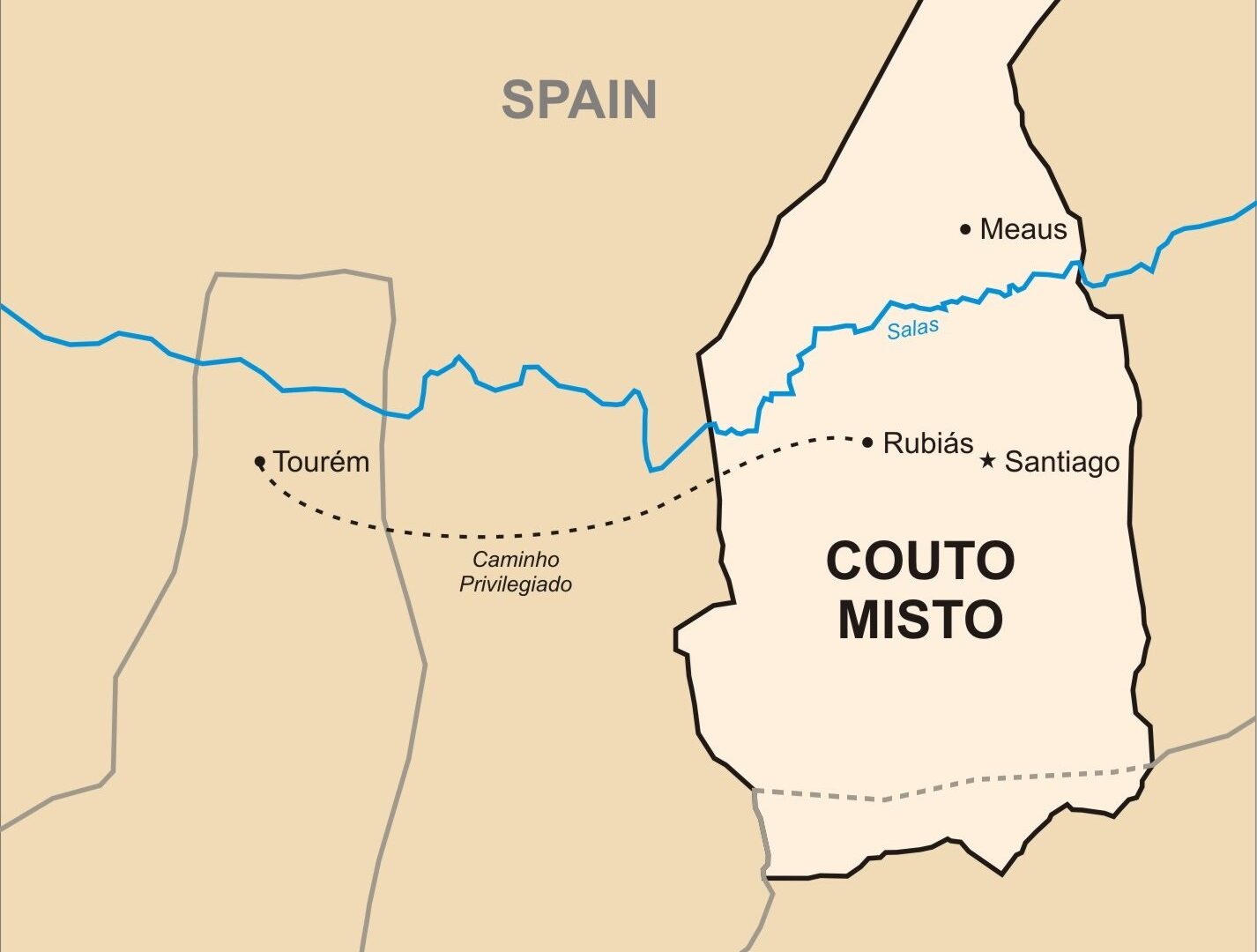
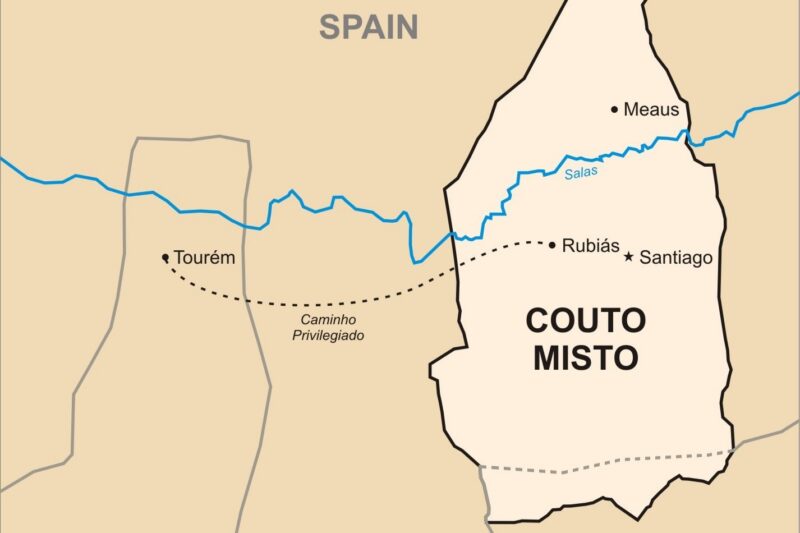
The Couto Mixto was for centuries a small border territory between Galicia and Portugal, in the valley of the river Salas, on the northern slope of the Larouco range. It was formed by three villages —Santiago, where the capital stood, Rubiás and Meaus (today As Maus, in Tosende, Baltar)— over an area of 26.9 km² and, according to its penultimate judge, Delfín Modesto Brandón, with no more than a thousand inhabitants between 1862 and 1864 [1][3]. It depended neither on the crown of Portugal nor on that of Spain, and its own organisation led to it being compared to a small State. The 25 Motivos tourist network today sums it up as a symbol of self-government and border culture, with a unique Galician-Portuguese coexistence [7].
Origin
The date of its creation is unknown. The Galipedia says it was constituted around the 12th century (1147) but is older, linked to the Late Middle Ages and the Picoña castle, and later tied to the house of Braganza [1]. Cerredelo, following Luís García Mañá, stresses its historical dependence on the noble houses of Braganza and Monterrei [2]. The documentary origin is impossible to clarify: Soult’s French troops destroyed in 1809 the documents of the "three-key chest" [1][2].
Initially the Couto was formed of four places, including Pena, which was razed by flames between 1517 and 1518, when an armed Portuguese group set fire to the houses; the inhabitants of Santiago, Rubiás and Meaus then sought the support of the Count of Monterrei, which they maintained until the end [1]. A census by King John III of Portugal in 1530 counts 17 households in Rubiás, 7 in Santiago and 8 in Meaus [1].
How it was governed
Every three years, the inhabitants of the three villages gathered in a field of the Salas valley and democratically elected the judge, who was the political, judicial and government head; he appointed six "men of agreement", two per village, and the "vicar of the month" carried out the measures [2]. In the churchyard of Santiago the stone bench where open councils were held is preserved [2]. Suffrage was male and for heads of household, and officials could be revoked if they failed in their duties [1].
The privileges
According to Cerredelo and the Galipedia, the Mixtos enjoyed tax exemption, free trade, the right to bear arms for defence or hunting without a licence, exemption from military service to both kingdoms, the right of asylum (with exceptions, such as homicide), freedom of crops, including tobacco, and the freedom to choose nationality, although they did not consider themselves subjects of any crown [1][2]. Houses marked the entrance with an "E" (Spanish) or "P" (Portuguese) [2]. The "privileged road" linked the Couto with Tourém without control by authorities [2].
Tobacco was the cause of many conflicts: in 1785 the Spanish Treasury ministry proposed to Portugal to jointly destroy the plantations and their mills, and around 1850 the ban became effective, with a maximum of three hundred plants for personal use [1].
The three-key chest
The Couto’s archive was kept in a 15th-century wooden chest, in the sacristy of the church of Santiago, which opened with three keys, held by representatives of each village, in a solemn ceremony [1][2]. Restored, it is the symbol of the Couto and is kept in the church of Santiago de Rubiás [1].
The end: Treaty of Limits (1864) and handover of 1868
In 1851 a joint commission was formed that failed to agree in 1856; in January 1863 the Mixtos elected Delfín Modesto Brandón as judge to put an end to the abuses by the authorities of both countries [1]. On 29 September 1864 the Treaty of Limits was signed: Spain received the Couto Mixto and Portugal the three "promiscuous villages" of Soutelinho da Raia, Lamadarcos and Cambedo, and their inhabitants had a year to opt for a nationality [1]. The ratification and handover of the Couto to Spain took place on 23 June 1868 in the church of Santiago, and the treaty came into force on 5 November 1868 [1].
Santiago and Rubiás passed to the concello of Baltar and, at the inhabitants’ request, the Deputation of Ourense created on 29 May 1870 the parish called «Rubiás dos Mixtos» (quote), today’s Santiago de Rubiás, in the concello of Calvos de Randín [1].
Memory today
In 1998 Luís García Mañá promoted an event in the churchyard of Santiago de Rubiás to recover the memory of the Couto; since then the naming of "Honorary Judges" has been celebrated on the first weekend of July, organised by the Association of Friends of the Couto Mixto, which since 2000 names three honorary judges each year and gives them a staff, a diploma and a symbolic key [2][5]. The Peoples of the Couto Mixto received a Premio da Crítica in the category of cultural initiatives for recovering memory and the meeting between Galicia and Portugal; today they number about 200 people [3]. There is a project for an Open Museum of the Couto Mixto with Calvos de Randín [3]. Issue 11 of the magazine Mazarelos was devoted to the history and ethnography of the Couto Mixto and presented in Meaus (Baltar), with talks by the political scientist Serxio María Rodríguez Álvarez, author of "Os pastos mistos. O derradeiro vestixio do Couto Misto", and the ethnographer José Rodríguez Cruz [9]. According to Turismo de Galicia, the churchyard of Santiago de Rubiás, where neighbours and authorities gathered to decide, has housed since 2008 a statue honouring all the judges and personifying them in the last, Delfín Modesto Brandón, unveiled on the 150th anniversary of the abolition of the Couto; the church keeps a replica of the chest and the old rectory houses the Couto Mixto Interpretation Centre, the "Gateway of Calvos de Randín" to the Baixa Limia–Serra do Xurés Natural Park [8].
Frequently asked questions
What was the Couto Mixto? A territory between Galicia and Portugal with self-government and privileges, made up of Santiago, Rubiás and Meaus [1][2].
When did it disappear? The privileges ended with the handover of 1868, after the Treaty of Limits of 1864 [1].
What was the three-key chest? The coffer where the Couto’s archive was kept, which opened only with three keys [1][2].
Links
- The handover of the Couto Mixto to Spain (23 June 1868)
- The Honorary Judges of the Couto Mixto, edition by edition
- History of A Limia
- Calvos de Randín
- Santiago de Rubiás
- Baltar
Sources
- «Couto Mixto», Galipedia (CC BY-SA 4.0). https://gl.wikipedia.org/wiki/Couto_Mixto
- Edelmiro Martínez Cerredelo, «Couto Mixto, unha antiga república entre dous reinos», Historia de Xinzo, 30-07-2021 (cita a Luís García Mañá, Couto Mixto. Unha república esquecida, Universidade de Vigo, 2000). https://historiadexinzo.wordpress.com/2021/07/30/couto-mixto-unha-antiga-republica-entre-dous-reinos/
- «Pobos do Couto Mixto», Premios da Crítica Galicia. http://premiosdacriticagalicia.org/premios/pobos-do-couto-mixto/ · Arquivo web (06-05-2021): https://web.archive.org/web/20210506162123/http://premiosdacriticagalicia.org/premios/pobos-do-couto-mixto/
- «Santiago dos Mixtos» e «Rubiás dos Mixtos» (cita), Galipedia (CC BY-SA 4.0). https://gl.wikipedia.org/wiki/Santiago_dos_Mixtos,_Santiago_de_Rubiás,_Calvos_de_Randín
- «O Couto Mixto, unha terra singular», OSIL. http://www.osil.info/o-couto-mixto-unha-terra-singular/
- «Igadi na Rede / Tempo Exterior nº 3 segunda época – Couto Mixto, unha república esquecida». https://web.archive.org/web/20120316051501/http://www.igadi.org/arquivo/te_se03/couto_mixto_unha_republica_esquecida.htm
- «O Couto Mixto: un microestado galego entre dous reinos», 25 Motivos. http://25motivos.gal/o-couto-mixto/
- Turismo de Galicia, «O Couto Mixto, a pequena república que sobreviviu sete séculos no sur de Ourense». https://blog.turismo.gal/o-couto-mixto-a-pequena-republica-que-sobreviviu-sete-seculos-no-sur-de-ourense/
- Gciencia, «O novo número da revista Mazarelos céntrase na historia do Couto Mixto». https://www.gciencia.com/perspectivas/revista-mazareloshistoria-couto-mixto/
In this topic
 History of the Couto Mixto: the republic between two kingdoms (until 1868)The Honorary Judges of the Couto Mixto, edition by editionEach July, in the church of Santiago de Rubiás, the Association of Friends of the Couto Mixto names new Honorary Judges. The honourees…
History of the Couto Mixto: the republic between two kingdoms (until 1868)The handover of the Couto Mixto to Spain (23 June 1868)On 23 June 1868, in the churchyard of Santiago, commissioners of Spain and Portugal carried out the Treaty of Limits of 1864 and handed the…
You may also like
 Antela Football Club (1919): the oldest club in OurenseAntela Football Club, founded in Xinzo de Limia in June 1919, is the oldest club in the province of Ourense: the statutes, the Toural…
 Archpriestship of A Limia: parishes and dedicationsThe Archpriestship of A Limia in the diocese of Ourense: 82 villages, 33 chapels and a list of parishes with their dedication, from Santa…
 History of A LimiaCinemas, café, radio, school and library: Xinzo’s cultural life from 1948 to the 1970sThe cinemas Los Molinos (1948) and Antelano (1954), the Café Ideal and the Ideal 6 disco, the 1950 radio, the Colegio Santa Marina, the…
 Emigration of the Limia people: from the 1950s diaspora to personal itinerariesHow the Limia people emigrated: destinations and phases (America from 1920, Venezuela, Brazil, the Basque Country and Catalonia in the…
 Ethnography of A Limia: canastros, houses, limewash, finger guards, stonemasons, blind singers’ verses and the GerinaldoEthnographic studies by Pepe Calleja on A Limia: the canastros of Fontemoura and Faramiñás, the houses of Xinzo, the limewash of Solbeira…
From the Republic to the coup: Xinzo and A Limia between 1931 and 1936How the proclamation of the Republic (1931), 1 May 1936 and the preparation and success of the military coup of 17 to 20 July 1936 were…
