


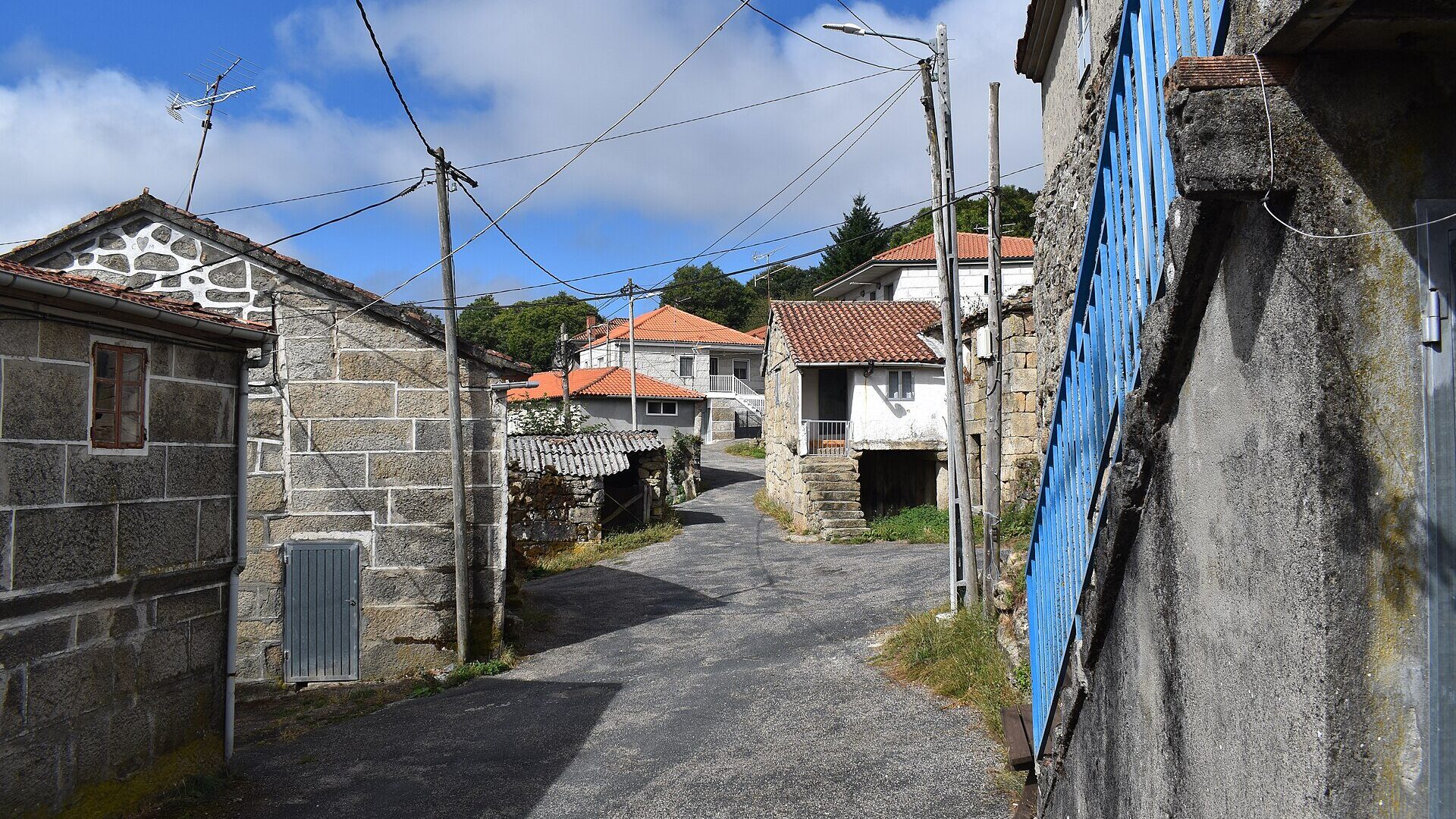
The Raíña Loba and her castle on the crags of Covas (Os Blancos)
On the crags of Covas, at about 1,150 metres, there was a rocky castle where a cruel queen lived who charged a calf, a sheep and a pig every day; the nobles of Pexeirós stormed it at night and put an end to her.
On the Penedo da Raíña Loba (Rock of the She-Wolf Queen), in the parish of Covas (Os Blancos), at about 1,150 metres altitude, locals say there was a rocky castle where a cruel queen lived. The legend explains the hill’s name and tells how her rule ended [1].
The place
The castle, of the rock-built type, would be dated to the 13th or 14th century according to the source. No wall remains survive, because the stones were reused by the neighbours for their houses. A well carved into the rock, which can hold about 5,000 litres of water, does survive; a circular hand mill and pottery fragments have turned up, and on one rock a "nine-men’s alquerque" game is carved [1]. About a thousand metres away there is another hillock, the Castelo Vello, also full of granite boulders, where according to the informant people also lived and stone walls and foundations could be seen [1].
The legend
In 2014 the author of the source spoke with the neighbour who was born in Covas and now lives in Xinzo. When he suggested that the name came from the wolves that roamed there (there were so many that hunts were organised from Xinzo to corner them at the Foxo do Lobo, of which remains survive), the man replied: "the queen existed". According to him, she was cruel and wicked and everyone feared her; she forced the farmers to bring her every day a calf, a sheep and a pig, and anyone who refused she killed and burned their house and crops [1].
One day, tired of the abuses, the people of Pexeirós gathered, agreed to put an end to her and stormed the castle at night, killing its inhabitants as they slept. It is not known how the queen died: some say she was put to the sword and others that, cornered, she threw herself from the top of the tower [1]. A verse survives from the event: "Fidalgos de Pexeirós / matastes á Raíña Loba / Fidalgos quedastes vós" (Nobles of Pexeirós, you killed the Raíña Loba, nobles you remained) [1].
Other versions
- Florentino López Cuevillas collected in 1956 a version in which the queen levied tribute from the neighbouring villages and the neighbours, taking advantage of an oversight, pushed her so that she fell to her death; the verse names Cuquexos and Pexeirós [2].
- The blog As tradicións da Limia tells that in the 1990s a shepherd attributed the crags to the Moors and that, seen from Xinzo, the crags trace the silhouette of a reclining woman (face, nose, chin and hands), "until she wakes" [3].
- In Parada do Monte (Lobeira, outside A Limia) it is told that the Raíña Loba stopped on a day of indisposition on her way to A Limia, gave birth and founded nearby the place of Lobeira, which explains the name [4].
To learn more
The Penedo da Raíña Loba is in the concello of Os Blancos, near the border with Calvos de Randín. The Cunca spring, in the surroundings, also has legends about the shape of the crags, which some attribute to giants and others to apparitions at the foot of the rocks [2].
The 2020 children’s book
The legend inspired an illustrated book, A Raíña Loba, a children’s tale by Manuel Seoane, president of the Centro de Cultura Popular do Limia, published in 2020 by the Ourense Provincial Council in collaboration with that centre and the Museo da Limia. It has illustrations by Moisés Míguez, a student at the Escola de Arte Antón Faílde, and design and layout by Tonho Ferreiro. It collects and interprets the oral tradition about events in that territory between Os Blancos and Baltar, and is the third instalment of a series of illustrated children’s books on the legends of A Limia, after A lenda da Lagoa de Antela, by Delfín Caseiro, and O paso do Esquecemento, by Antón R. Coello [5]. The Provincial Council’s agreement with the Limia groups also included four publications, the annual edition of the magazine Lethes for four years and the digitisation of the Biblioteca da Limia, part of the Museo da Limia [5].
Links
Sources
- Xabier Moure Salgado, «O Castelo da Raíña Loba», Galicia Encantada, xullo de 2014. https://galiciaencantada.com/lenda.asp?cat=7&id=2378
- «Penedos da Raíña Loba» e «A fonte da Cunca», Fronteira Esquecida Limia-Lima; cita Cuevillas, «Un nuevo castillo de la Reina Loba», Boletín da Comisión de Monumentos de Ourense XVIII (1956). https://fronteiraesquecida.eu/gl/fichas/penedos-da-raina-loba-2/
- «Tres contos de mouras e mouros», As tradicións da Limia, 12/05/2021. https://tradicionsdalimia.es/tres-contos-de-mouras-e-mouros/
- «A Raíña Loba e a orixe de Lobeira», Galicia Encantada. https://galiciaencantada.com/lenda.asp?cat=19&id=145
- Deputación de Ourense, «A obra A Raíña Loba, de Manuel Seoane, relato infantil sobre a tradición ancestral limiá» (25-11-2020). https://www.depourense.gal/index.php/actualidade/5387-a-obra-a-raina-loba-de-manuel-seoane-relato-infantil-sobre-a-tradicion-ancestral-limia
You may also like
 LegendMoors of A Limia: treasures, broken secrets and enchantmentsThe legends of Moorish men and women in A Limia: the mouras of Treboal, the Covelas mine, the gold cart of A Touza, the Moors' girl, the…
 LegendLegends of the Torre do Castro and SandiásThe legends of the Torre do Castro and Sandiás: the Moors' tower and the hammer that made the Lagoa de Antela, the treasure in the well,…
 LegendLegends of Vilar de Barrio: xianas, Moors’ holes and the Lagoa de AntelaLegends and tales of Vilar de Barrio: the xianas of Arnuíde, the Moors' holes at Bóveda with the twelve chicks, the Pozo dos Mouros at…
 LegendLegends of Vilar de Santos: the Mariquiña, Santa Marta and the St John’s snakeLegends of Vilar de Santos: the moura Mariquiña of Monte das Cantariñas (Laioso), Santa Marta and the Castelaos serpent, St John, the…
LegendLegends of Xinzo de Limia: the Lethes, Trandeiras, the Torre da Pena and the river mourasLegends of Xinzo de Limia: the river of oblivion, the Virgin and Xoán Folgoso at Trandeiras, the moura of the sieve at Lamas, the moura of…
 LegendCrags, healing stones and humorous tales of A LimiaThe Arangaño rock for curing children, the stones of the moura of Nocelo da Pena, the ears of Monte de Rubiás, the crags of Meaus and…
