

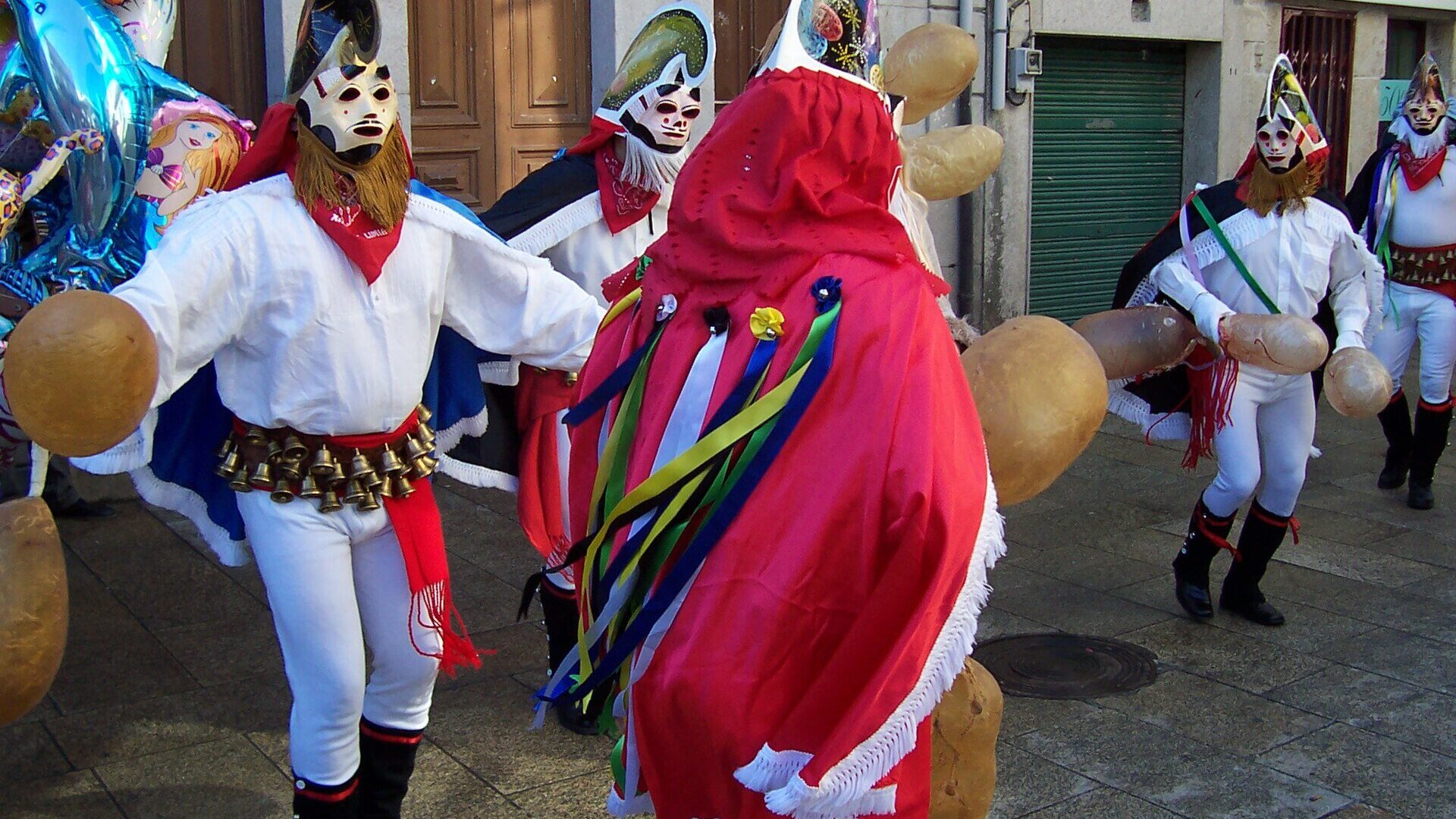
The manturreiro and the Entroido of Boado
The Entroido of Boado (Xinzo de Limia) and its manturreiro, the night mask that scared people in their homes: costume, actions, the rope with Pidre and the revival by the Tras-la-Xas association, per Camilo Vila García (2010).
- Where
- Boado (Xinzo de Limia)
- Mask
- Manturreiro (manturrieiro)
- Costume
- Manturria, carapucho, belt, stick and basket
- Study
- Camilo Vila García, 2010
The manturreiro (in the proceedings, manturrieiro) is the most feared mask of the Entroido of Boado, a parish of the concello of Xinzo de Limia. Camilo Vila García studied the mask and the whole Entroido of the village in the paper "O manturreiro no entroido en Boado", published in the proceedings of the III Congress of Galician Ethnographic Heritage, titled O ciclo do entroido: de práctica social comunitaria a obxecto de estudo etnolóxico (Ourense, Deputación de Ourense, 2010, pages 65–72) [1][2]. The full text of the paper, reproduced with the author’s permission, is at The manturreiro in the Entroido of Boado: full text. This page summarises that work and the complementary description in the blog As tradicións da Limia [3].
Boado and the Tras-la-Xas association
Boado is a village about three kilometres from Xinzo, watered by the rivers Bea and Limia. The author proposes that the place name comes from a Celtic root meaning "still water, pond, spring", since the village has around twenty springs and sources. At the time of the study about a hundred people lived there, more than half over 65, living mainly from farming (potatoes and cereal) [2].
The work stems from the Cultural, Rural Development and Camino de Santiago Promotion Association "Tras-la-Xas", created unofficially in spring 2007 and officially in 2008, which takes advantage of the Portuguese Way passing through and recovers ethnographic resources such as a centuries-old oven that became the axis of the village’s social life (magosto, Noiteboa dos Mozos, Epiphany Eve, biggest-potato contest and, finally, the Entroido) [2]. On the Camino, see The Camino de Santiago through A Limia.
The Entroido of Boado through the 20th century
According to residents’ memories, the Entroido existed in Boado before the Civil War, with celebrations on the two Sundays before Lent. Banned by Francoism until 1955, it revived in 1942 as a rural, home-made festival, with costumes and entertainment made at home; the 1950 one is still remembered as famous throughout the comarca. When the ban was lifted, Boado’s went into decline: Xinzo’s offer was much bigger and the return of emigrants, from the second half of the 1960s, tilted people towards a more massive Entroido. Mr Silvestre, who kept the festival going by playing at the Aira dos Moitos, beside the cruceiro, stopped playing, and record players replaced the bagpipers and the lateiras who played on pepper tins. The last testament performed in Boado was that of 1981 [2]. The author sees in Xinzo’s pantalla a symbol of the festival, but also a centralising force that gradually finished off village entroidos [2].
The Entroido cycle
- Corredoiro, Fareleiro or chirnas Sunday. It began with a mass and a big bonfire between the cruceiro and the Aira dos Moitos; the game consisted of smearing people with chirnas (half-burnt wood remains), ash or bran and coming out clean, with refuge behind a stone wall [2].
- The week of scaring. The vellos das chocas ran through the village with cowbells around their backs and, at night, the lads scared above all the marriageable girls, sometimes pretending to be thieves; this gave rise to legends such as that of the assaulted spinning-party [2].
- Entroido Sunday. Mass, then the visit of people from neighbouring villages (Pena, Soutelo and, above all, Pidre), whom the Boado people received dressed as feas (ugly ones); the visitors dressed well that day [2].
- Monday. A quiet day; only at dusk did the boldest go out, who might enter the girls’ looms and kitchens [2].
- Entroido Tuesday. The order was reversed: the Boado people, as bonitas (polka-dot costume), went to Pidre, where they read the testament [2].
- Ash Wednesday. End of the festival and start of Lent, with the most solemn mass of the year [2].
Among the costumes, the study cites men’s (straw scarecrow, Civil Guard, cow or mule with two people under a blanket), women’s (feas, bonitas or gypsies, Spanish, period costumes), reed carozas and caruchos with their hood, and the farrumeiros, the simplest costume, made of old rags, which children also wore [2].
The rope with Pidre
The greatest attraction was the verbal confrontation with the neighbouring village of Pidre, a kilometre away. The Pidre people reached the outskirts of Boado and found a rope stretched across the path, symbolising that they could not pass; from there they exchanged verses, one from each side, in the manner of the regueifa. Whoever lost the dialectical fight was mocked for a year, so there were highly esteemed improvisers, such as Tío Soutelo ("the king of the Boado Entroido") and Antonio Furela. The author records a verse by Ángela Iglesias, the last figure of the genuine Boado Entroido: "Se me facedes o favor / retirades a cordela / porque se non a quitades / chega o sangre a Pontecela" [2].
The manturreiro
The author describes the manturreiro as the most important and feared character of the Boado Entroido. He entered houses, above all the hearths where people gathered, and, in the latest times described by the author, taverns, and scared everyone present: his wrath was aimed at women, whom he tried to undress, and at children [2]. He also acted in the street, where anyone daring to walk on the marked days got a fright [2].
- The manturria: a cloak made from leftovers of other garments or from old rags, covering the whole body; its parts were the carapucho (on the head), the back and the chest.
- The rope, with the knot that forms the carapucho and hides the face.
- The belt, normally leather, to tie the manturria at the waist.
- The shawl, covering the back, black or coloured.
- The stick, the main tool for scaring, best with a point.
- The basket, where they carried ash, flour or dry straw to dirty people.
- Cowbells (optional): according to popular wisdom, one current says they did not wear them to keep secrecy and another that they did, because the point was to be noticed.
- It was common to impregnate the costume with excrement or mud for a more macabre look.
They went out at night or at dusk, never by day, because the point was that, once the Entroido was over, nobody knew who the manturreiro had been and people argued whether it was one person or another [2].
The revival
With the decline of the local Entroido, the manturreiro disappeared. The real revival of the Boado Entroido and its emblematic figure was one of the association’s aims, starting with the village gathering at the festival, snacks for all, the reappearance of the manturreiro and the reading of the Entroido verses [2]. The blog As tradicións da Limia confirms that Boado’s youths revived the mask in 2010 and 2011 [3].
Links
- The Entroido of Xinzo
- Full text of Camilo Vila García’s paper
- Domingo Fareleiro
- Testaments of the donkey and of the Entroido
- Pantalla and masks of the Ourense Entroido
- Boado
Sources
- O manturreiro no entroido en Boado (Camilo Vila García, Dialnet). https://dialnet.unirioja.es/servlet/articulo?codigo=7238588
- O manturreiro no entroido de Boado, en Actas do III Congreso de Patrimonio Etnográfico Galego, pp. 65-72 (Deputación de Ourense, 2010). http://revistas.biblioteca.uvigo.es/libros/ACTAS_III_CONGRESO_ETNOGRAFIA.pdf
- Aclaracións sobre textos «collidos prestados» sen nomear ao autor – O MANTURREIRO (Tradicións da Limia). https://tradicionsdalimia.es/aclaracions-sobre-textos-collidos-prestados-sen-nomear-ao-autor/
You may also like
 Entroido of Xinzo de LimiaThe Pantalla among the masks of the Galician Entroido: peliqueiros, cigarrones, felos and vergalleirosThe Xinzo Pantalla shares a family with the Ourense masks: the peliqueiro of Laza, the cigarrón of Verín, the felo of Maceda and, in A…
 Entroido of Xinzo de LimiaThe FESMOU Entroido Gathering in Xinzo: traditional masks from all over GaliciaThe Xuntanza de Entroidos, known as FESMOU, brings together in Xinzo de Limia more than 30 traditional entroido groups from all over…
 Entroido of Xinzo de LimiaVocabulary of the Pantalla: parts, curls and making processesThe names of the parts of the Xinzo Pantalla (corno, rizo, faldón, barba, fleco, pano picado) and of the making processes (empapelar,…
Entroido of Xinzo de LimiaWills and shares of the donkey: Cortegada, Gudes and CongostroThe Entroido wills of A Limia: that of Cortegada (1947), the sharing out of the donkey of Gudes and the will of the Brea family's donkey…
Entroido of Xinzo de LimiaThe vergallo and the bell belt of the PantallaThe lost vergallo of the Xinzo mask, the belt of bells and jingles that announces the Pantallas and the belt-makers who made it, with…
Entroido of Xinzo de LimiaThe sounds of the Pantalla and Vicente Risco’s riddle about the cigarrones in XinzoWhat a Xinzo Pantalla sounds like: the belt of bells and jingles, the guttural "O" sound and the hunt for an acquaintance as far as the…
