

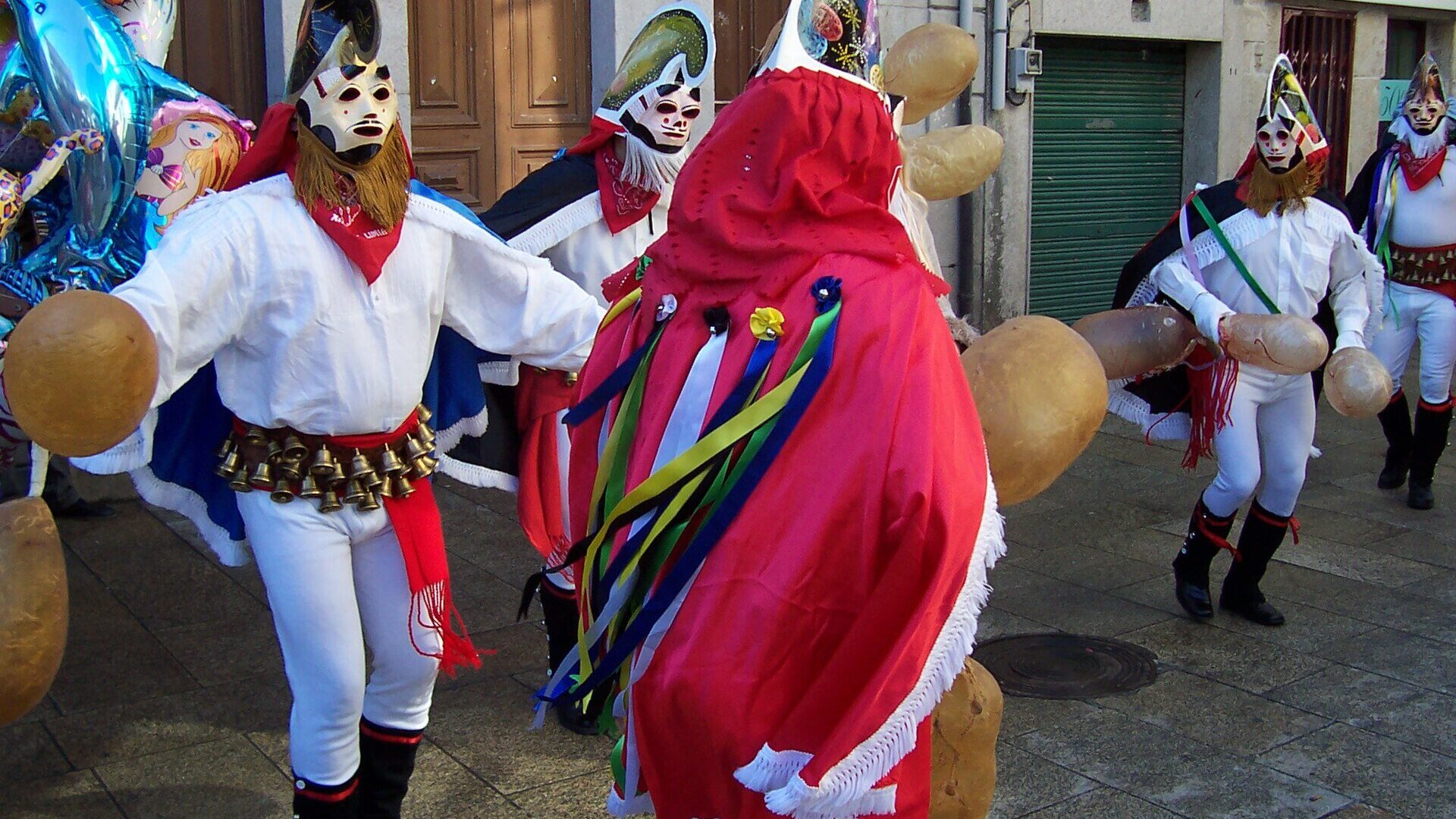
The Xinzo Entroido in memory: 1889, Casares, the A Pantalla association and the blind singers of the fairs
Archive texts on the Xinzo Entroido: the 1889 chronicle, Carlos Casares as Entroido devotee and chronicler, the Cultural Association A Pantalla (1996), the blind singers of the fairs and the tourist-interest designations of 1997 and 2019.
The Entroido of Xinzo de Limia has a written archive wider than one might think. This page gathers the oldest documentation, Carlos Casares’s memories, the history of the association that defends the Pantalla and a trade of the fairs that has disappeared: the blind man who sang verses.
The first chronicle: 1889
The Entroido, popular in character and opposed to abuses of power, left few traces before the 20th century; that is why an article published in March 1889 in El Eco de Galicia (Lugo) on the "Carnestolendas" in Xinzo is exceptional [1]. Carnestolendas and Carnaval are old synonyms; Entroido derives from the Latin intruitus ("entry" of Lent), already an "antiquated word" in 18th-century Spanish, and for that reason is the most fitting term for Xinzo’s ancestral festival [1]. The chronicle does not mention the pantallas, but describes two elements [1]:
- A farmer walked the streets covered in official paper (notaries’ paper), with only the tip of his cap showing and a sign reading «Fruta del tiempo en Ginzo» (quote); several groups cheered the "mask".
- A troupe mimicked opportunistic politics in a gardener, with morality dragged along by a skinny horse.
The author of Vía Lethes interprets that critical tone: it was the only time of year when farmers could mock, in public, though with sarcasm, the local bosses and mayors [1].
Tourist interest
The Entroido was declared a Festival of National Tourist Interest in 1997 and a Festival of International Tourist Interest on 14 January 2019, culminating a process begun in 2013 by the Culture Department; it was the first festival in Ourense with that recognition and the fourth carnival in Spain to have it, after those of Tenerife, Cádiz and Águilas. It is the longest carnival cycle in Spain, a month, and The Guardian published in January 2018 a gallery on Fareleiro Sunday [2].
Carlos Casares at the Entroido
According to Edelmiro Martínez Cerredelo, Carlos Casares was not an Entroido devotee in his youth, but two photos of him in costume survive: in 1959 as a shoeshine boy, with Manolo Dobaño as a clothes-cleaner, and in 1962 in a group of students of the Colegio Santa Mariña [3]. As an adult he came almost every year on Entroido Tuesday to see the parade and gather anecdotes for his column "A Marxe" in La Voz de Galicia. On his last visit (2002) he wrote three chronicles: "O Entroido de Xinzo" (14/02/2002), in which he tells that he dressed as a pirate, that he saw "three priests, a cardinal with a goliard’s face" and that the pantallas’ parade seemed short to him, and "Disfrazado de KGB" (15/02/2002) [3]. He also recalled "those sermons of Don Cesáreo" that sent everyone to hell on the first Sunday of Lent [3].
The Cultural Association A Pantalla (1996)
It was born at the 1996 Entroido, with minutes drawn up that summer, signed by Jesús Fariñas Diz, Daniel Rodríguez Enríquez and Jorge Gómez Fidalgo, who formed the first board (with Carlos Asensio Fernández as treasurer). It seeks the promotion, dissemination, protection and training of the Pantalla: information campaigns, talks and workshops to make the masks and traditional elements, collaboration with the Museo Galego do Entroido, an archive of old materials and the recovery of disused elements (capes, gaiters, belts, percalines, sashes). It was born from the overcrowding of the Entroido and the deterioration of the Pantalla’s behaviour; it reduced, according to the source, the presence of so-called "espantallos" (scarecrows), and published instructions on how a Pantalla is dressed, what it does and what it must not do [4]. See Anatomy of the Pantalla.
The blind singer of the fairs
In the 1940s and 1950s, the fairs of the 14th and 27th had blind men who told and sang stories, almost always real and gruesome, with a violin, accompanied by a wife or a guide who sold the printed verses; they showed a painted placard, the "maltrana", which they pointed to with a stick. They stood in San Roque street and disappeared in the early 1960s. Delfín Caseiro cites popular blind musicians of A Limia: José Dacal Peaguda ("o cego da Gándara", 1876-1939), Ángel López Villar ("o cego de Sas", 1867-1925), José Lorenzo («o cego da Alberguería» (quote)), José Quintas Ribao ("o cego da Pereira", 1919-2004) and Sergio Ramos Fernández ("o cego de Buxán") [5]. See Fair traders, cinzarradas and proxy weddings.
The tailor "O Fona"
Antonio Sousa, "o Fona", was a popular Xinzo tailor, portrayed by Casares in the chronicle "Un home pequeniño": one of the musicians of the puppet theatre "O Barriga Verde", which performed in Xinzo, had exactly his face and a spectator shouted "O Fona!" [6].
Links
- The Xinzo Entroido Song Contest
- The sounds of the Pantalla and Vicente Risco’s riddle
- Entroido of Xinzo de Limia
- Craftspeople and historic pantallas
- Carlos Casares
- Xinzo de Limia
Sources
- Alexander de los Ríos Conde, «Un Entroido en Xinzo de Limia a finales del siglo XIX», Vía Lethes, 05/02/2017 (cita El Eco de Galicia, 06/03/1889). https://vialethes.es/entroido-xinzo-finales-xix
- «El Entroido de Xinzo ya es oficialmente Fiesta de Interés Turístico Internacional», Vía Lethes, 22/01/2019. https://vialethes.es/entroido-xinzo-fiesta-interes-turistico-internacional
- Edelmiro Martínez Cerredelo, «Carlos Casares no Entroido de Xinzo», Historia de Xinzo, 07/04/2017. https://historiadexinzo.wordpress.com/2017/04/07/carlos-casares-no-entroido-de-xinzo/
- «En defensa da Asociación Cultural A Pantalla», Historia de Xinzo, 16/04/2026. https://historiadexinzo.wordpress.com/2026/04/16/en-defensa-da-asociacion-cultural-a-pantalla/
- «Coplas de cegos nas feiras de Xinzo», Historia de Xinzo, 15/10/2018 (cita Delfín Caseiro, Lethes 7). https://historiadexinzo.wordpress.com/2018/10/15/coplas-de-cegos-nas-feiras-de-xinzo/
- «O xastre Antonio Sousa "O Fona"», Historia de Xinzo, 11/09/2017. https://historiadexinzo.wordpress.com/2017/09/11/o-xastre-antonio-sousa-o-fona/
You may also like
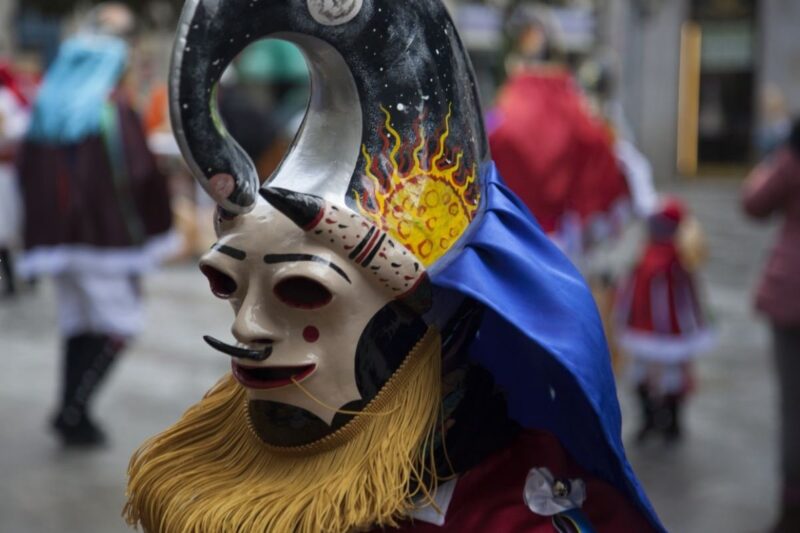 Anatomy of the Pantalla: what the Xinzo Entroido mask looks like and how it is fittedHow a Xinzo Pantalla is made: face perimeter, beard, mouth, eyes, the horn and its dots, the hat and the traditional cut, and how…
 Anecdotes and memories of the Xinzo Entroido: the 1943 jail, a parody and the 2002 photosThree memories of the Xinzo Entroido collected by Pepe Calleja: the neighbours fined and jailed in 1943 for celebrating it, an improvised…
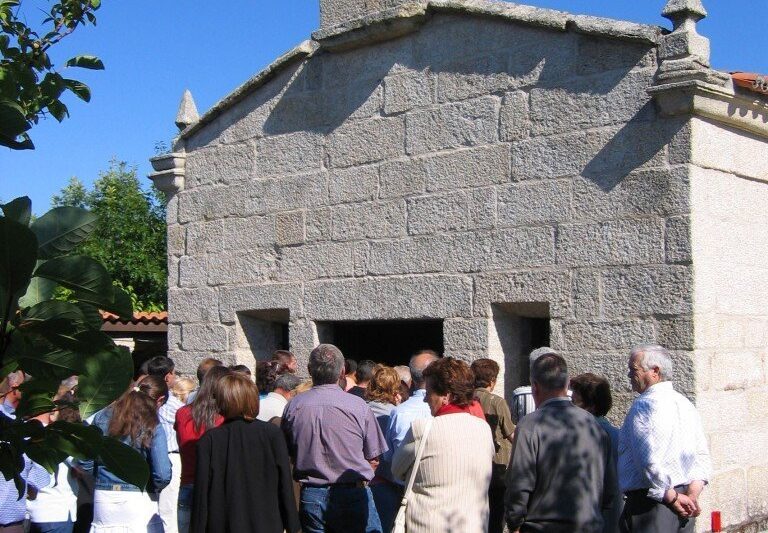 Calendar of patron-saint festivals, pilgrimages and magostos of A LimiaCalendar of the patron-saint festivals, pilgrimages, magostos and traditional fairs of the concellos of A Limia (except Os Blancos), with…
Craftspeople and historic pantallas of the Xinzo EntroidoWho made the Xinzo Pantallas and how the trade was passed on: Pepucho, José Santiago Taboada, Julio Villarino, Celso Lorenzo, Pucho,…
FestivalEntroido of Xinzo de LimiaThe Entroido of Xinzo de Limia lasts five weeks, has the Pantalla as its emblematic mask and has been a Festival of International Tourist…
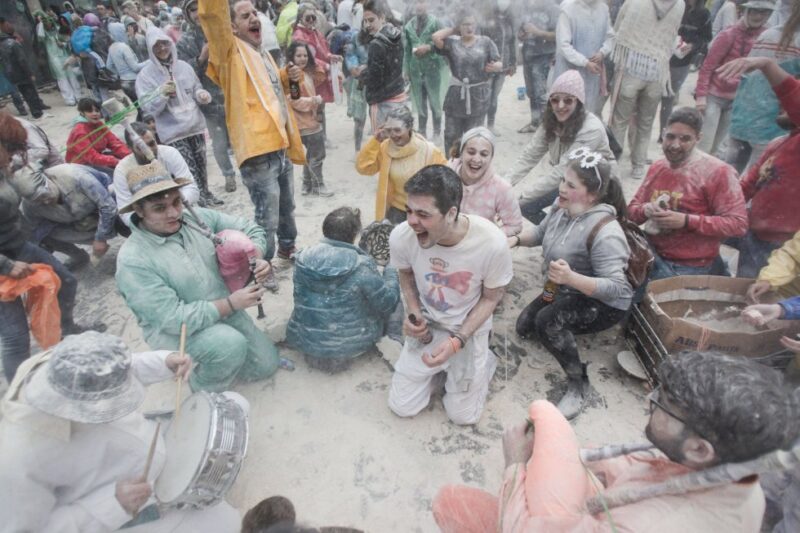 Fareleiro Sunday: the flour battle that opens the Xinzo EntroidoFareleiro Sunday opens the traditional cycle of the Xinzo Entroido with a bran and flour battle in the Praza Maior; it is a day designed…
