

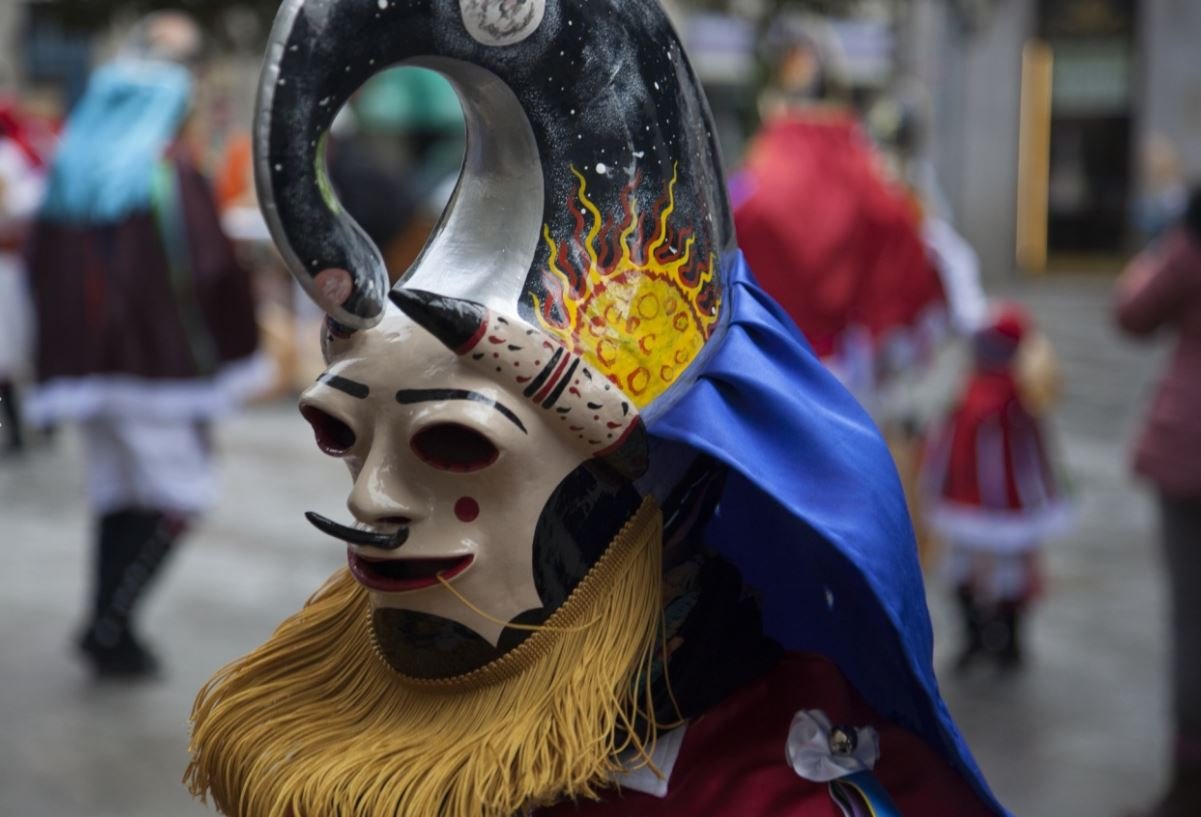
The 1955 Pantalla cape: a dated piece of the Xinzo Entroido
A two-fabric Pantalla cape, red and green, with five groups of ribbons and two embroideries ("CARNAVALES 1955" and "CARNAVALES 1980"), documenting that in 1955 people already went out as a Pantalla in Xinzo, sixteen years after the war.
The cape is the piece of the Pantalla costume that is least studied. A cape kept by a family in Xinzo, studied in March 2024 by Xosé "Pepe" Calleja López and Justo Gude in As tradicións da Limia, has special documentary value: it carries embroidered ribbons with years, the oldest being 1955 [1]. The study warns that it is a jewel and that not all capes of the period were made to the same standard.
How it is made
The cape is double: two fabrics sewn together, the red one (the front, where the bows and ribbons go) and a green lining. It is not cut in one piece: it has a central seam dividing it into two halves of 86 cm, and measures 172 cm wide (178 with the perimeter fringe) by 75 cm high, plus a 4 cm collar, from which two 35 cm ties come out to fasten it round the neck. It weighs 450 grams. Around the collar it has three small finishing seams on each side of the central seam to give it a round shape, and the 3 cm dark blue fringe runs round the whole perimeter except the collar [1].
Bows and ribbons
On the front there are five groups of ribbons springing from as many 4 × 4 cm bows around the collar. The corner ones are in a range of greens; the next two go from violet to light pink; the central one is the most unusual, in blues. Each group has five ribbons in varied colours (green, pink, yellow, blue, white, red…) between 2.3 and 7 cm wide and between 53 and 60 cm long, all with serrated ends [1].
The embroideries
Two ribbons carry embroidered white letters. The one in the central group, 7 cm wide, reads "CARNAVALES 1955" and must be the date the cape was made, because all the groups have five ribbons except the one with the second embroidery: a sixth ribbon added later, light blue, reading "CARNAVALES 1980", the year in which, according to the family, father and son first went out together as Pantallas [1].
What it proves
The study stresses that 1955, sixteen years after the Civil War, showed that going out as a Pantalla had been normalised in Xinzo. We know of people imprisoned earlier for going out to revel at the Entroido (see the 1943 Entroido), but this cape puts a firm date on a Pantalla going out in 1955. Who made it is not known: perhaps one of the seamstresses working in Xinzo at the time [1]. The family’s pantalla had a horn by Quique Suárez (Quique de Barcelona) [1], one of the craftsmen in craftspeople and historic pantallas.
Links
- Entroido of Xinzo de Limia
- Anatomy of the Pantalla
- Vergallo and bell belt
- History of the Xinzo Entroido
Sources
- «A CAPA DE JOSE LUIS CASTRO BECERRA. ANO 1955 – Tradicións da Limia», As tradicións da Limia. https://tradicionsdalimia.es/a-capa-de-jose-luis-castro-becerra-ano-1955/
You may also like
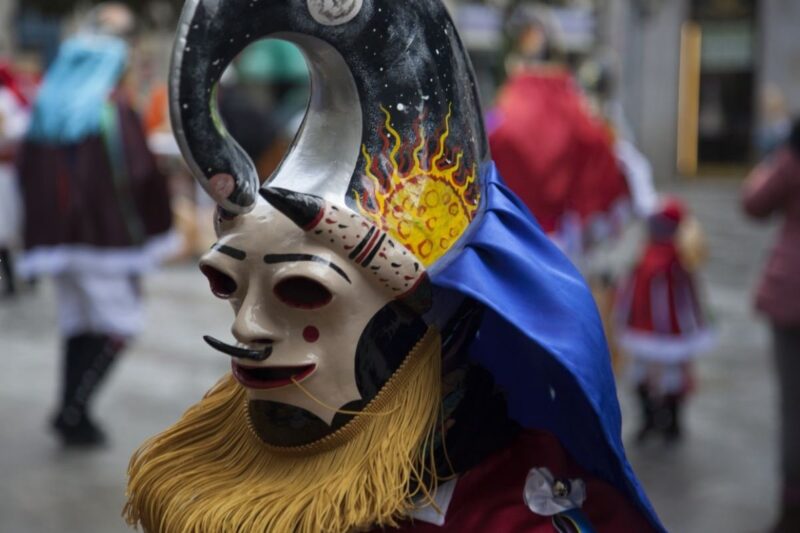 Anatomy of the Pantalla: what the Xinzo Entroido mask looks like and how it is fittedHow a Xinzo Pantalla is made: face perimeter, beard, mouth, eyes, the horn and its dots, the hat and the traditional cut, and how…
 Anecdotes and memories of the Xinzo Entroido: the 1943 jail, a parody and the 2002 photosThree memories of the Xinzo Entroido collected by Pepe Calleja: the neighbours fined and jailed in 1943 for celebrating it, an improvised…
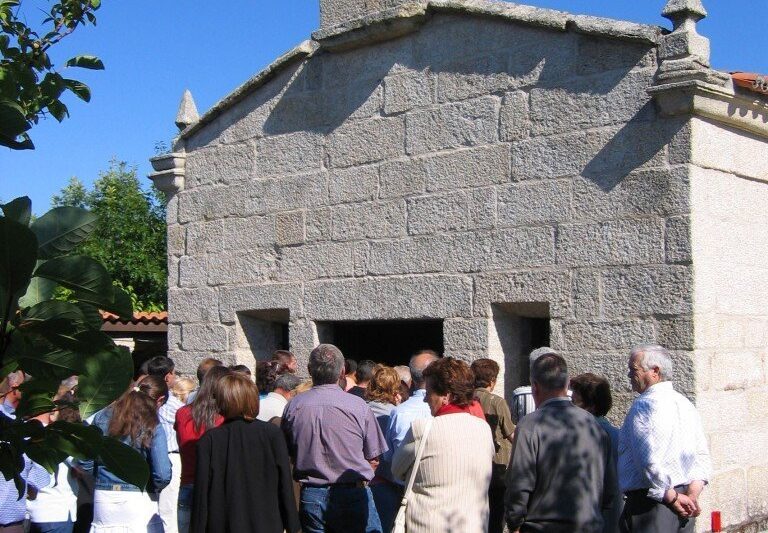 Calendar of patron-saint festivals, pilgrimages and magostos of A LimiaCalendar of the patron-saint festivals, pilgrimages, magostos and traditional fairs of the concellos of A Limia (except Os Blancos), with…
Craftspeople and historic pantallas of the Xinzo EntroidoWho made the Xinzo Pantallas and how the trade was passed on: Pepucho, José Santiago Taboada, Julio Villarino, Celso Lorenzo, Pucho,…
FestivalEntroido of Xinzo de LimiaThe Entroido of Xinzo de Limia lasts five weeks, has the Pantalla as its emblematic mask and has been a Festival of International Tourist…
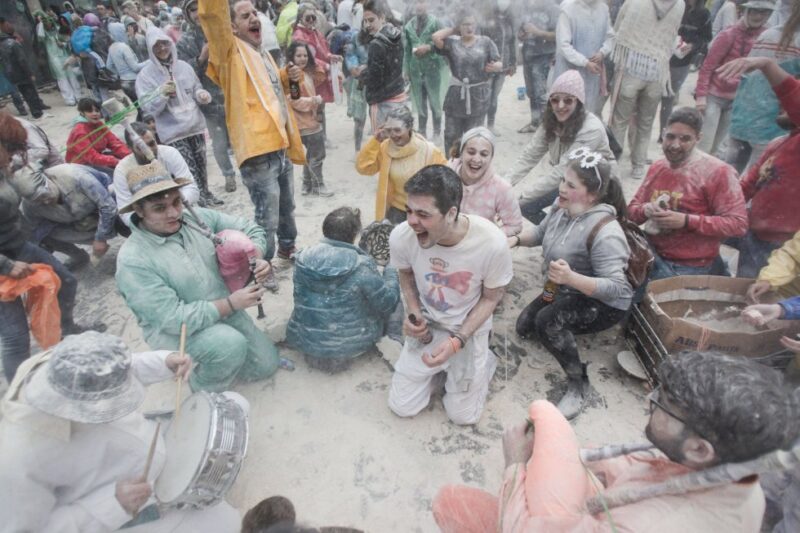 Fareleiro Sunday: the flour battle that opens the Xinzo EntroidoFareleiro Sunday opens the traditional cycle of the Xinzo Entroido with a bran and flour battle in the Praza Maior; it is a day designed…
