

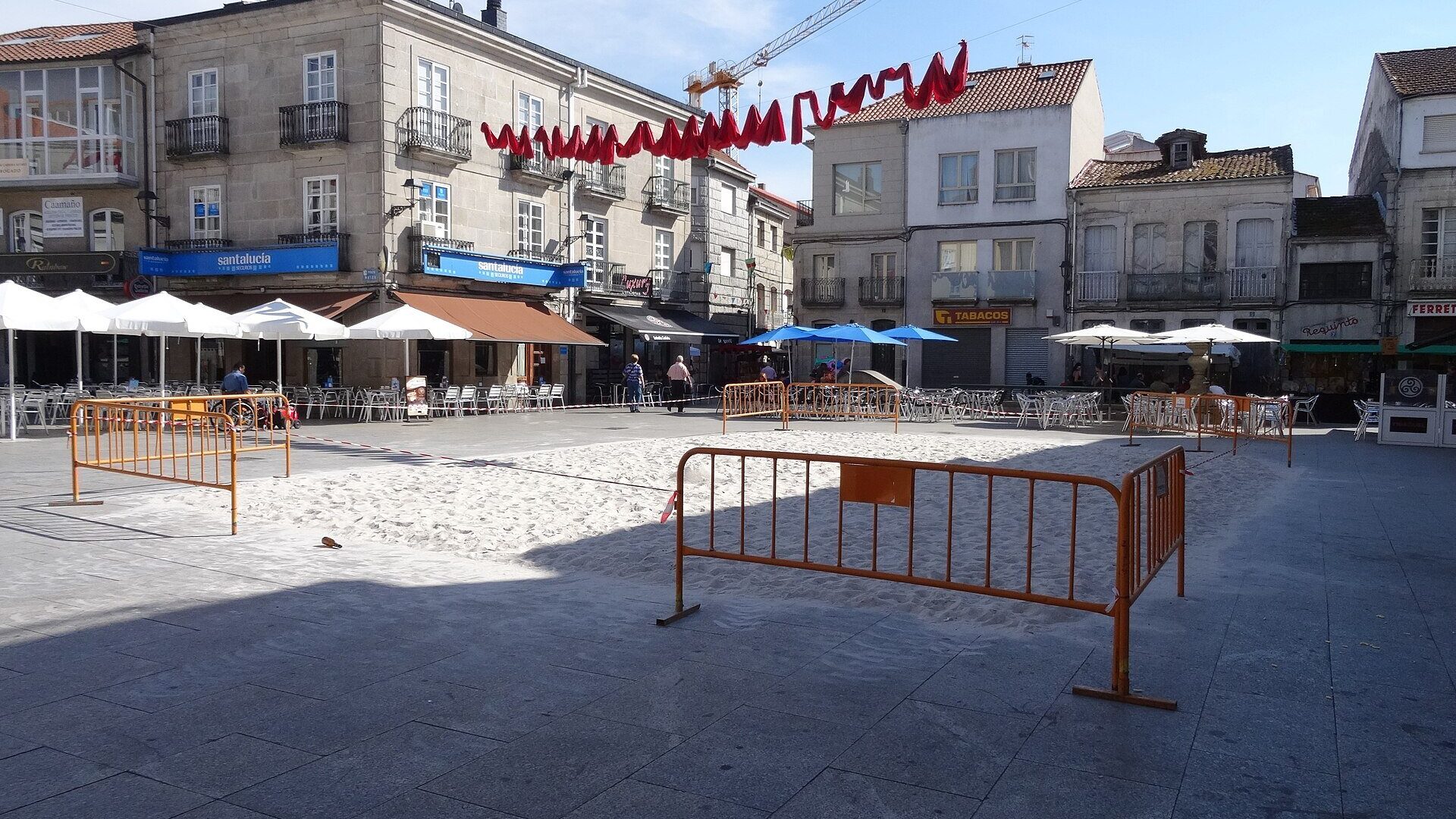
Fair traders, cinzarradas and proxy weddings: customs of old Xinzo
Three customs of 20th-century Xinzo told by Edelmiro Martínez Cerredelo: the traders at the fairs of the 14th and 27th and Remy of the snakes, the cinzarradas for widowers and the proxy weddings of emigrants to America.
Three pieces by the historian Edelmiro Martínez Cerredelo record customs of 20th-century Xinzo that no longer exist or have changed greatly: the world of the fair traders, the cinzarradas and the proxy weddings.
Remy of the snakes and the fair traders
The Xinzo fairs of the 14th and 27th of each month were, until a few years ago, the most important in the province. Pickpockets, three-card tricksters (the best known was the Titá) and patter-merchants like Mario wandered among them, entertaining the locals with auctions and the sale of goods [1]. Quack healers, like Remy, set up in San Roque street, one of the busiest: she wore snakes round her neck, sold ointments "for rheumatism" and spread the cream on the tanned skin of arms. According to Cesáreo Rúa, she announced: "¡una a tres pesetas y dos a un duro y al que compre dos se le regala uno más que son tres!" ("one for three pesetas and two for a duro, and whoever buys two gets one more free, which makes three!"). She repeated "¡Vergüensa me dá! ¡Que no me conozcan!" ("I’m ashamed! Let them not know me!") and called her assistant: "¡Felipeee! ¡saca la culebraa!" ("Felipe! bring out the snake!"). Alfonsito Villarino remembers one of her harangues, that of the lizard who fights the snake and goes to find the thistle (white thistle, cuckoo thistle, cetero thistle) to heal itself, and which ended with "¡NIÑOS PA TRÁS!" ("kids, stand back!") [1].
In summer the lemonade sellers passed by; there were blind singers’ songs and many beggars. Children, when the fair ended, rummaged on the floor of the rye-selling areas for ergot to earn a few coins and, for a few pennies, minded in the yard of the old church under construction the locals’ donkeys, mules and horses [1].
The cinzarradas
The cinzarrada (cencerrada in Spanish) was an unpleasant din made with cowbells, horns and other objects to mock widowers on the first night of a second wedding, while mocking verses were sung. It was also done when an outsider married a local girl and did not pay the young men what was agreed. Old people, widowers and couples of mismatched ages were given cinzarradas. To avoid one, widowers had to invite the young men to the wedding, give a snack and pay a bagpiper; otherwise they married at dawn, but were then subjected to cinzarradas for several nights in front of their house, and next morning found objects such as discarded mule harnesses at their door [2].
In Xinzo there were cinzarradas. On 30 March 1919 a "tragic cencerrada" took place that the press called a "barbaric custom": César Rivero, to whom it was given, came down with his brother Xosé to rebuke the young men, a brawl followed and Antonio Rivero was seriously wounded by several stab wounds, and another person went to jail [2].
The young men turned to Francisco Seijo (see Francisco Seijo Iglesias) to write their verses. His granddaughter Rosa Seijo recovered two. One is the verse to Luisito Conde (O Ruca), a wealthy oculist of Xinzo, an elderly man married to a much younger girl from Allariz: "se casó Luisito y, el año que viene, le saldrán cuernos en toda la frente" ("Luisito married and next year horns will grow across his forehead"). The other, to Rafaela de Pascual, a widow who owned an inn in San Roque street and was married to a younger Portuguese man, the lad Neves: "Rafaela, Rafaela, logo as de romper os tratos, que o amor dos portugueses miáñanche coma os gatos" (Rafaela, Rafaela, you’ll soon break the deals, for Portuguese love miaows at you like cats) [2].
Proxy weddings
In the 1950s and 1960s there were quite a few proxy weddings in Xinzo, in which one of the couple was not in the church and a proxy represented them by notarial power. The reason was emigration to America: the young man left and, to send for the bride, they had to be married; parents would not let unmarried daughters go, and the ship took almost a month [3]. The photos in the article are of the wedding of Manola and Quique Suárez in 1961, in which the groom was represented by his friend Portabales and the ceremony was performed by the parish priest Don Cesáreo Sobrado, with guests and a banquet. Quique later returned to Spain and settled in Barcelona; he came every Entroido to Xinzo and wore his Pantalla, of which he was one of the finest examples. Manola in turn reached Santiago de Chile, where the official portrait was taken [3].
Links
- Curiosities of A Limia
- Xinzo de Limia
- Antonio Nieto Oliva, chronicler of the Xinzo of that time
Sources
- Edelmiro Martínez Cerredelo, «A Remy das cobras e outros feirantes en Xinzo de Limia», Historia de Xinzo, 12/06/2016 (publicado antes en Ourense no Tempo). https://historiadexinzo.wordpress.com/2016/06/12/a-remy-das-cobras-e-outros-feirantes-en-xinzo-de-limia/
- Edelmiro Martínez Cerredelo, «Cinzarradas aos viúvos na vila de Xinzo de Limia», Historia de Xinzo, 05/09/2016. https://historiadexinzo.wordpress.com/2016/09/05/cinzarradas-aos-viuvos-na-vila-de-xinzo-de-limia/
- Edelmiro Martínez Cerredelo, «Os matrimonios por poder: a voda de Quique e Manola en Xinzo», Historia de Xinzo, 21/09/2016. https://historiadexinzo.wordpress.com/2016/09/21/os-matrimonios-por-poder-a-voda-de-quique-e-lola-en-xinzo/
You may also like
 LegendAntioquía, the Drowned City beneath the Lagoa de AntelaBeneath the waters of the Lagoa de Antela would sleep Antioquía, the proud city that God flooded for refusing alms to a beggar. All the…
 Archive stories: the trees of 1755, the three-key chest, the union of 1061 and the 1932 revoltFour documented episodes from A Limia: the royal order to plant trees on common land (1755), the three-key chest of the Xinzo jurisdiction,…
Blind singers’ songs, Ermelinda do Muíño, the pot game and drowned citiesOral and popular traditions of A Limia in the Galipedia: blind singers' songs and ballads, the singer Ermelinda do Muíño (Sas, Sarreaus),…
 LegendCrags, healing stones and humorous tales of A LimiaThe Arangaño rock for curing children, the stones of the moura of Nocelo da Pena, the ears of Monte de Rubiás, the crags of Meaus and…
A Limia, a district of OurenseCuriosities of A LimiaTrue and curious stories of A Limia told with sources: the miser of Xinzo, the Escornabois plague, the Randín fire, the 1878 Paris…
A Limia, a district of OurenseLegends of A LimiaThe legends of A Limia by concello: the drowned city of Antioquía, the Raíña Loba, the mouras and treasures, the Torre do Castro, the…
