

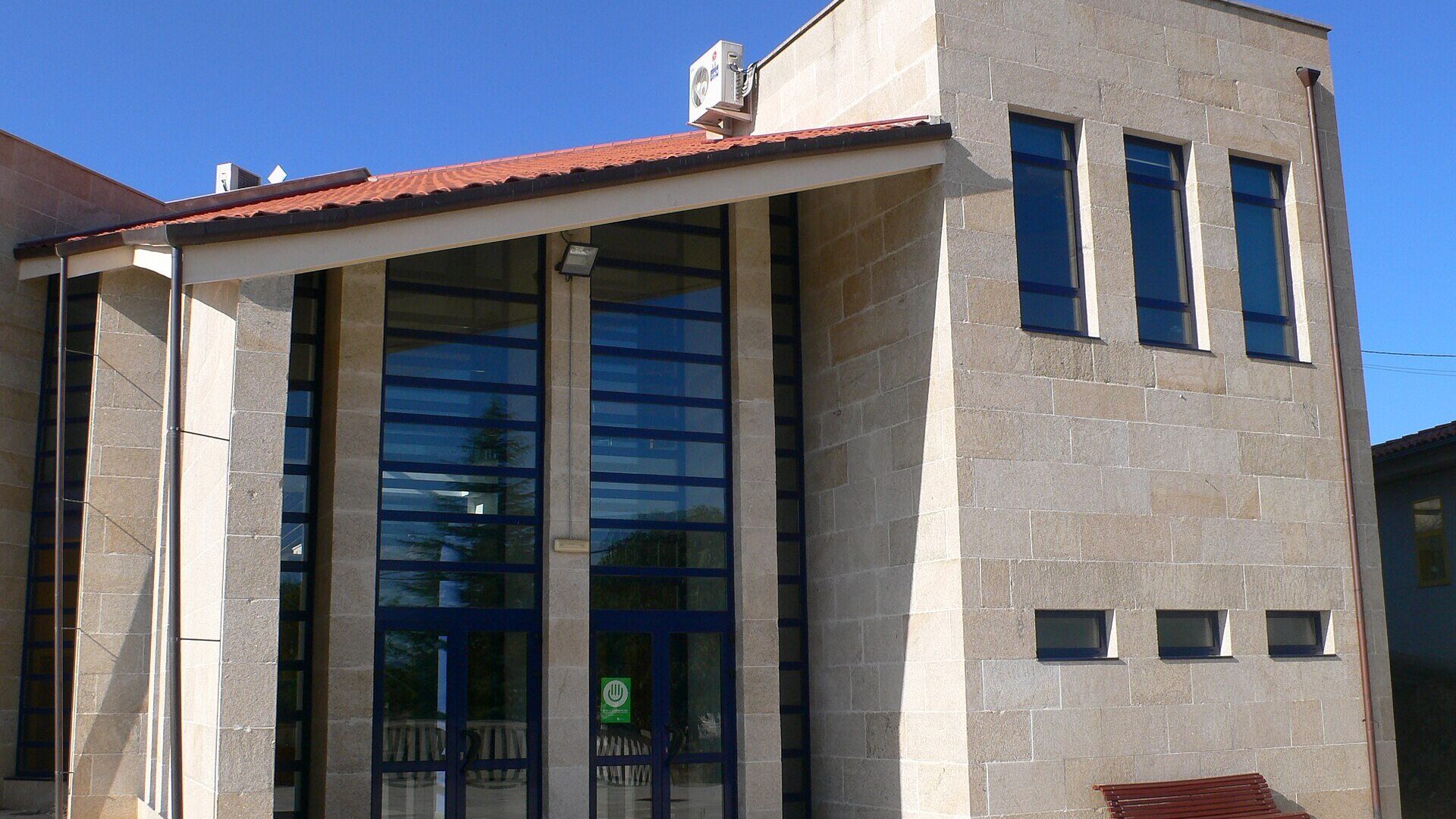
Rural Development Centre “O Viso” of Lodoselo
The CDR "O Viso" of Lodoselo (Sarreaus), born in 1985-1990 from a community process, is a public-utility body with a school-village, hostel, community housing, day centre, social inclusion and anti-depopulation programmes.
The Centro de Desenvolvemento Rural "O Viso" (CDR O Viso) is a non-profit body, declared of public utility, based in Lodoselo, in the concello of Sarreaus, with a second office in Xinzo de Limia (Rúa Ladeira, 21) [2][12]. It grew out of a community development process in a village that was running out of people and today works across the whole A Limia comarca with educational, care, inclusion and anti-depopulation projects [3]. Its website is cdroviso.org.
Origin: from the "O Cruceiro" association to the CDR (1985–1990)
To know the origins one must go back to the cultural association "O Cruceiro", created in 1985 by a group of neighbours to value Galician rural culture; in 1990, through observing the area’s needs and the will to answer them, the Centro de Desenvolvemento Rural "O Viso" was born [1][3]. Its motto, taken from Antonio Gandoy, founder of Preescolar na Casa, is "O que é necesario, ten que ser posible" (what is necessary must be possible) [3]. The project arose in the 1980s, when open councils were still held and neighbours devoted half a day a week to community work (bringing water to houses, mending paths), a circumstance favourable to a community process that spread from Lodoselo and Sarreaus to other villages in the concello, with the involvement of some parish priests [3].
According to the article by Edesio Díaz González (2019), Lodoselo then had about 60 houses open all year; in half of them two people over 65 lived, and in only 16 did three or more people live [3].
Mission and philosophy
The organisation defines its mission as "accompanying the people of rural Limia in development processes that take up the challenge of making the whole person and all persons grow", and its vision as being a reference for the "achievable utopia" in rural Galicia, with an integral strategy aimed at the most vulnerable population of A Limia [2]. Its philosophy draws on community development and the pedagogy of Paulo Freire, and proposes a rural world that is "habitable, not just visitable" [3]. In the early years, before 1990, it ran socio-educational support actions called "Dobleescola" at the village school, and later, in the former rectory, which took the name Pobo Escola hostel, adult education, socio-cultural animation and summer camps [3].
Milestones
- 1985. Founding of the Cultural Association "O Cruceiro" [1].
- 1990. Founding of the CDR "O Viso" [1].
- 1994. The Pobo Escola programme begins [4].
- 1997. "Promoción da Terra" award from the Irmandade Moncho Valcarce [1].
- 1998–1999. The social and community canteen opens (running since February 1999 according to the article) [1][3].
- 2000. The Youth and Community Information Centre opens, which the organisation presents as the only one in Galicia not belonging to a public body [1][15].
- 2002. The Community Housing "A túa outra casa" is inaugurated [1][6].
- 2010. Declared a Public-Utility Entity [1].
- 2012. The Lodoselo Day Centre is inaugurated; "Macario Asenjo Ponce" Rural Development Award in the national category [1][7].
- 2013. Participation in the European Symbios programme [1].
- 2015. The Family Early Childhood Education programme in A Limia is added, successor to Preescolar na Casa [1][11].
- 2017. The Union of Rural Associations "Terra e Xente" is formed, with four centres: Ancares, Euro Eume, Portas Abertas and O Viso [1].
- 2019. The Casa Niño Lodoselo opens, for ages 0 to 3 [1][11].
- 2022. Biocare project (2022-2024) of COCEDER, one of six long-term care innovation projects in the Recovery, Transformation and Resilience Plan, with 19 CDRs taking part [1].
- 2023. AGADER Galician rural development award, social-interest category [1].
- 2026. Its educational proposal with the Seed Bank wins, in the general citizenship category, the 1st Ecosalud Innova Local Contest of the Vivo Sano Foundation [1].
Areas of work
The organisation arranges its activity in four areas [3][2]:
A. Education and environment
- Pobo Escola (since 1994): the village of Lodoselo becomes a school. According to the article, it is "a living museum" in which people, especially the elderly, are the ones who teach rural culture; it offers workshops such as baking bread in the communal oven, spinning, natural dyes, basketry, donkey rides, care of farmyard animals, vegetable garden and greenhouse. On the current website it offers traditional games, a clue game with QR codes, natural spaces (the Poulas de Monelo, a sensory garden) and the Casas da Memoria. Income goes to the organisation’s social programmes [3][4].
- Multipurpose social centre and Hostel: in the restored former rectory, with 40 bunk places, no architectural barriers, for schools, youth groups, the elderly, training and families, with kitchen service and an educational team [3][5].
- Family Early Childhood Education in A Limia and Casa Niño: since 2015, meeting spaces that foster positive parenting, heirs to Preescolar na Casa, which operated in A Limia between 1985 and 2012; in 2019 the Casa Niño opened [1][11].
- Nature Classroom: greenhouse and animals (rabbits, sheep, hens of several breeds, donkeys), seed bank and environmental education "as immersion in reality" [3].
B. Community care (local services)
- Community Housing "A túa outra casa" (since April 2002): supervised accommodation for older people, up to 12 places, all on the ground floor [6][3].
- Lodoselo Day Centre (since June 2012): a socio-therapeutic gerontological centre, Monday to Friday 9:00 to 17:00, with meals, hygiene, physiotherapy, occupational therapy, psychosocial care, podiatry and adapted transport [7].
- Services at your home (since 1999), under the motto "Axúdame a quedar" (help me stay): meals at home, occupational therapy, adapted transport, loan of technical aids and hospital accompaniment [13][3].
- Rural Space for Equality and Women ("ELAS"): shelter and support for women in vulnerable situations, empowerment workshops and campaigns on 8M, 15O and 25N [14].
C. Information and social participation
- Youth Information and Integrated Services Centre (since 2000), of the Galician Youth Information Network, in Xinzo de Limia [15].
- Voluntary action programmes and the European Voluntary Service, with agreements with bodies in Hungary, France, Germany and Latvia [3].
- Tecendo Redes. Coidándo-Nós (since December 2024): itinerant local services in an equipped van, A Tecedoira, to prevent loneliness and foster autonomy, especially of people over 65, funded by the Xunta’s 0.7 % income-tax allocation and the Fundación la Caixa [9].
- Inclusive Communities (since July 2025): a COCEDER programme co-funded by the ESF+ and the Fundación la Caixa, to activate the neighbourhood’s role in mutual care [10].
- Anti-depopulation programmes (since 2018): an information service so local people can offer housing, land or businesses, and support for urban families who want to come to A Limia, through the website volveralpueblo.org; in 2024 a collaboration began with the Concello de Sandiás [8].
D. Social and labour inclusion
- Basic-needs services (since 2013): distribution of food and hygiene products, minor first aid, clothes store and laundry, mainly in Sarreaus, Xinzo de Limia and Trasmiras.
- Integral pathways (since 2013): social and labour inclusion pathways with programmes such as RuralemprégaT and Includere [3].
Reach, funding and network
The 2017 report cited in the article puts the annual reach at 2,500 people in education, an average of 500 in local services, 200 in social and labour inclusion and over 7,000 in information; the organisation had more than twenty professionals on staff [3]. According to the 2016 report, 62 % of funding was public and 38 % own resources, mainly from the community housing, local services and the school-village [3].
The CDR has belonged since 1990 to the Confederation of Rural Development Centres COCEDER, and also to Terra e Xente, EAPN-Galiza and the POIG; it holds agreements with three universities (Vigo, Santiago and Trás-os-Montes e Alto Douro), with the concellos of Sarreaus, Trasmiras, Xinzo de Limia and Sandiás and with schools in the comarca [3][12].
The article’s internal analysis
The social worker who signs the article (Díaz González, 2019) points to dependence on subsidised funds, the personal load falling on the co-founders and the need to renew the board as weaknesses, and to the mutual-aid way of rural life, the own resources of the local services and a multidisciplinary team as strengths [3].
Links
Sources
- A nosa historia en hitos (CDR O Viso). https://www.cdroviso.org/index.php?V_dir=MSC&V_mod=showart&id=47
- Misión, visión e valores (CDR O Viso). https://www.cdroviso.org/cdr-o-viso.html
- Díaz González, Edesio: «Por un medio rural habitado e habitable. C.D.R. "O Viso" comarca da Limia (Ourense)», Fervenzas, n.º 21, 2019, pp. 41-59. https://dialnet.unirioja.es/servlet/articulo?codigo=6966484
- A.1 Pobo escola (CDR O Viso). https://www.cdroviso.org/pobo_escola_lodoselo_gal.html
- A.2 Centro social polivalente e Albergue (CDR O Viso). https://www.cdroviso.org/campamentos_albergue.html
- B.1 Vivenda Comunitaria (CDR O Viso). https://www.cdroviso.org/vivenda_comunitaria.html
- B.2 Centro de día Lodoselo (CDR O Viso). https://www.cdroviso.org/centro_dia_gal.html
- C.4 Programas contra o Despobamento (CDR O Viso). https://www.cdroviso.org/despoboamento.gal.html
- C.3.1 Tecendo redes. Coidándo-Nós (CDR O Viso). https://www.cdroviso.org/tecendo_redes.html
- C.3.2 Comunidades Inclusivas (CDR O Viso). https://www.cdroviso.org/c_inclusivas.html
- A.3 Educación Infantil Familiar na Limia e Casa Niño (CDR O Viso). https://www.cdroviso.org/educacion_infantil_familiar_limia.html
- Pertenza e colaboracións (CDR O Viso). https://www.cdroviso.org/index.php?V_dir=MSC&V_mod=showart&id=25
- B.3 Servizos na túa casa (CDR O Viso). https://www.cdroviso.org/servizos_a_domicilio.html
- B.4 Espazo Rural para a Igualdade e a Muller (CDR O Viso). https://www.cdroviso.org/espazorual_igualdademuller
- C.1 Centro de Información Xuvenil e Servizos Integrados (CDR O Viso). https://www.cdroviso.org/informacion_xuvenil.html
You may also like
 A Limia, a district of OurenseAssociations and organisations of A LimiaAssociations and organisations of A Limia with an entry on this website: Civitas Limicorum, A Pantalla, the Board of the Museo da Limia,…
 A Limia, a district of OurenseEconomy of A LimiaThe economy of A Limia: the weight of the potato and livestock, the food industry, trade and construction, and Xinzo's industrial history…
Economy of A LimiaFlax in A Limia in the 18th and 19th centuries: land, weavers and tradeFlax growing and industry in A Limia according to the Ensenada Cadastre and Madoz: the best land, rotations, weavers by concello, the linen…
 Gasosas Berardo Méndez (Sandiás): 80 years of a Limia factoryGasosas Berardo Méndez, a soft-drinks factory in Sandiás founded in 1945, honoured in 2025 at the Museo da Limia: a talk, a collection of…
 Economy of A LimiaGastronomy of A LimiaThe gastronomy of A Limia: the potato as the star product and its designation, the bread from Xinzo's ovens, the pig slaughter and the…
 Economy of A LimiaPropasi, AGA and the Feculera of Xinzo: the potato industry in the 20th centuryThe history of Propasi and Agrícola Ganadera Antelana (seed potatoes, from the late 1940s) and the Feculera of Xinzo (starch, c.…
