

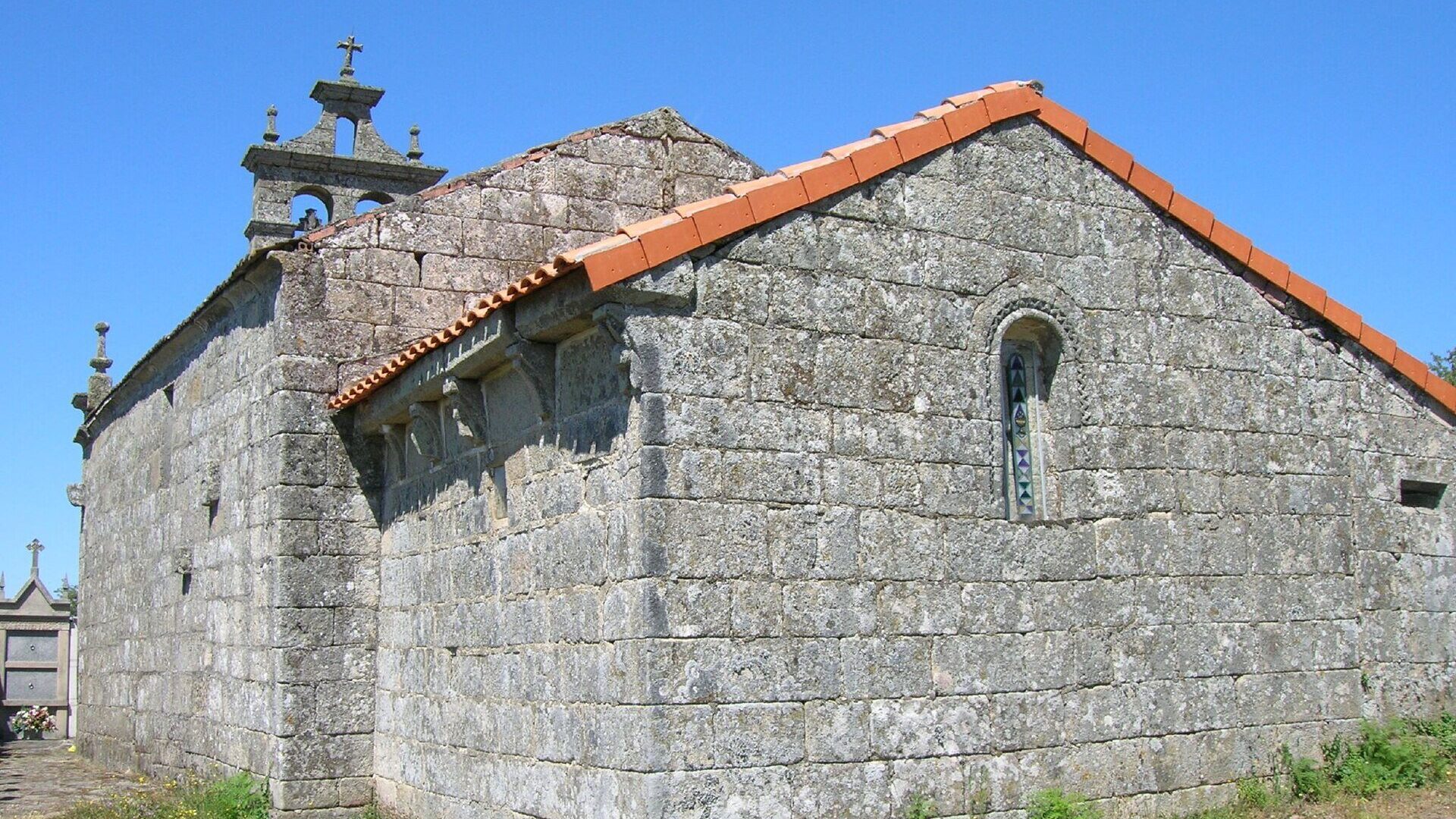
Juan Álvarez Sotelo, the Jesuit from Perrelos Who Wrote the First History of Galicia
Juan Álvarez Sotelo (Perrelos, Sarreaus, 1648 – 1712), a Jesuit, wrote an unpublished General History of the Kingdom of Galicia and a life of St Marina, and was the first to accept a significant Celtic presence in Galicia.
Juan Álvarez Sotelo was born in Perrelos (Sarreaus) on 25 November 1648 and died on 16 June 1712. He was a Jesuit and historian, and early sources say that he «wrote a History of Galicia with great elegance, though lightly» [1].
Life
He entered the Society of Jesus in 1672 and was ordained ten years later. He taught Grammar and Humanities in Monterrei until 1694 and soon afterwards was transferred to Santiago de Compostela [1].
Work
He wrote several works that were not printed, some of which were lost [1]:
- Epílogo de Santa Eufemia.
- Epílogo de la vida y martirio de Santa Mariña de Aguas Santas, an elegant though brief treatise recalled by Muñoz in his Historia de Ourense.
- Predicación y viaje de Santiago a España.
- Historia general del Reino de Galicia, repartida en cinco libros, dealing with the settlers after the Flood, the antiquities and the civil wars in Spain up to the Arab domination. It was left unfinished and is held by the Real Academia de la Historia; there is also a 212-folio manuscript in the Biblioteca Nacional (25-5-C-100) and another was in the hands of José Cornide [1].
Murguía and other authors cite this Historia de Galicia as a valuable work. In the years of transition between the 17th and 18th centuries Álvarez Sotelo, although he maintains that Galicia was settled by the descendants of Noah and by Greek foundations, is the first to accept a significant Celtic presence in Galicia [1].
The visit to Pico Sacro
Bishop José Guerra Campos, who wrote two small books on Pico Sacro, tells that Father Álvarez Sotelo visited it in 1698. He referred to the openings of the mountain’s tunnel, especially the main one, «not the work of nature, as some have been seen, but of men», and that «one corresponds to the other»: a curious man fired an arquebus into the interior from the western side and shortly afterwards the powder smoke came out of the eastern one. He also passed on the account of a 1649 exploration by another Jesuit and an anecdote according to which a man who had been in the Indies and seen the silver mines picked up some stones on the mountain, threw them into a blacksmith’s forge and extracted eight or ten ounces of fine silver, which the silversmiths of Compostela exchanged for him [1].
Links
Sources
- «Padre Juan Álvarez Sotelo (séculos XVII y XVIII)», xinzodelimia.eu (Wayback capture), with quotations from Murguía, Muñoz (Historia de Ourense), José Guerra Campos and the Biblioteca Nacional manuscript. http://www.xinzodelimia.eu/juan_alvarez_sotelo.htm
You may also like
 Notable personOlimpia Valencia López, the First Woman in Galicia to Graduate in MedicineBorn in Baltar in 1898, Olimpia Valencia was the first Galician woman to graduate in Medicine (1925) and in 1928 opened a general medicine…
 People of A LimiaHistorical Figures of A Limia: A TimelineTimeline of historical figures linked to A Limia, from Roman times to the 20th century: Limicians of Rome, Hidatius, counts, medieval…
People of A LimiaPoliticians and Public Officials of A LimiaDirectory of people from A Limia who held public office: Restoration-era deputies for the Xinzo district, Galician parliamentarians,…
 Notable personInés de Castro, the Queen Tradition Says Was Born in A LimiaInés de Castro (c. 1320 – Coimbra, 1355), natural daughter of a Galician nobleman, loved Prince Pedro of Portugal, was executed on Afonso…
 Notable personMartín de Ginzo, the Minstrel of Xinzo de Limia Who Sang the PilgrimageMartín de Ginzo was a 13th-century Galician minstrel, born in Xinzo de Limia, of whom eight cantigas de amigo survive, seven of them…
Notable personMarcus Flavius Sabinus, the Limician Who Became a Priest of the Imperial CultMarcus Flavius Sabinus, of the Civitas Limicorum, was duumvir of his city and provincial flamen of Hispania Citerior in the 2nd century; he…
