

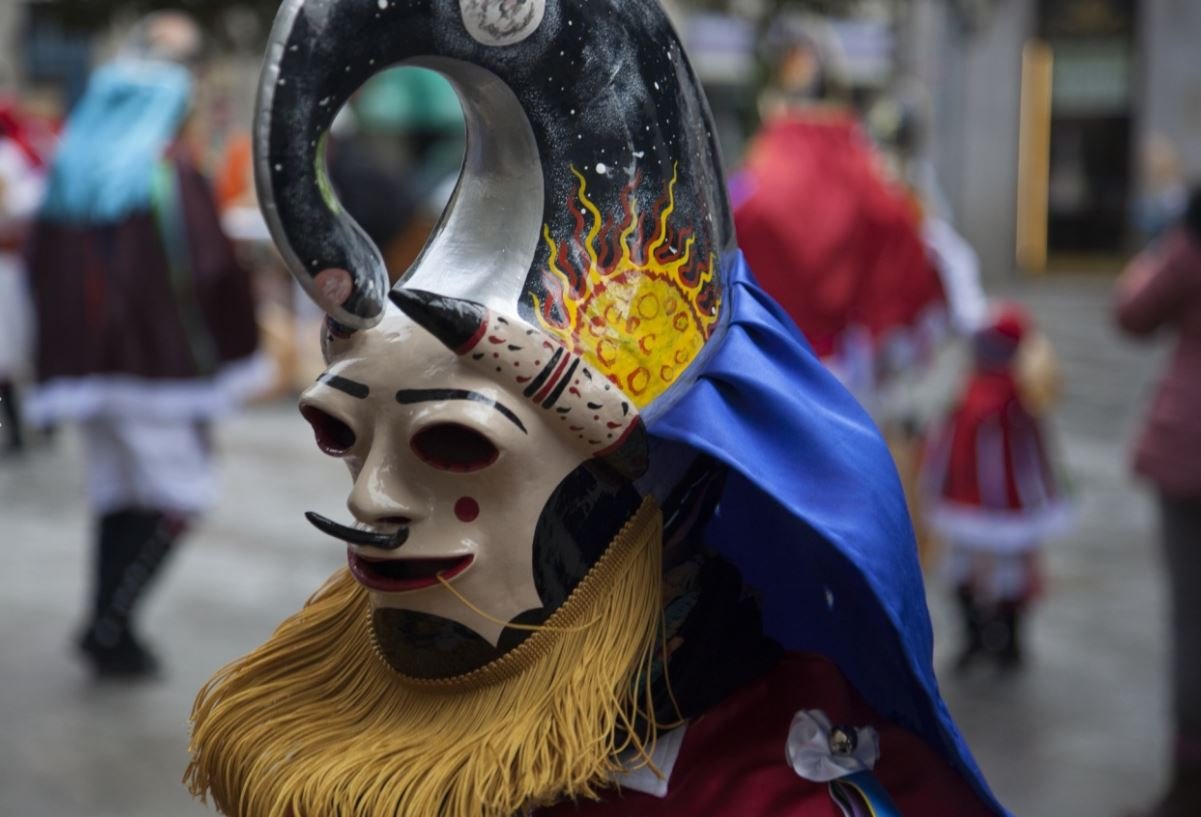
Vocabulary of the Pantalla: parts, curls and making processes
The names of the parts of the Xinzo Pantalla (corno, rizo, faldón, barba, fleco, pano picado) and of the making processes (empapelar, esgazar, engrudo, debullar, aplomar, embolar), from the glossary by Gude and Calleja.
Anyone who studies the Pantalla soon discovers that every part and every step of its making has its own name that was only passed on by word of mouth. Xosé "Pepe" Calleja López, author of the blog As tradicións da Limia, gathered the names of the parts and processes around a glossary prepared by Justo Gude, and warns that not all of them may be included, but that these are the ones used for years. The aim, he says, is that they are not lost: "respect comes from knowledge" [1]. This page complements the one on the anatomy of the Pantalla with the vocabulary.
The two main parts
The Pantalla is made in two pieces that are produced separately until they are joined: the face and the corno (horn), also called the cucurucho (cone) [1].
The corno
- Pantalla: each of the two sides of the corno, where the astral motifs, which are essential, are painted [1].
- Borde (edge): the ribbon running round the whole perimeter of the corno; it can be several colours and aims to stand out from the background [1].
- Faldón (skirt): the widest space of the edge at the bottom, where the cloth is sewn [1].
- Corte (cut): the triangle at the back that adjusts the mask to the size of the head. It is sewn with hemp thread and on children’s and teenagers’ pantallas it can be unpicked and adapted [1].
- Triángulo: a separate piece of card joining the corno and the face above the eyes; it is hard to sew, but gives the mask consistency [1].
- Rizo (curl): the circular piece at the front, above the face. By shape, the types are primitivo (small, circle facing forward), antigo (small, tending to droop), tradicional (bulkier and curled in on itself), Julio Villarino (narrow, non-circular, drooping), lingua (very long and stylised) and Quique Suárez (long and wider, rolled over the triangle) [1].
- Orellas (ears): of felt from the hat brim (sometimes card), with the corno (black tip), the media (where the dots, mostly red and black, are painted), the galóns (horizontal coloured lines) and the base, painted black [1].
- Pano (cloth): the fabric sewn to the whole perimeter of the corno, light blue or red depending on the cape colour. It is always picado (punched): diamond-shaped holes and four-, six- or eight-petalled flowers with a central button, made with folds and scissors [1].
The face
When picking it up, first look at the outside and then the inside, to see the cut of the hat and so identify the craftsman or, at least, the model [1].
- Papo: the lower part of the face. The visible part is the barba (beard), with side waves (patillas) and a central one (queixo), and sometimes horizontal correas (straps) joining them [1].
- Fleco or gorla (fringe): hides the wearer’s throat; it should not be too long so as not to cover the head cloth that Pantallas wear round the neck [1].
- Bigote (moustache): always black, painted or of painted felt or wood [1].
- Ollos (eyes): must allow sight, because visibility with the mask is limited; usually painted red inside, with or without lashes depending on the craftsman [1].
- Coloretes (rosy cheeks): two red circles between the eyes and the moustache [1].
- Cellas (eyebrows): always black, along the edge of the upper eyelid [1].
- Nariz (nose): traditionally triangular or circular, with a single hole; for some years now with a septum and two holes [1].
- Boca (mouth): always red; the cut of the hat decides the size and separation of the lips [1].
Terms of the trade
- Empapelar: covering the whole mask with newspaper (avoiding parts with photos, glossy or very colourful paper). The hat, the corno card and the ears are papered separately and then sewn together [1].
- Esgazar: tearing the paper along the natural direction of the fibres so it comes out uniform [1].
- Engrudo: flour-and-water paste with salt or sugar, heated over a fire so it does not go lumpy [1].
- Enchoupar: soaking the paper with paste so it sticks well [1].
- Vinchocas: air bubbles between the paper and the card or hat, a defect to avoid [1].
- Remendos (patches): the paper marks that paint leaves visible; a Pantalla with many is a remendada Pantalla [1].
- Birolla: the Pantalla that comes out crooked because the face was not papered symmetrically, especially at the eyes [1].
- Afiado (sharpening): the cut along the inside of the card, before sewing the two halves of the corno, so they join well and the edge ends in a point [1].
- Enfiar: sewing the corno so the marks do not show; if they remain they are called costelas (ribs) [1].
- Debullar: cutting away defects in the papering with a razor in order to paper over again [1].
- Aplomar: joining face and corno taking care that the rizo is centred on the face [1].
- Embolar: pressing balls of paper into the inside of the corno, towards the rizo, so it does not sag from year to year [1].
Links
- Entroido of Xinzo de Limia
- Anatomy of the Pantalla
- Craftspeople and historic pantallas
- Styles and workshops of the Pantalla
Sources
- Xosé Calleja López, «Os nomes das partes da máscara de Xinzo: a Pantalla (reportaxe fotográfica)», As tradicións da Limia. https://tradicionsdalimia.es/os-nomes-das-partes-da-mascara-de-xinzo-a-pantalla-reportaxe-fotografica/
You may also like
 Entroido of Xinzo de LimiaThe Pantalla among the masks of the Galician Entroido: peliqueiros, cigarrones, felos and vergalleirosThe Xinzo Pantalla shares a family with the Ourense masks: the peliqueiro of Laza, the cigarrón of Verín, the felo of Maceda and, in A…
 Entroido of Xinzo de LimiaThe FESMOU Entroido Gathering in Xinzo: traditional masks from all over GaliciaThe Xuntanza de Entroidos, known as FESMOU, brings together in Xinzo de Limia more than 30 traditional entroido groups from all over…
Entroido of Xinzo de LimiaWills and shares of the donkey: Cortegada, Gudes and CongostroThe Entroido wills of A Limia: that of Cortegada (1947), the sharing out of the donkey of Gudes and the will of the Brea family's donkey…
 Entroido of Xinzo de LimiaThe vergallo and the bell belt of the PantallaThe lost vergallo of the Xinzo mask, the belt of bells and jingles that announces the Pantallas and the belt-makers who made it, with…
Entroido of Xinzo de LimiaThe sounds of the Pantalla and Vicente Risco’s riddle about the cigarrones in XinzoWhat a Xinzo Pantalla sounds like: the belt of bells and jingles, the guttural "O" sound and the hunt for an acquaintance as far as the…
Entroido of Xinzo de LimiaThe manturreiro and the Entroido of BoadoThe Entroido of Boado (Xinzo de Limia) and its manturreiro, the night mask that scared people in their homes: costume, actions, the rope…
