


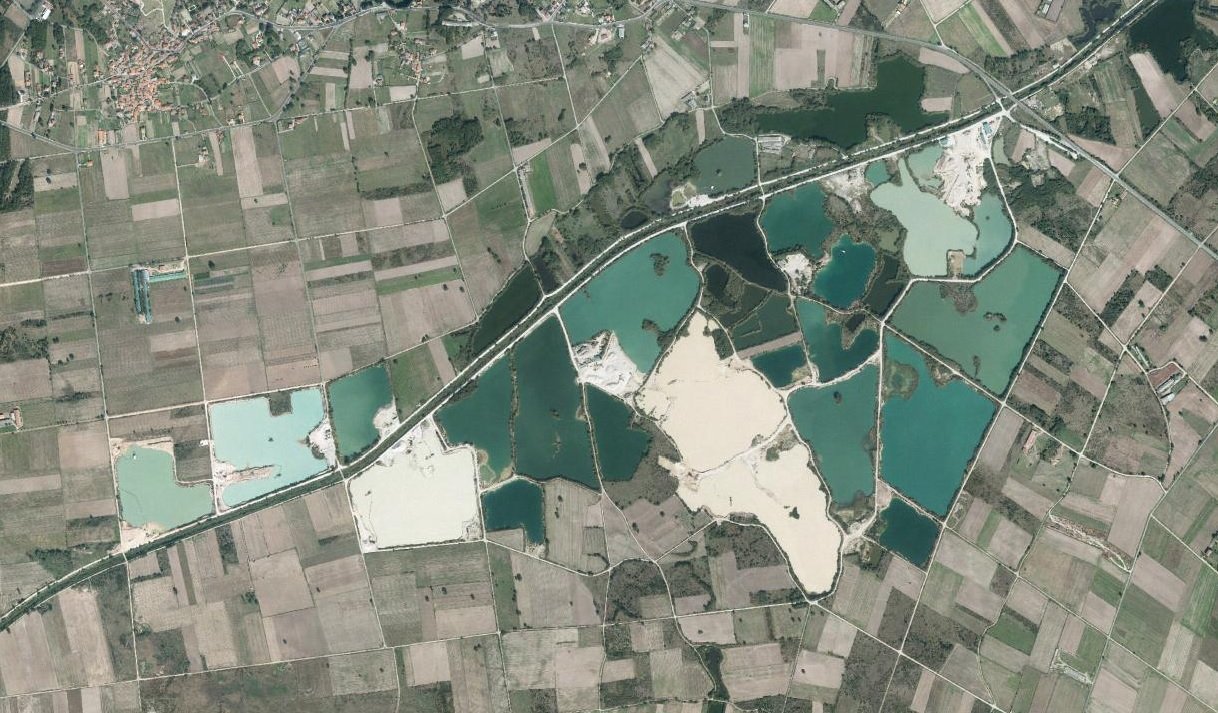
The draining of the Lagoa de Antela: from the 18th-century projects to the works of 1958
A documented chronology of the attempts to drain the Lagoa de Antela: Toubes (1827), Pelayo Cuesta, the Mugártegui, Iscar, Stone and Freeman (concession lapsed in 1890) and the works of the Instituto Nacional de Colonización (1958–1964).
- First project
- 1765 (Pedro González de Ulloa)
- Stone and Freeman concession
- Transferred by the Gaceta de Madrid and lapsed by Royal Order in 1890
- Drainage law
- Declared of high national interest
- Works
- from September 1958; improved area of 3,165 ha
The draining of the Lagoa de Antela was not a single undertaking but a chain of projects lasting more than two centuries, carried out only when the State took over the works in 1958. This page arranges the chronology according to the various sources and points out where they disagree.
Before the 19th century: Romans and the Academy of Agriculture
Tradition, recorded by Elixio Rivas and Conde-Valvís, attributes to the Romans, under Hadrian (117–138), a first canal to drain the lagoon [1][12]. In 1765, the abbot of Covelas Pedro González de Ulloa presented to the Real Academia de Agricultura del Reino de Galicia the first documented project for modern draining [2].
1827–1831: Julián Toubes
The first serious attempt was led by the magistrate of Xinzo, Julián Toubes. With a royal order of 1827 he was commissioned to draw up the plan and calculate the cost; with help from the abbot of San Pedro de Pena, Leocadio García, and Fr. Benito Valencia, a Franciscan of the Trandeiras convent, he produced the geographical map of A Limia and opened a canal of more than three and a half leagues [3]. By 1831 17,000 varas of new canal, 16 wide, had been opened and he had begun breaking the rock at Ponte Liñares, although the works remained incomplete and were suspended when Toubes ceased to be magistrate [3][2]. Canon Juan Manuel Bedoya, exiled at Bo Xesús de Trandeiras, wrote that year the Memoria sobre el desagüe de la laguna Antela, which described the lagoon as a "fatal lagoon" and "pestilent pool" [3][2].
1848–1864: Pelayo Cuesta, the Mugártegui and Iscar
In 1848 a royal order provided for surveying the lagoon in order to budget the draining [2]. In 1850, Justo Pelayo Cuesta requested the concession and received a provisional authorisation (R. O. of 17 June), but did not deposit the 160,000-real bond until January 1852 and, after successive extensions, lost the concession [2][3]. On 25 February 1854, the brothers Román and Francisco J. Mugártegui Parga presented a well-founded project, with a model farm [3]; on 27 March, 300 heads of household from Porqueira, Rairiz de Veiga, Sandiás, Sarreaus, Vilar de Barrio and Vilar de Santos opposed it in writing, with the support of the parish priests [3][4]. To block the project, the local people bought 17 adjoining plots (more than 3,200 ha) whose names included "lagoa", "veiga" or "braña" [4]. In 1864, Toribio Iscar Sáez requested the concession (BOP of Ourense, 5 July) and the Mugártegui ended up reaching an agreement with him [3][4].
1868: the first riot
The Royal Decree of 15 April 1868 gave them the concession: the company would keep the drained land, apart from 5 % for common use, and had to open a school-farm [4]. Works began on 16 June 1868 and by November about 50,000 m³ of earth had been moved (9,770 metres of canal); on the 3rd of that month, armed neighbours from Sandiás attacked the engineer Ángel del Monte and the works stopped, because of the opposition and the September Revolution [3][4].
1873–1890: John H. Stone and Richard H. Freeman
In June 1873 works resumed at A Forxa (Porqueira) under the English engineer John H. Stone; on the 13th of that month armed neighbours threatened the workers and Stone, "saved from lynching", and on the march towards Xinzo four people died; the rioters burned the civil registry books of Sarreaus and Trasmiras and the Abavides cadastre and cut the telegraph [3][5]. The Gaceta de Madrid of 26 December 1874 recorded that the concessionaires transferred the authorisation to Stone and Richard Henry Freeman, Englishmen resident in Santiago [6]. In January 1876 El Diario de Santiago reported that Stone had obtained a loan of ten million reales in Lisbon to reclaim about a hundred thousand ferrados (a Galician land measure); in 1877 he published the book Modo de obtener de 500 a 1.000 reales por ferrado de tierra [5]. Even so, the works did not advance: Stone and Freeman obtained six extensions, the last until 15 October 1888, and the Royal Order of 20 June 1890 declared the concession lapsed [6][7].
Then came Carlota Partington, Duchess of Longeville, who, according to Martínez Cerredelo, took over the enterprise "with great willingness" and little success, the end of the century’s last attempt [3].
1918–1949: projects that never became works
The Greenpeace dossier recalls that the lagoon survived the Cambó Law of 1918 [11]. In 1937, Conde Valvís’s project, approved by the Falange’s National Congress of Technical Services, was not carried out [8]. In 1949 the company "Agrícola de Antela S.A." appeared, which also failed to finish [8].
1956–1964: the Instituto Nacional de Colonización
The Law of 27 December 1956, built on the Cambó Law, declared the drainage and colonisation of the lagoon of "high national interest" [9]. In June 1957 the engineer Francisco Zapata Tejedor was commissioned to produce the project within two months [9]. Works began at Ponte Liñares in September 1958 with the channelling of 6.6 kilometres of the Limia river, followed by 7.5 kilometres of the outlet; from 1962 10 kilometres of canal-drains were opened inside, in 1963 the network of secondary drains and the ploughing, and in 1964 the tertiary ones, the rural roads and an experimental irrigation of 50 ha [10]. The improved area was 3,165 ha, with 81 km of excavated canals and an investment of 92 million pesetas up to 30 September 1964 [10]. Decree 2336/1962 set the lagoon’s area at 3,244 ha [11].
Ramón Otero Pedrayo bade the lagoon farewell on 4 October 1958 in La Región with the article "Se quiebra el mágico cristal" [13]. Channelling the river through the urban stretch demolished the old Toural bridge, and the INC workers, known ever since as "los laguneros", energised the town: many stayed in Xinzo [13].
The assessment
A 1968 article in La Vanguardia criticised that the soils had not been analysed, that more than 180 million pesetas had been spent, that only two hundred hectares had been irrigated and that a dam on the Arnoia was lacking [12]. The scientific assessment came later. A team from the Misión Biolóxica de Galicia (CSIC) compared the soil data of 1962–1963 with those of 2019 and published in Catena (2022) that drainage had more effect than cultivation on soil acidification, that between 20 and 70 % of carbon was lost and that the peat subsidence was 17 to 32 centimetres, six to eight times more than initially predicted [14][17]. According to Gciencia, the 1956 law declared the zone of high national interest and the researchers took 106 sample points in 2019 [17]. The website lagoadeantela.es sums up in its conclusions that the arguments of 1956 (farmland and drainage) were the same as in the 19th century, that the work was planned in haste and that the second-phase irrigation failed [15].
The vanished lagoon took with it the greylag goose as a breeding bird in the peninsula [11]; intensive agriculture centred on the potato [12]. The neighbours’ testimonies, for and against, are in Memory and testimonies.
Links
- The 1956 Law and the drainage project
- Lagoa de Antela
- The original lagoon
- The Lagoa de Antela today
- Antioquía, the drowned city
Sources
- Edelmiro Martínez Cerredelo, «A lagoa de Antela ou lago Beón na Limia», Historia de Xinzo, 22-02-2014. https://historiadexinzo.wordpress.com/2014/02/22/a-lagoa-de-antela/
- lagoadeantela.es, «Intentos de desecación de la laguna de Antela». https://lagoadeantela.es/intentos-de-desecacion-laguna-antela/ · https://lagoadeantela.es/segundo-intento-desecacion-lagoa-antela/
- Edelmiro Martínez Cerredelo, «Os sete malogrados intentos de desecamento da Lagoa de Antela no século XIX», Historia de Xinzo, 31-08-2018. https://historiadexinzo.wordpress.com/2018/08/31/os-sete-malogrados-intentos-de-desecamento-da-lagoa-de-antela-no-seculo-xix/
- lagoadeantela.es, «Tercer y cuarto intento de desecación de la laguna de Antela». https://lagoadeantela.es/tercer-y-cuarto-intento-de-desecacion-de-la-laguna-de-antela/
- Alexander de los Ríos Conde, «John H. Stone: el inglés que quiso desaguar la Laguna de Antela (1873-1877)» (cita), Vía Lethes, 06-11-2016. https://vialethes.es/john-stone-ingles-antela
- Alexander de los Ríos Conde, «El fracaso de John H. Stone en la desecación de la Laguna de Antela (1878-1890)» (cita), Vía Lethes, 13-11-2016. https://vialethes.es/john-stone-fracaso-antela
- lagoadeantela.es, «Intentos de desecación: Stone y Freeman» (cita la Gaceta de Madrid del 26-12-1874). https://lagoadeantela.es/567-intentos-desecacion-lagoa-antela/
- lagoadeantela.es, «Intentos de desecación: Conde Valvís y Agrícola de Antela S.A.». https://lagoadeantela.es/567-intentos-desecacion-lagoa-antela/
- lagoadeantela.es, «La desecación de la laguna durante la dictadura franquista». https://lagoadeantela.es/desecacion-lagoa-de-antela-dictadura/
- Edelmiro Martínez Cerredelo, «Obras de desaugamento da lagoa de Antela (1958–1964)», Historia de Xinzo, 22-09-2016 (datos do INC). https://historiadexinzo.wordpress.com/2016/09/22/obras-de-desaugamento-da-lagoa-de-antela-19581964-46-fotos/
- Greenpeace España, dossier «Tres lagunas», marzo de 2026. https://es.greenpeace.org/es/wp-content/uploads/sites/3/2026/03/dossier-tres-lagunas_.pdf
- lagoadeantela.es, «Consecuencias de la desecación de la laguna». https://lagoadeantela.es/consecuencias-de-la-desecacion-de-la-laguna/
- Edelmiro Martínez Cerredelo, «Se quiebra el mágico cristal», Historia de Xinzo, 02-05-2014. https://historiadexinzo.wordpress.com/2014/05/02/se-quiebra-el-magico-cristal-desaugamento-da-lagoa-de-antela-por-r-otero-pedrayo/
- Vía Lethes, «Un estudio científico demuestra que la desecación de la Laguna de Antela afectó a la fertilidad del suelo» (cita) (sobre S. González Prieto e M. Romero Estonllo, Catena, vol. 217, 2022). https://vialethes.es/estudio-cientifico-constata-desecacion-laguna-antela-afecto-fertilidad-suelo
- lagoadeantela.es, «Conclusiones». https://lagoadeantela.es/conclusiones/
- «La desecación de la Laguna durante la Dictadura franquista». https://lagoadeantela.es/la-desecacion-de-la-laguna-durante-dictadura-franquista/
- Gciencia, «A drenaxe da lagoa de Antela provocou máis danos no solo que os cultivos». https://www.gciencia.com/medioambiental/drenaxe-lagoa-de-antela-danou-solo-cultivos/
- Sociedade Galega de Historia Natural, «Intentos de desougamento da Lagoa de Antela». https://sghn.org/intentos-desougamento-lagoa-antela/ (ver tamén A Lei de 1956 e o proxecto de desaugamento)
You may also like
 Antela in photography and in memory: “A memoria asolagada” and the “Cadernos da Limia”How photography and oral memory told the loss of the Lagoa de Antela: the book "Antela. A memoria asolagada" (1997), its exhibitions at the…
Antela: the 1956 Plan and why the drainage was a hydraulic failureThe analysis by geographers of the University of Oviedo on Antela's drainage: the 1958-1963 works, the Arnoia irrigation never built,…
Bibliography on the Lagoa de AntelaReference works on the Lagoa de Antela cited by the Sociedade Galega de Historia Natural: memoirs by Bedoya and Mugártegui, studies by…
A Limia, a district of OurenseLagoa de AntelaGalicia's largest wetland until 1958: the history of the Lagoa de Antela, life around its waters, the draining, the memory and the…
Lagoa de AntelaLegislation on the Lagoa de Antela (1868–2002)Chronology of the rules of the Gaceta de Madrid, BOE and DOG on the draining of Antela: concessions from 1868 to 1907, the 1918 law, the…
Lagoa de AntelaMemory and testimonies of the draining of the Lagoa de AntelaWhat the people of A Limia say about the draining of the Lagoa de Antela: who gained plots and work, who lost pasture, bión and birds, and…
