
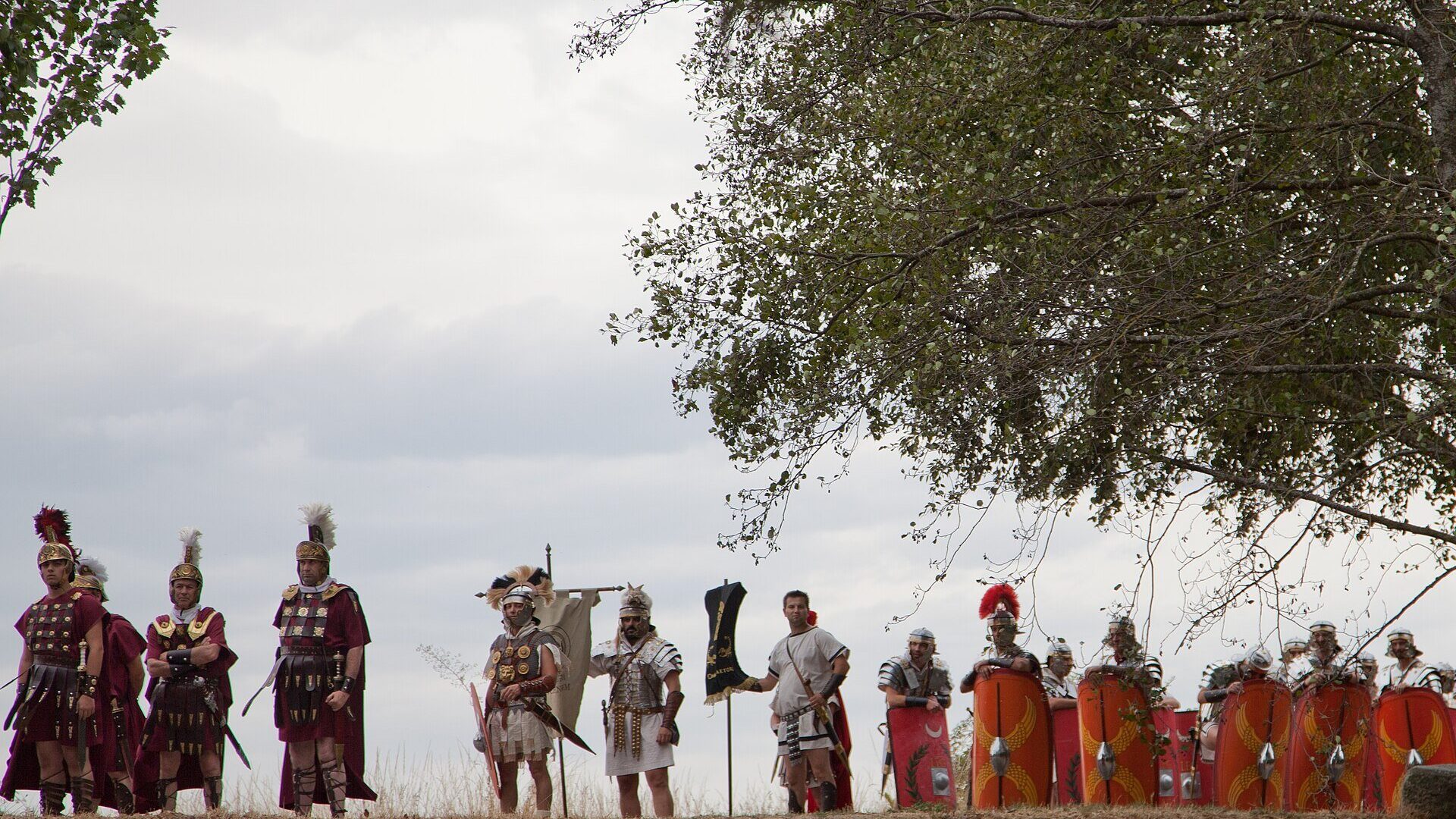
Festa do Esquecemento
Every August Xinzo de Limia relives the arrival of Decimus Junius Brutus's legions at the river Limia, the Lethes that, legend said, made anyone who crossed it forget their homeland.
- When
- Second-to-last weekend of August
- Where
- Xinzo de Limia, on the banks of the river Limia
- Since
- 2001
- Organiser
- Civitas Limicorum cultural association
The Festa do Esquecemento (Festival of Oblivion) is Xinzo de Limia’s great historical re-enactment: over a weekend in late August, hundreds of local people dressed as Iron Age hillfort dwellers and Roman legionaries commemorate the arrival of Decimus Junius Brutus’s troops at the river Limia, which the ancients identified with the Lethes, the mythical river of forgetfulness [1][4]. It is organised by the Civitas Limicorum cultural association with the support of the Concello de Xinzo de Limia, and has been held every year since 2001, apart from a forced break during the pandemic [1][6].
A legend between history and myth
Greek and Latin geographers and poets described the Limia as the river of forgetfulness: Strabo called it the Lethes, Pomponius Mela the Flumen Oblivionis, and Pliny said it was "Oblivionis antiquis dictus" ("called Oblivion by the ancients") [3]. According to the tradition recorded by the Enlightenment writer Lucas Labrada and cited by the historian Elixio Rivas, Brutus’s soldiers refused to cross the river for fear of losing their memory, until the general took the standard, waded across and called his men by name, one by one, from the far bank [3][4]. For that campaign against the Lusitanians and Gallaeci, Brutus was given the surname Callaicus, "the Galician", in Rome [3].
The myth is explained in detail, with quotations from the classical authors, on the page The myth of the Lethes.
In what year did Brutus cross the Limia?
The sources disagree. The organising association sets the festival in 137 BC [1], a date repeated in the report on the 2026 edition [8]; Edelmiro Martínez Cerredelo’s report gives 137 BC as the year of Brutus’s triumph (following Bedoya and the Capitoline Fasti) and 138 BC as the year of his arrival according to Elixio Rivas, who follows Appian [3]. The Vía Lethes reports from 2023 to 2025 say 138 BC [5][6][7], and the Páxinas Galegas entry says 135 BC [9]. This site follows the association’s official date, 137 BC, while noting the others.
How the festival began
The idea came from Carlos Gómez Salgado and was carried through by a committee made up of him, Arsenio Martínez Paz and the historian Edelmiro Martínez Cerredelo, who say they started "from nothing" and even met some institutional and local resistance [2]. They had three aims: to recreate the legend, to boost Xinzo’s shops, bars and restaurants, and to keep summer visitors in A Limia after 15 August [2][3]. According to Martínez Cerredelo it was the first Roman re-enactment festival in Galicia, and members of Civitas Limicorum later advised on the creation of Arde Lucus in Lugo [3].
The association was founded the same year, 2001 [1][2], although one popular guide gives 2000 [10]. The festival’s development edition by edition is told in History of the festival, and the organising body in The Civitas Limicorum association.
When it takes place
The rule is a weekend in late August, Friday to Sunday. The association speaks of "the second-to-last weekend of August" [1] and Martínez Cerredelo of the third week of the month [3]; in practice the 2023–2026 editions fell between 18 and 25 August [5][6][7][8]. Some years the camp already opens on the Thursday: in 2019 the festival lasted four days [5].
What you will see
The heart of the festival is the Gallaeco-Roman camp set up on the Alameda do Toural, beside the river [2][9]. Around it there is a craft market, a children’s area, parades through the old town and Roman circus shows [2][6]. The association claims one of the most spectacular Celtic-Roman camps in Europe [1].
The moments repeated year after year are these [2][4][6][8]:
- Friday night: a grand opening parade with fachós (lit straw torches) and the Prendido do Lume Sagrado, the lighting of the Sacred Fire, the festival’s symbol.
- Saturday: reception of the visiting troops and presentation of the Bispo Idacio Awards, gladiator fights, games and contests in the camp, and Celtic or Roman weddings.
- Sunday: naming ceremonies, the re-enactment of the crossing of the river Lethes and the great battle between hillfort warriors and Romans on the banks of the Limia, won by the legions; Brutus is then crowned Galaicus [11]. It ends with a victory parade.
Each event is described in more detail in Typical festival programme. Even in the early editions, the photo galleries on xinzodelimia.eu showed the Roman camp, the Celtic camp, the parades, the nasciturus, the sacred fire, the river crossing, the battle and the games [12].
A festival made by local people
More than 500 people take an active part, most of them from A Limia, and the association has about 500 members [1]. Local groups of Roman troops and hillfort clans, such as Belionis, Guerreiros de Breogán, Legio IX Hispana and Patricios Límicos, share the streets with guest groups from other re-enactments, such as Arde Lucus, Astures y Romanos in Astorga and Cartago Nova [9]. The 2026 edition brought together 54 participating groups, 13 foreign troops and 12 music groups in more than 50 free activities [8].
During the year the same association also holds the Vestalia, a Roman ceremony dedicated to the Vestal Virgins first staged in June 2024 [13].
Memorable moments
- 2025 marked the 25th anniversary, the Annus Argenteus, with exhibitions of all 25 posters and 25 years of photographs [7].
- That same year, in solidarity with the wildfires that burned across the province of Ourense, the parade of some 400 torches went out unlit and the Sacred Fire stayed dark for the first time in its history [7].
- The festival has been declared of local tourist interest [7]; the association is seeking recognition as a Festival of Galician Tourist Interest [1], and in 2026 the Concello agreed to apply for it [3].
FAQ
Why is it called the Festa do Esquecemento?
Because the Romans identified the river Limia with the Lethes, the mythological river that made people forget; the festival recalls how Brutus broke that belief by crossing it [4].
When is the Festa do Esquecemento?
On a weekend in late August, usually the one after 15 August, Friday to Sunday [1][3].
Where is the river crossing re-enacted?
On the river Limia as it passes through Xinzo, by the camp on the Alameda do Toural; the crossing and battle usually take place on Sunday afternoon [2][5].
Do you have to pay to get in?
No: the activities on the programme are free [8].
Can you take part in period costume?
Yes. The festival relies on local people who join Civitas Limicorum and become part of a Celtic or Roman group; in some years the camp is even closed at night to anyone not in period dress [1][5].
Sources
- A.C. Civitas Limicorum, "A Asociación Cultural Civitas Limicorum" (About). https://civitaslimicorum.com/acerca-de
- Edelmiro Martínez Cerredelo, "A lenda do río Lethes ou río do esquecemento. A 1ª festa en 2001", Historia de Xinzo, 05-08-2022. https://historiadexinzo.wordpress.com/2022/08/05/a-lenda-do-rio-lethes-ou-rio-do-esquecemento-a-1a-festa-en-2001/
- Edelmiro Martínez Cerredelo, "Informe histórico en que se fundamenta a orixe e motivo da celebración da Festa do Esquecemento na vila de Xinzo de Limia", Historia de Xinzo, 01-07-2026. https://historiadexinzo.wordpress.com/2026/07/01/informe-historico-en-que-se-fundamenta-a-orixe-e-motivo-da-celebracion-da-festa-do-esquecemento-na-vila-de-xinzo-de-limia/
- "Festa do Esquecemento", Galipedia (in Galician; CC BY-SA 4.0). https://gl.wikipedia.org/wiki/Festa_do_Esquecemento
- Vía Lethes, "Festa do Esquecemento 2023" (18-08-2023) and "Festa do Esquecemento 2019, programa completo" (17-08-2019). https://vialethes.es/festa-esquecemento-2023-xinzo-limia · https://vialethes.es/festa-do-esquecemento-2019-xinzo-limia-programa-completo
- Vía Lethes, "Festa do Esquecemento 2024, programa oficial" (21-08-2024) and "Festa do Esquecemento 2022" (19-08-2022). https://vialethes.es/festa-do-esquecemento-2024-xinzo-de-limia-programa-oficial · https://vialethes.es/festa-esquecemento-2022-xinzo-limia-programa-completo
- Vía Lethes, "Festa do Esquecemento 2025, programa oficial", 20-08-2025. https://vialethes.es/festa-esquecemento-2025-xinzo-de-limia-programa-oficial
- Vía Lethes, "Festa do Esquecemento 2026, programa oficial", 21-08-2026. https://vialethes.es/festa-esquecemento-2026-xinzo-limia-programa-oficial
- Páxinas Galegas, "Festa do Esquecemento en Xinzo de Limia" (accessed 2026). https://www.paxinasgalegas.es/fiestas/festa-do-esquecemento-xinzo-de-limia-2346.html — Wayback (17-08-2012): https://web.archive.org/web/20120817011806/http://www.paxinasgalegas.es/fiestas/festa-do-esquecemento-xinzo-de-limia-2346.html
- Fronteira Esquecida (Provincial Council of Ourense), "Festa do Esquecemento". https://fronteiraesquecida.eu/en/fichas/festa-do-esquecemento-oblivion-feast/
- A.C. Civitas Limicorum, "A Festa do Esquecemento". https://civitaslimicorum.com/festa-do-esquecemento
- xinzodelimia.eu, "Festa do Esquecemento" (galleries 2002–2009). Site offline; Wayback (01-01-2008): https://web.archive.org/web/20080101043045/http://www.xinzodelimia.eu:80/esquecemento.htm
- Concello de Xinzo de Limia, "Xinzo de Limia retrocede no tempo coa celebración das Vestalias", 05-06-2024. https://www.xinzodelimia.gal/cultura/xinzo-limia-retrocede-tempo-coa-celebracion-das-vestalias/20240605090734006505.html
In this topic
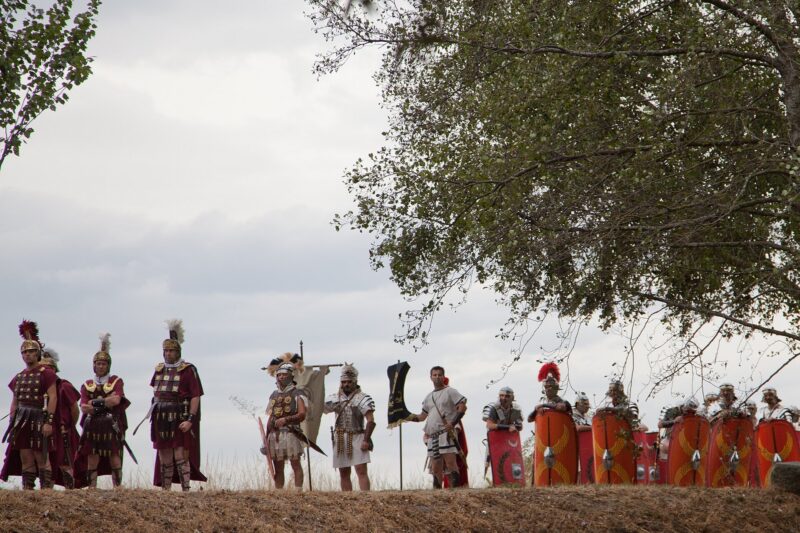 Festa do EsquecementoThe myth of the Lethes, the river of forgetfulnessStrabo, Pomponius Mela and Pliny called the Limia the river of forgetfulness. This is how the legend of the Lethes was born, and what is…
Festa do EsquecementoTypical programme of the Festa do EsquecementoThree days, Friday to Sunday: a Gallaeco-Roman camp, market, sacred fire, gladiators and parades, leading up to the crossing of the river…
Festa do EsquecementoThe Vestalia of Xinzo de LimiaXinzo de Limia's other great Roman re-enactment: the festival of Vesta and the Vestal Virgins, held by Civitas Limicorum in the Praza Maior…
You may also like
 FestivalEntroido of Xinzo de LimiaThe Entroido of Xinzo de Limia lasts five weeks, has the Pantalla as its emblematic mask and has been a Festival of International Tourist…
 A Limia, a district of OurenseXinzo de LimiaThe capital of A Limia, in southern Ourense: home of the Entroido carnival, the Festa do Esquecemento, the Torre da Pena and the Bon Xesús…
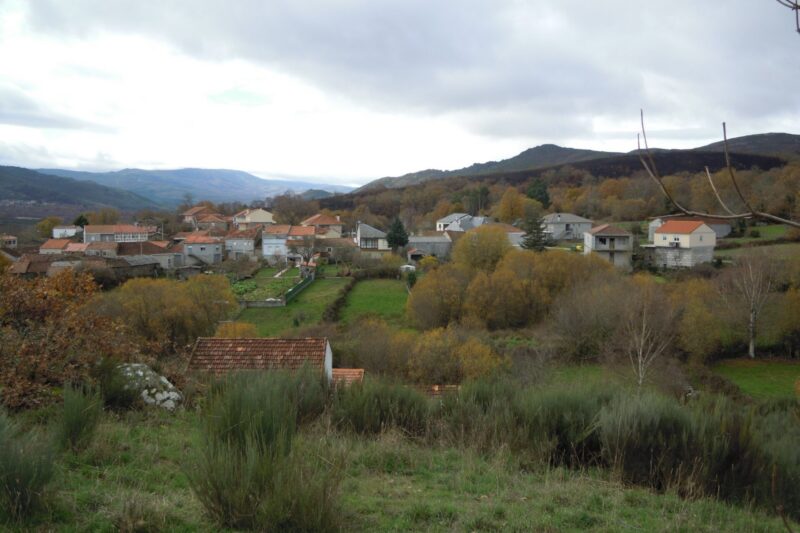 A Limia, a district of OurenseBaltarA concello on the 'dry border' with Portugal, between the plain of A Limia and the Larouco range: heir to part of the Couto Mixto, with…
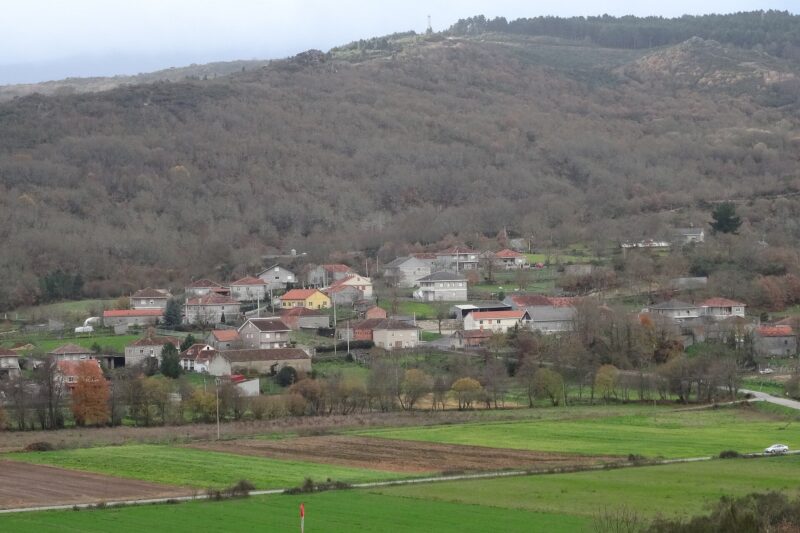 A Limia, a district of OurenseOs BlancosA small concello between the plain of A Limia and the southern hills, home to the 4th–5th century Christian oratory of Ouvigo and,…
 FestivalRomaría da SaínzaAround 24 September, thousands of pilgrims fill the field of A Saínza, in Rairiz de Veiga, to watch the Christians storm the castle held by…
 A Limia, a district of OurenseCalvos de RandínA mountain concello on the Portuguese border, home to the capital of the Couto Mixto, Santiago de Rubiás, and to the Portuguese castle of A…
