

Carlos Casares in Xinzo: Boy, Student, Carnival-goer and Adopted Son
Carlos Casares's life in Xinzo as told by his neighbours: childhood games and football, La Voz de la Limia and the Santa Mariña school, Carnival in his «Á marxe» columns, the 2001 tribute and the Día das Letras Galegas of 2017.
- Family in Xinzo
- his father, Francisco Casares, was the town's schoolteacher
- Schooling in Xinzo
- secondary school at the Colexio Santa Mariña, 1957-1961
- First tribute in his lifetime
- 2001, with the Civitas Limicorum
- Día das Letras Galegas
- 2017
Carlos Casares Mouriño (Ourense, 1941 – Vigo, 2002) lived in A Limia from the age of three, between Piñeira de Arcos, Lamas, Sabucedo and Xinzo. His literary biography is at Carlos Casares; this page gathers what neighbours and friends have told, above all Edelmiro Martínez Cerredelo in Historia de Xinzo, about the Casares who walked about the town [1][2].
A boy in Xinzo
According to a neighbour five years his junior, Carlos would come back from the seminary on holiday and organise the children’s games of the group of boys, among them his brother Xabier: cops and robbers, and football matches on the main road. His father, the schoolmaster don Paco, kept an iron and wood workshop at the school where he made knives with wooden or bone handles; at the school the powdered milk sent by the Americans was handed out to post-war children. When the «cheap houses» built by the Organización Sindical on the Pombal field were allocated, the Casares family and the family of the man telling the story lived door to door for many years [1].
Football and Antela F.C.
Football was part of his youth. Antela F.C. was officially born in June 1919 from a conversation in a tavern; the first ground was the Toural and, from 1936, the Seara, where Carlos played in the 1960s. His brother Xabier remembers that they called him «Kubalita», after Kubala, and Casares recalled in his columns that he had scored the odd goal for the town team and the satisfaction of provoking an explosion of joy in the crowd [4]. See Antela F.C..
Student: radio, cinema and theatre
Between 1957 and 1961, after leaving the seminary, he did his secondary schooling at the Colexio Santa Mariña. He took part in the union radio station La Voz de la Limia, where with his friend Manolo Dobaño he ran the humorous section «Diálogos gramaticais entre Orto e Grafo» (1959), and in the programme «Cara al Público», at the Antelano cinema. In January 1960 he was King Balthasar in the Epiphany parade, and in March that year the children’s comic play Examen final, written by him, premiered at the Molinos cinema. In the 1960s he had an intimate literary friendship with Francisco Domínguez Romero, and in 1965 they travelled to Barcelona for a tribute to Catalonia [2]. See Francisco Domínguez Romero.
Casares at the Xinzo festivals
In 1967, the year of his book Vento ferido, he published a short article on the origin of the word «Limia» in the programme of the Santa Mariña festivities. He was a festival chronicler in La Región (1979, «Lembranzas») and in 1980 gave the opening speech of Carnival on the Praza Maior, invited by councillor Antonio Rodríguez. In 1993 he presented in the town the book of poems Versos heridos by Manuel López Martínez [2].
Carnival in his columns
According to surviving photographs, Carlos went out dressed as a shoeshine boy in 1959, with Dobaño as a cleaning woman, and again in 1962 with a group of students. Almost every year he came on Shrove Tuesday to see the parade and gathered anecdotes and characters for his column Á marxe in La Voz de Galicia. His last visit gave rise to three columns in February 2002. In the one of the 14th, «O Entroido de Xinzo», he says he went dressed as a pirate, wandered through the Barrio de Abaixo and saw a parade lasting more than two hours with thousands of spectators. He confesses that when democracy arrived and Carnival stopped being a sin (he recalls the sermons of the first Sunday of Lent), he feared for it: «o carnaval de Xinzo segue apetecendo» (Xinzo’s carnival is still appealing) [3]. See The Xinzo Carnival cycle.
Tributes
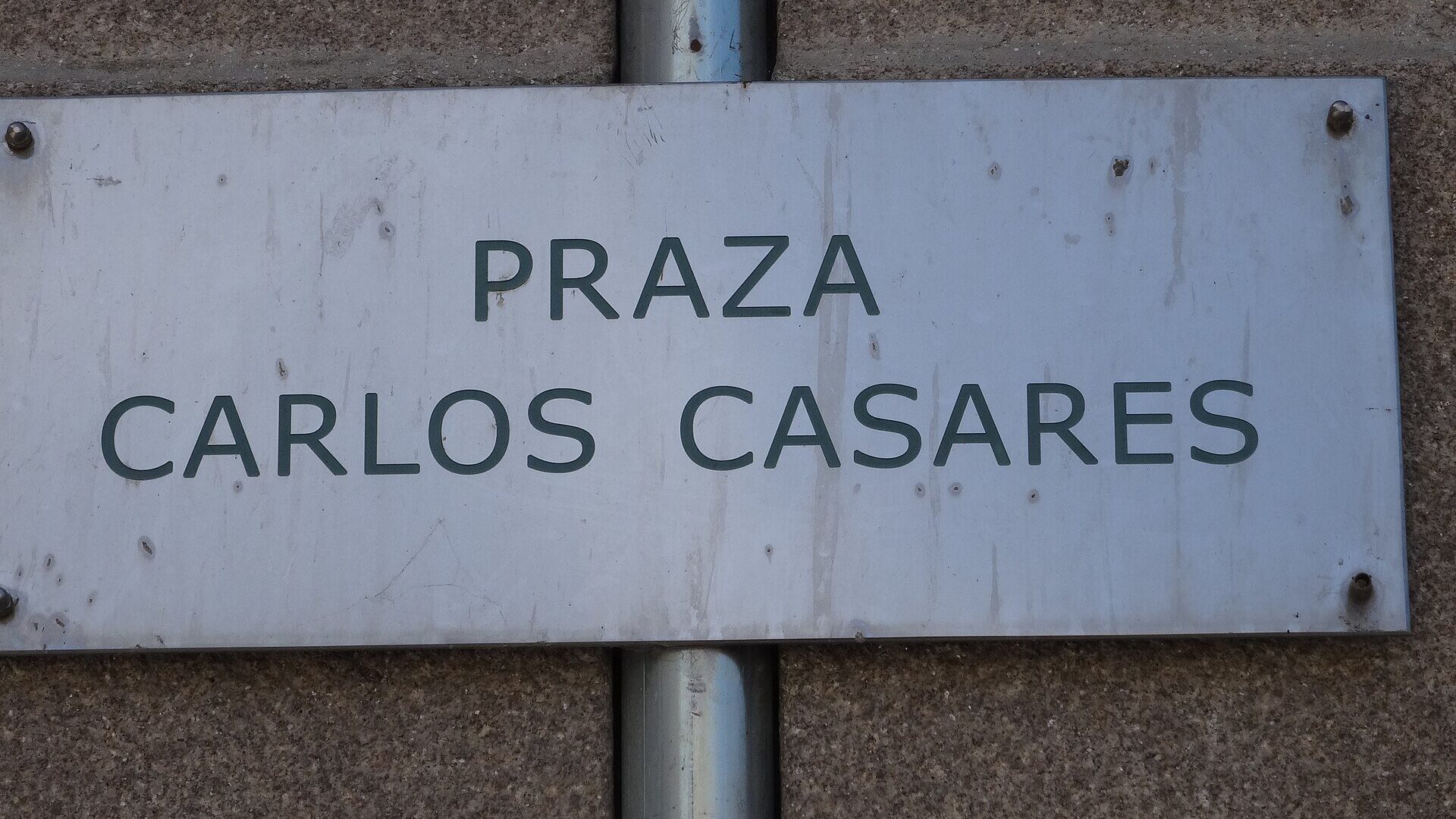
The first tribute in his lifetime, and probably the only one, came in 2001, taking advantage of a lecture by Sánchez Dragó organised by the Civitas Limicorum, which unveiled a marble plaque in the Culture House; Casares wrote an ironic column in Á marxe, «Convertido en placa». After his death in March 2002 the council declared him adopted son and gave his name to the square in front of the Culture House, on Rúa Curros Enríquez. The DOG of 11 February 2011 approved the renaming of the CEIP Sergio Mascareñas school as Carlos Casares. In 2012 there was a round table at the Culture House on the tenth anniversary of his death; in 2016 an event in Xinzo called for the Día das Letras Galegas to be dedicated to him, which it was in 2017 [2].
Frequently asked questions
When did Casares receive his first tribute in Xinzo? In 2001, with the Civitas Limicorum plaque in the Culture House [2].
Which school bears his name? The CEIP Carlos Casares, formerly Sergio Mascareñas, since 2011 [2].
Links
Sources
- Edelmiro Martínez Cerredelo, «Lembranzas de Carlos Casares en Xinzo», Historia de Xinzo, 26/02/2014 (published in Lethes no. 11, 2012). https://historiadexinzo.wordpress.com/2014/02/26/lembranzas-de-carlos-casares-en-xinzo/
- «Carlos Casares en Xinzo. Actividade cultural. Fotos e textos», Historia de Xinzo, 02/04/2017. https://historiadexinzo.wordpress.com/2017/04/02/carlos-casares-en-xinzo-actividade-cultural-fotos-e-textos/
- «Carlos Casares no Entroido de Xinzo», Historia de Xinzo, 07/04/2017, with texts by Casares in La Voz de Galicia (14/02/2002). https://historiadexinzo.wordpress.com/2017/04/07/carlos-casares-no-entroido-de-xinzo/
- «Carlos Casares e o fútbol en Xinzo», Historia de Xinzo, 11/04/2017. https://historiadexinzo.wordpress.com/2017/04/11/carlos-casares-e-o-futbol-en-xinzo/
- «“O arcebispo de Antioquía”». https://historiadexinzo.wordpress.com/2014/03/09/o-arcebispo-de-antioquia/
- «Carlos Casares e a fotografía – Cultura – Concello de Xinzo de Limia». http://www.xinzodelimia.es:80/articulo/cultura/carlos-casares-fotografia/20170404211328001254.html
- «O Concello de Xinzo de Limia e a Deputación de Ourense e organizan un acto para pór en valor a figura do escritor limiao baixo o lema: Carlos Casares e o seu mundo creativo – Cultura – Concello de Xinzo de Limia». http://www.xinzodelimia.es/articulo/cultura/concello-xinzo-limia-deputacion-ourense-organizan-acto-valor-figura-do-escritor-limiao-baixo-lema-carlos-casares-seu-mundo-creativo/20160516184004000887.html
- «Carlos Casares e a fotografía». http://www.xinzodelimia.es:80/content/print/carlos-casares-fotografia/201704042113281254
You may also like
 Notable personAiras Vasques, Bishop of Lisbon Born in Xinzo de Limia (13th Century)Airas Vasques (Xinzo de Limia, c. 1170 – Lisbon, 1258) was Bishop of Lisbon from c. 1241, archdeacon of Santiago, founder of the collegiate…
 Notable personAlfredo Nan de Allariz, Poet and Playwright from Xinzo in HavanaAlfredo Fernández, «Nan de Allariz», was born in Xinzo de Limia (1874 or 1875) and died in Madrid in 1927; poet, playwright and composer,…
 Notable personÁlvaro de Oca y Zúñiga, the Jurist from Celme Who Became Viceroy of NavarreÁlvaro de Oca y Zúñiga (Celme, Rairiz de Veiga, 16th century – Pamplona, 1638) was a professor at Salamanca, judge, regent of the Royal…
 Notable personAna Prieto, pharmacist and MP born in Xinzo de LimiaAna Prieto Nieto (Xinzo de Limia, 1965) is a pharmacist, was president of the Lugo Pharmacists' Association (2009-2015), deputy mayor of…
Notable personÁngel Cocho Ferrero, Headmaster of the Colexio Santa Mariña in XinzoÁngel Cocho Ferrero (A Coruña, 1914) ran the Colexio Santa Mariña in Xinzo from 1953, the town's educational landmark of the 1950s–70s. In…
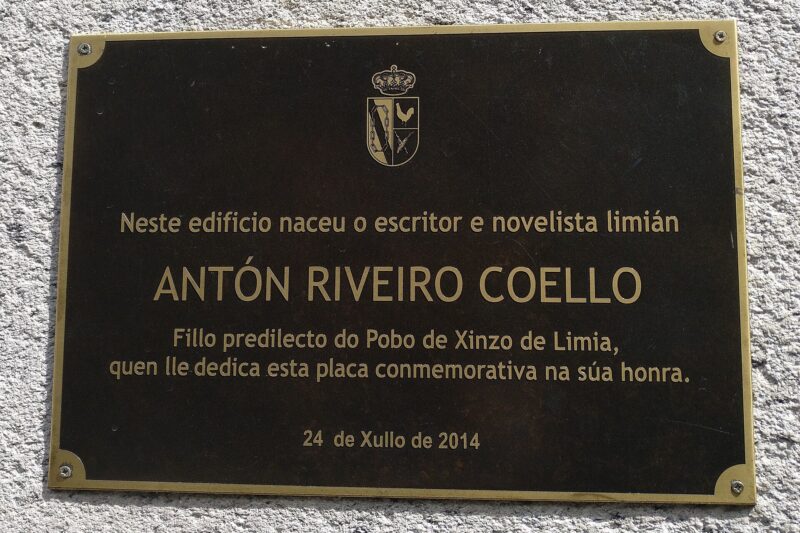 Notable personAntón Riveiro Coello, Writer from Xinzo de LimiaAntón Riveiro Coello (Xinzo de Limia, 1964) is one of the most translated Galician novelists: author of «As rulas de Bakunin», «Laura no…
