


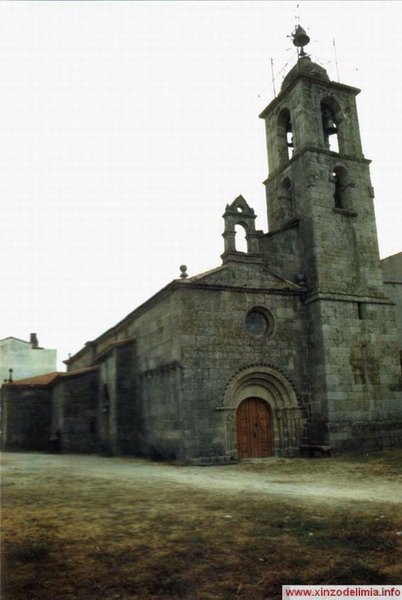
The churches of Xinzo: the old church, the chapels, the new church (1908-1965) and religious life
History of Xinzo's churches: the ruin of Santa Mariña (1859), the chapels of 1831, the new church of 1908-1965, Holy Week 1954, the old Corpus Christi and the clergy brotherhood of 1900.
Edelmiro Martínez Cerredelo reconstructed the history of Xinzo’s temples from parish and municipal documents. This page summarises those dealing with buildings and religious life.
The ruin of Santa Mariña church (1859-1860)
In 1859 the parish priest, Xosé Gómez Muíños, repeatedly warned of the ruinous state of the roof and north wall of the church, which threatened to fall in the middle of Mass. With the consent of the Concello and a committee of residents it was agreed to rebuild the north wall and build in the nave two semicircular granite arches, able to carry a vault like the choir, and to use chestnut wood for the roof. In April 1860 the priest wrote to the bishop that "the nave of this parish church is in a ruinous state", that part of the roof had sunk more than a vara, that only props prevented collapse and that, on rainy days, water fell inside; the work would cost 5,500 reals in masonry and 3,000 in carpentry, and the church fabric had 5,000 reals available [1].
The chapels and the bishop’s visit (1831)
The reports of the pastoral visit by Bishop Dámaso Iglesias y Lago, on 13 June 1831, say that in the parish there were three chapels: Santo André (in Baronzás, documented in 1743), Santa María Madalena (on the Royal Road to Castile, where the town cemetery was, at the present crossing of Avenida de Madrid with Rosalía de Castro street; documented in 1683) and San Roque and San Caetano (on the livestock fairground; documented in 1718). The Concello maintained the two in Xinzo and the one in Baronzás, without their own endowment [2][3]. The bishop visited the high altar (Santa Mariña), the side altars of the Carmen and the Holy Christ and the altar of Our Lady of the Rosary, in a chapel half of which, with six graves, belonged to the Count of Gimonde, and the rest to the heirs of Xosé Gómez Opazo and of Antonio Villarino; they paid the church fabric in rye as endowment and the count also had the burden of a weekly said Mass [3].
The new church: 1908-1965
At the start of the 20th century the church of Santa Mariña was becoming too small. In February 1908 the acting priest, Francisco Arias Moleiro, bought on the bishop’s behalf some land opposite the "egg square" (today Xoán XXIII), for 1,250 pesetas, for a new church; the first project is attributed to the architect Daniel Vázquez-Gulías. Work began without municipal licence, there was an expropriation file for house number 4 on Lepanto street and the parish sold part of a plot at O Formigueiro (1,800 m²) to finance it, but it ended up halted [4]. In 1931 the councillor Álvaro Rodríguez Suárez proposed buying the abandoned church (turned into a dump and donkey park) to open a street; it did not prosper. Later the priest planned a second church on the old one’s churchyard land, which would have demolished part of the parish house: fortunately it was not done and the old church was saved [4].
In the 1960s, with the chaplains Benigno Moure and Darío Carracedo and the parish priest Cesáreo Sobrado, a new project, "Cristo Rei", was commissioned from the architect Manuel Conde Fidalgo (budget 2,259,012.95 pesetas). It was not built as designed: a more modest church was built, financed by monthly contributions from each family (about twenty thousand pesetas a month) and anonymous donations, and the parish had to sell the rest of the plot. It was finished in 1965 and solemnly inaugurated on Sunday 29 August of that year [4].
Holy Week 1954
The town was very religious: during Holy Week the cinemas closed, radio stations broadcast only sacred music and sermons and festivity was practically forbidden. The 1954 programme, printed at the Blanca printing house in Xinzo, announced general communion of men and a palm Mass on Palm Sunday (with a procession of Our Father Jesus of Nazareth and a broadcast sermon), the washing of twelve children’s feet and the procession of the Prayer in the Garden on Maundy Thursday, or the Good Friday processions; the station «Radio Ginzo» (quote) broadcast the services [5].
The old Corpus Christi
Until the early 1950s Corpus Christi and the Santa Mariña festivals were held separately, with the town’s main festivities at Corpus; in 1953 they were unified. The programme included giants and big-heads, bagpipes, bands, vermouth sessions, dances with orchestras (Los Chicos del Jazz, Casanovas, Jo, Bellas Farto, Continental, Florida, La Palma, Reñones), fireworks by the pyrotechnician Eladio, football, motorbike gymkhanas and cycle races. The processions were huge, with girls representing the Virtues, angels and the first-communion children [6]. Otero Pedrayo wrote in 1961 that the procession "is well worth seeing", with "a crowd of dressed girls representing the Virtues" [6]. See Festivals of Santa Mariña.
The clergy brotherhood (1900)
On 1 September 1900 the parish priests, acting priests, curates, presbyters and deacons of A Limia constituted the «Hermandad Eclesiástica del Sagrado Corazón de Jesús de Ginzo de Limia» (quote), based in the church of Santa Mariña: it celebrated the patron’s feast on the first Tuesday of September, with an anniversary Mass for the dead, and required visiting sick brothers, attending funerals within two leagues round and applying three Masses for each dead brother [7].
Links
- History of A Limia
- Xinzo de Limia
- The Praza Maior, the Ladeira and the Toural
- Cultural life of Xinzo (1948-1970)
Sources
- Edelmiro Martínez Cerredelo, «O estado ruinoso da igrexa parroquial de Xinzo no século XIX», Historia de Xinzo, 06/05/2020. https://historiadexinzo.wordpress.com/2020/05/06/o-estado-ruinoso-da-igrexa-parroquial-de-xinzo-no-seculo-xix/
- «As capelas anexas da parroquia de Santa Mariña de Xinzo», 26/11/2018. https://historiadexinzo.wordpress.com/2018/11/26/as-capelas-anexas-da-parroquia-de-santa-marina-de-xinzo/
- «Visita pastoral do bispo de Ourense, Dámaso Iglesias e Lago, á parroquia de Santa Mariña o día 13 de xuño de 1831», 10/06/2020. https://historiadexinzo.wordpress.com/2020/06/10/visita-pastoral-do-bispo-de-ourense-damaso-iglesias-e-lago-a-parroquia-de-santa-marina-o-dia-13-de-xuno-de-1831/
- «Historia da construción da igrexa nova de Xinzo de Limia (1908-1965)», 05/11/2017. https://historiadexinzo.wordpress.com/2017/11/05/historia-da-construcion-da-igrexa-nova-de-xinzo-de-limia-1908-1965/
- «A Semana Santa en Xinzo de Limia (1954)», 05/04/2014. https://historiadexinzo.wordpress.com/2014/04/05/a-semana-santa-en-xinzo-de-limia-1954/
- «As antigas festas de Corpus Christi en Xinzo de Limia», 22/06/2014. https://historiadexinzo.wordpress.com/2014/06/22/as-antigas-festas-de-corpus-christi-en-xinzo-de-limia/
- «Hermandad Eclesiástica del Sagrado Corazón de Jesús de Ginzo de Limia» (cita), 12/04/2022. https://historiadexinzo.wordpress.com/2022/04/12/hermandad-eclesiastica-del-sagrado-corazon-de-jesus-de-ginzo-de-limia/
You may also like
 History of A LimiaPrehistory and castros of A LimiaFrom the Pedra Alta de Antela to the castro of Bóveda: megaliths, the Roufeiro weapons, the Outeiro de Baltar and the gold earring of Vilar…
 History of A LimiaThe Limici in Roman inscriptions: Celer’s gladiatorial tessera and Corellius LimicusTwo epigraphic pieces outside A Limia that mention a "Limicus": the bronze gladiatorial tessera from Niebla (Huelva), of the 1st century,…
 History of A LimiaThe battle of the Xinzo bridge (23 February 1809)On 23 February 1809 farmers, abbots and friars of A Limia, poorly armed, tried to stop Soult's French vanguard at the Xinzo bridge; they…
History of A LimiaThe Limici and Romanisation: Civitas, Forum Limicorum and Via NovaWhat is known of the Limici and Roman Limia: the Civitas Limicorum, the debate over where the Forum Limicorum stood (A Cidá of Nocelo da…
 History of A LimiaThe Praza Maior, the Ladeira and the Toural: history of Xinzo’s central placesHistory of the Praza Maior (fairs since the 16th century, the 1907 Espolón, the fountain), the Ladeira and the Toural (the lagoon, the…
History of A LimiaLight, chocolate, fizzy drinks and roads: the industrial and service Xinzo of the 20th centuryHow electricity (1911), the printing press, chocolate and soda factories, the Rubio Cold-Storage Slaughterhouse and buses to Ourense and…
