


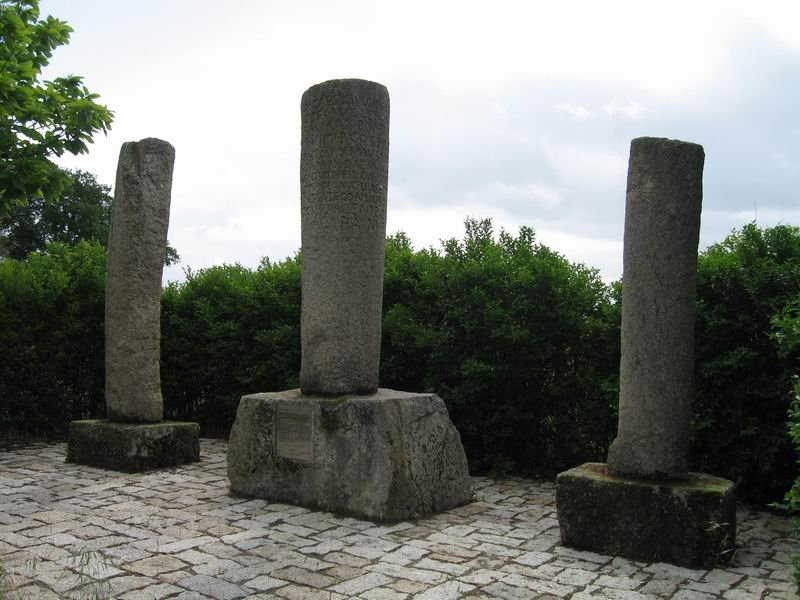
The Limici in Roman inscriptions: Celer’s gladiatorial tessera and Corellius Limicus
Two epigraphic pieces outside A Limia that mention a "Limicus": the bronze gladiatorial tessera from Niebla (Huelva), of the 1st century, and the tablet of Corellius Limicus at Complutum, of the late 2nd century.
- Main piece
- Bronze gladiatorial tessera (National Archaeological Museum, inv. 37.810)
- Find origin
- Niebla (Huelva), 1867
- Chronology
- 1st century AD
- Second piece
- tablet of Corellius Limicus, Complutum, late 2nd century
The word Limicus, "Limician", appears in Latin inscriptions far from A Limia. Two of them, gathered by the comarca website xinzodelimia.eu in its "Civitas Limicorum" section, are of interest because they show individuals bearing the name of the Limici people, that of the civitas Limicorum of the Conventus Bracaraugustanus, who lived or travelled elsewhere in Hispania [1][2].
The Niebla gladiatorial tessera
The website shows the piece and its entry: a tessera (rectangular bronze plate, 17 cm long and 4.3 wide, with four holes at the corners and a handle) found in 1867 on the banks of the river Tinto, between Niebla and Moguer (Huelva), and now kept in the National Archaeological Museum with inventory number 37.810; the entry dates it to the 1st century. The epigraphic field has four lines, surrounded by an incised line, and the letters are dotted [1].
The text reads:
CELER ERBVTI F(ilius) LIMICVS / BOREA CANTI(filio) BEDONIE(n)SI / MVNERIS TES(s)ERA(m) DEDIT / AN(n)O M(arco) LICINIO CO(n)S(ule)
The translation given by the website, attributed to Professor J. González, is: "Celer, son of Erbutius, native of the city of the Limici, gave this gladiatorial tessera to Borea, son of Cantius, native of Bedunia, in the year of the consulship of Marcus Licinius" [1]. According to the Museum’s entry, Celer would be an organiser of games (munus) and Borea a gladiator native of Baedunia, near La Bañeza (León). The piece must have hung on a house wall, vertically or horizontally, as a souvenir of those games; its exact function is not known [1].
Discrepancy in the date. The website itself offers two incompatible datings: the Museum’s entry suggests "possibly the year 64", while a note from an Ancient History department links the consul Marcus Licinius Crassus with the date of AD 27. The translation and reading have been interpreted in different ways, as the source acknowledges [1]. There are no data here to decide between them.
What it says about A Limia. The comarca website interprets Celer as a native of the civitas Limicorum, and the section that hosts it identifies that civitas with Roman Xinzo. That location is disputed in the historiography: some researchers placed the Forum Limicorum in Nocelo da Pena and others in Xinzo. What the tessera proves, in any case, is that in the 1st century a man presented himself as a "Limicus" hundreds of kilometres away, in southern Hispania, and took part in the world of public games [1]. See The Civitas Limicorum.
Corellius Limicus at Complutum
The second inscription, found at Complutum (modern Alcalá de Henares), is a funerary tablet whose text reads: D(is) M(anibus) / CORELLI SATVRNINI / ANN(orum) XXX / CORELL[i]VS LIMICVS / FRATRI PIISIMO / S(it) T(ibi) T(erra) L(evis), that is, "to the Manes gods; of Corellius Saturninus, aged thirty; Corellius Limicus to his dearest brother; may the earth lie light on you" [1]. Julián Hurtado Aguña’s study of population movements in the north of the Conventus Carthaginensis considers that the cognomen Limicus may refer to the civitas Limicorum and dates the tablet to the late 2nd century AD. The deceased’s name also appears in an inscription at Las Cuevas (Soria) [1].
What these pieces teach
Although they are not finds from A Limia, the two inscriptions support the idea that the ethnonym Limici was present in Roman Hispania and that people from the territory moved for work, trade or military service. It is a useful context for the Festival of Forgetting, which re-enacts the crossing of the Lethe by the Roman legions, and for the history of the Civitas Limicorum itself [1][2].
Monte do Viso: mines and inscriptions
In A Limia itself, Monte do Viso (Nocelo da Pena, Sarreaus) concentrates, in under four square kilometres, four groups of tin mines and two streams that served as washing places (the Roupeiro and the Regueiro do Lobo). A new reading of an altar attributes it to Ulpius, an imperial freedman and procurator of metals (2nd century), and nine inscriptions have appeared on the Viso, including one to Nabia and one to Jupiter, according to García Valdeiras in Minius IX [3]. This mining activity helps explain the Roman presence in the territory.
Frequently asked questions
What is a gladiatorial tessera? A small tablet commemorating gladiator games that could be given as a souvenir or proof; in this case, of bronze and inscribed [1].
Where is Celer’s tessera? In the National Archaeological Museum, according to the entry on the comarca website itself [1].
Links
- History of Xinzo de Limia
- Prehistory and castros
- Roman Xinzo: seated statues and ivory piece
- The Civitas Limicorum
Sources
- «Civitas Limicorum», xinzodelimia.eu (arquivo web), sección de inscricións romanas, con ficha do Museo Arqueolóxico Nacional e cita de J. González, Corpus de Inscripciones latinas de Andalucía, Huelva, vol. I, 1989, e Hispania Epigraphica 2, 1990, n.º 428; e de Julián Hurtado Aguña (USAL). http://www.xinzodelimia.eu:80/civitas_limicorum.htm
- Copia en Wayback da mesma páxina. https://wayback-xinzodelimia.xinzodelimia.com/civitas_limicorum.htm
- García Valdeiras, Minius IX, citado nas notas internas de investigación do proxecto (a URL orixinal non se conserva).
You may also like
 History of A LimiaPrehistory and castros of A LimiaFrom the Pedra Alta de Antela to the castro of Bóveda: megaliths, the Roufeiro weapons, the Outeiro de Baltar and the gold earring of Vilar…
 History of A LimiaThe battle of the Xinzo bridge (23 February 1809)On 23 February 1809 farmers, abbots and friars of A Limia, poorly armed, tried to stop Soult's French vanguard at the Xinzo bridge; they…
 History of A LimiaThe Limici and Romanisation: Civitas, Forum Limicorum and Via NovaWhat is known of the Limici and Roman Limia: the Civitas Limicorum, the debate over where the Forum Limicorum stood (A Cidá of Nocelo da…
 History of A LimiaThe Praza Maior, the Ladeira and the Toural: history of Xinzo’s central placesHistory of the Praza Maior (fairs since the 16th century, the 1907 Espolón, the fountain), the Ladeira and the Toural (the lagoon, the…
History of A LimiaLight, chocolate, fizzy drinks and roads: the industrial and service Xinzo of the 20th centuryHow electricity (1911), the printing press, chocolate and soda factories, the Rubio Cold-Storage Slaughterhouse and buses to Ourense and…
 History of A LimiaCinemas, café, radio, school and library: Xinzo’s cultural life from 1948 to the 1970sThe cinemas Los Molinos (1948) and Antelano (1954), the Café Ideal and the Ideal 6 disco, the 1950 radio, the Colegio Santa Marina, the…
