


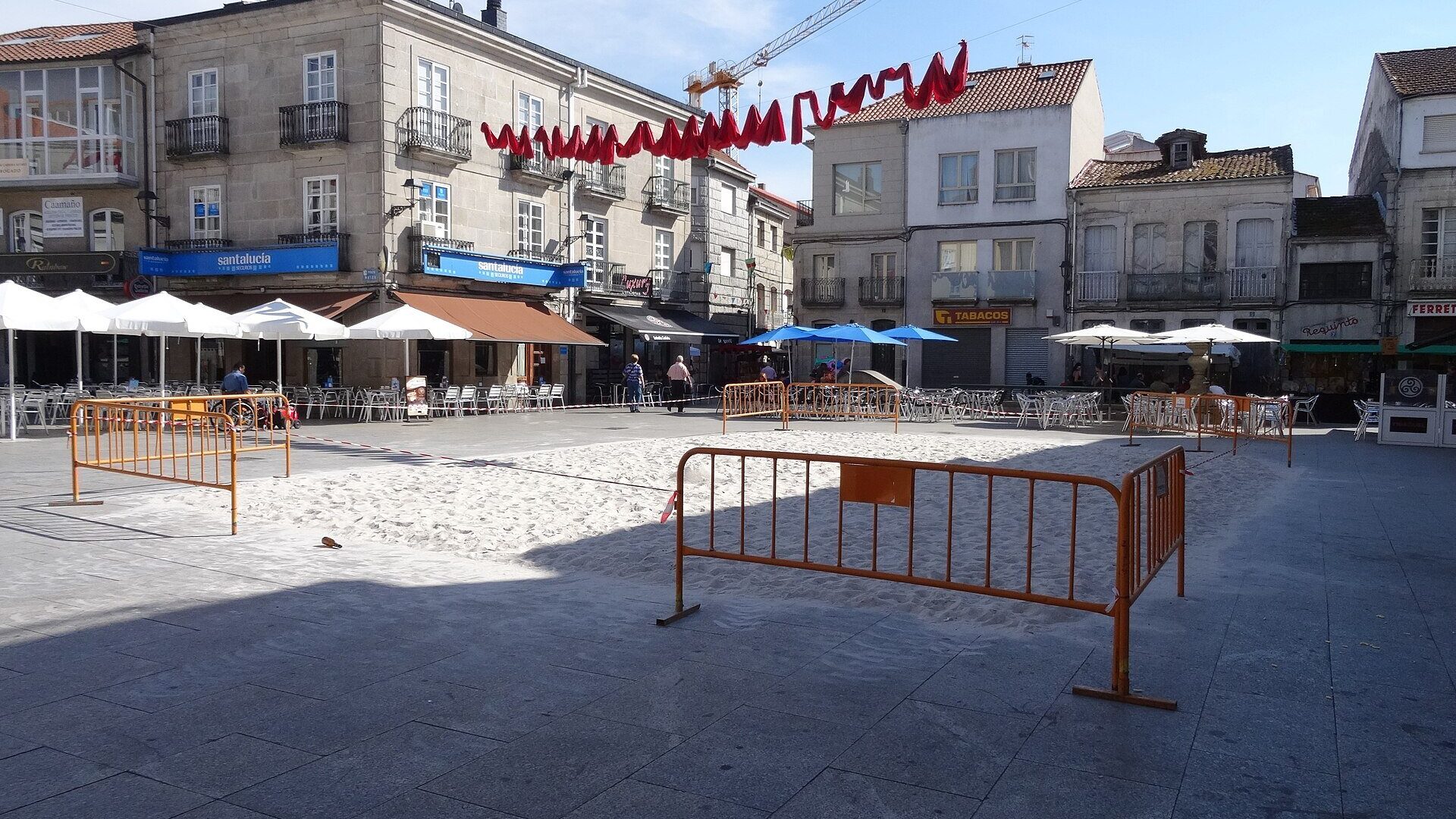
Light, chocolate, fizzy drinks and roads: the industrial and service Xinzo of the 20th century
How electricity (1911), the printing press, chocolate and soda factories, the Rubio Cold-Storage Slaughterhouse and buses to Ourense and Verín reached Xinzo, and why the railway never came, according to Edelmiro Martínez Cerredelo.
Edelmiro Martínez Cerredelo told in several pieces how Xinzo de Limia modernised in the 20th century. This page gathers the most important.
Electricity (1911)
In the late 19th and early 20th centuries the town was lit by paraffin lamps. On 29 July 1906 the councillor Rudesindo Sagrario proposed switching to acetylene gas lamps (budget of 2,500 pesetas) and on 25 July 1909 he proposed electric lighting, which the council approved with 4,250 pesetas. The auction was awarded at the end of December 1909 to Camilo Conde Conde and Francisco Conde-Valvís. The work to lay the line from the Allariz power station suffered setbacks: the storms of December 1909 and the flood of the Limia brought down the Damil bridge. Electric light finally arrived in the first days of October 1911, with the Valvís company, supplied from the Briñal and Acearrica dams, on the river Arnoia, in Allariz. In 1912 it was also installed in the church of Santa Mariña, and El Eco Antelano said that at night "the sacred precinct has an unaccustomed and solemn look" [1].
Chocolate
Chocolate factories exist in Xinzo only in the 20th century. The first of which there is news is "El Iris", of José Santiago Taboada, advertised in 1909 in Ourense’s El Miño as a "great factory of hand-made chocolates". Later there were those of Alejandro Varela (1915), José Bernárdez, Manuel Saburido ("La Ambrosía" brand) and Francisco Salgado, the "Ferrín" ("La Selecta" brand, with a grocery at the corner of Dous de Maio street and Avenida de Madrid). Salgado’s son, Antonio, continued in the 1950s with "Chocolates Berta". In 1960 only that of José Bernárdez remained, at the corner of Lepanto street and Xoán XXIII square (the "egg square"); in the 1940s and 1950s Castilians bought sacks of cocoa husk there with mule carts. It stopped being made around the early 1960s, and with it ended Xinzo’s chocolate tradition [2]. On José Santiago Taboada see Writers, artists and scholars of A Limia and Craftsmen and historic pantallas.
Soft drinks
"La Ibérica" (Primo Ramos sodas, Lola and Vanguard soft drinks) was one of Xinzo’s soda factories. In the 1950s it was on Lepanto street, the "back street", between the Estrecho house and Euloxio Portela’s carpentry, jointly owned by Primo Ramos and Luís Fariñas; later it moved to the Vilasana neighbourhood as Ramos sodas. There was another, Benito Rodríguez’s, the "Garnacha", in Vilasana. They made sodas, seltzer water in siphons and Vanguard orange, lemon and cola drinks; the water was fetched in drums, by lorry, from the Marquinas spring at the manor of Vilariño das Poldras. Bottles were washed by hand, filled by hand with syrup and closed with a pedal device in which many bottles burst [3].
The Rubio Cold-Storage Slaughterhouse
In July 1943 the Concello was asked to move to Xinzo a sausage factory and drying house from Tabernes Blanques (Valencia). In 1953 the Matadero General de la Limia, inaugurated in the 1940s, was working at full capacity and must have been the town’s largest industry by number of employees: it slaughtered on average per month 300 cows and 900 calves, which left in refrigerated lorries for Madrid, Barcelona, Valencia, Zaragoza and Bilbao, with 6,500 kg of meat per shipment. A kilo of live cow was paid at the fair at 22 pesetas and of calf at 31; the horns were sent in lots of a thousand kilos to comb and button factories [4]. Other industries of those decades: the flour factory "La Antelana", the Feculera, Propasi and Mantequerías Anduriña [4]. See Propasi, AGA and Xinzo’s Feculera.
Printing houses and the press
It is not known when printing reached Xinzo; the Bailly-Baillière yearbook records in 1901 a printing house and bookshop of Antonio Bobillo, and in 1919 that of Lino Pereda Álvarez. The local press was short-lived: El Eco Antelano (1911-1912, printed in Ourense), Juventud (1919, directed by Alejandro Álvarez, with an anti-cacique campaign), El Agrario (1919), El Camelo (1920), El Látigo (1923) and El Pueblo Antelano (1925, ten issues) [5]. See Francisco Seijo Iglesias and Antonio Nieto Oliva.
Passenger transport
Before modern roads people travelled in ox-drawn wagons, mail chairs, litters and stagecoaches. In August 1913 the Empresa Hispano Antelana ran the route from Ourense to Xinzo and extended it to Verín (seat 10 pesetas); that year "Automóviles de Verín" linked Ourense and Verín and the Mangana brothers of Xinzo advertised a service to Verín via Laza with two Hispano-Suizas with heating and electric lighting. With the motor car, the Ourense–Verín journey went from about eleven hours to four. By 1918 stagecoaches no longer ran and two companies, the Correo (stop at Francisco Ledo’s café) and "La Popular", ran the service to Ourense and Verín [6]. The text includes a traveller’s description: the road over the hills, the towers of the Castro and the Pena, the Lagoa de Antela crossed by a flat bridge, and the "magnificent entrance" to Xinzo with a long avenue of plane trees [6].
The railway that never came
Xinzo twice lost the chance of having a railway. In the late 19th century the Deputation thought of an Ourense–Allariz–Xinzo–Verín line to link at Chaves with the Portuguese railways; in 1890 José Ontaneda made a study, the Deputation accepted that of the "Zamora and Portugal Railway Galicia Ltd.", which ceded it in 1911 to a company of the engineer Sáez Díez that never began works. Later the Zamora–Ourense–Santiago route prevailed, which bypassed Allariz, Xinzo and Verín. The Concello, in an extraordinary session of 11 May 1925, rejected Mr Cantero’s Ourense–Zamora railway project and defended the variant of Eloi Luís André, of Verín, from km 14 to the Portilla da Canda, with a single tunnel at the Estibadas; the local press (Nuevo Támega and El Pueblo Antelano) supported it, but it did not prosper [7].
Links
Sources
- Edelmiro Martínez Cerredelo, «A chegada da electricidade a Xinzo de Limia (1911)», Historia de Xinzo, 29/04/2020. https://historiadexinzo.wordpress.com/2020/04/29/a-chegada-da-electricidade-a-xinzo-de-limia-1911/
- «As fábricas artesanais de chocolate en Xinzo», Historia de Xinzo, 11/07/2020. https://historiadexinzo.wordpress.com/2020/07/11/as-fabricas-artesanais-de-chocolate-en-xinzo/
- «Fábrica de gasosas Ramos. Crónica de Casares: Refrescos Lola», Historia de Xinzo, 10/01/2017. https://historiadexinzo.wordpress.com/2017/01/10/fabrica-de-gasosas-primo-ramos/
- «Matadero General de la Limia. Matadero Frigorífico Rubio», Historia de Xinzo, 21/04/2020. https://historiadexinzo.wordpress.com/2020/04/21/matadero-general-de-la-limia-matadero-frigorifico-rubio/
- «Apuntes da historia das imprentas de Xinzo de Limia», Historia de Xinzo, 12/05/2021. https://historiadexinzo.wordpress.com/2021/05/12/apuntes-da-historia-das-imprentas-de-xinzo-de-limia/
- «Transporte de viaxeiros desde Xinzo a Ourense e Verín (s. XX e XXI)», Historia de Xinzo, 21/06/2021. https://historiadexinzo.wordpress.com/2021/06/21/transporte-de-viaxeiros-desde-xinzo-a-ourense-e-verin-s-xx-e-xxi/
- «A Limia e o ferrocarril que nunca chegou», Historia de Xinzo, 21/03/2014. https://historiadexinzo.wordpress.com/2014/03/21/a-limia-e-o-ferrocarril-que-nunca-chegou/
You may also like
 History of A LimiaPrehistory and castros of A LimiaFrom the Pedra Alta de Antela to the castro of Bóveda: megaliths, the Roufeiro weapons, the Outeiro de Baltar and the gold earring of Vilar…
 History of A LimiaThe Limici in Roman inscriptions: Celer’s gladiatorial tessera and Corellius LimicusTwo epigraphic pieces outside A Limia that mention a "Limicus": the bronze gladiatorial tessera from Niebla (Huelva), of the 1st century,…
 History of A LimiaThe battle of the Xinzo bridge (23 February 1809)On 23 February 1809 farmers, abbots and friars of A Limia, poorly armed, tried to stop Soult's French vanguard at the Xinzo bridge; they…
History of A LimiaThe Limici and Romanisation: Civitas, Forum Limicorum and Via NovaWhat is known of the Limici and Roman Limia: the Civitas Limicorum, the debate over where the Forum Limicorum stood (A Cidá of Nocelo da…
 History of A LimiaThe Praza Maior, the Ladeira and the Toural: history of Xinzo’s central placesHistory of the Praza Maior (fairs since the 16th century, the 1907 Espolón, the fountain), the Ladeira and the Toural (the lagoon, the…
 History of A LimiaCinemas, café, radio, school and library: Xinzo’s cultural life from 1948 to the 1970sThe cinemas Los Molinos (1948) and Antelano (1954), the Café Ideal and the Ideal 6 disco, the 1950 radio, the Colegio Santa Marina, the…
