


Santa Mariña Festivities in Xinzo de Limia
The patron saint festivities of Xinzo de Limia, around 18 July: procession from the old church, solemn Mass, the game of la chave, orchestras and concerts over several days.
- When
- Around 18 July, the saint's day
- Where
- Xinzo de Limia, between the old and the new church
- Patron saint
- Santa Mariña, of the parish and the municipality
- Tradition
- Procession and the game of la chave
The Santa Mariña festivities are the patron saint festivities of Xinzo de Limia. They are held around 18 July, the saint’s day, patron of the parish and of the municipality, and last several days in which the procession and the solemn Mass mix with orchestras, concerts and attractions for all ages [1][5][6].
When the festivities take place
The rule is simple: the big day is 18 July, the liturgical feast of Santa Mariña and, according to tradition, the day of her martyrdom [1][2][6]. Around that day the Concello, through its Festivities councillorship, organises a programme of several days; in 2026, for example, the festivities ran from Thursday 16 to Monday 20 July, five days with the main stage on the Toural esplanade [5]. The parish also has a co-patron, Saint Sebastian, celebrated on 20 January [1].
The patron saint’s day
18 July concentrates the most traditional events: the dawn serenade, Mass, the procession and the street parades with giants and big-heads [5]. The parish chronicle of the 2023 festivity describes a typical day: Mass in the morning in the old church; at twelve, a procession from the old church with the images of Santa Mariña and the Virgin of Carmen, the banners and the flag of the Nocturnal Adoration, accompanied by the Concello’s Bagpipe and Percussion Band and the Agrupación Musical da Limia and with the municipal corporation present; on reaching the new church, a sung Eucharist by the Coral Santa Mariña; and another Mass in the afternoon [7]. Along the route, the procession stopped to pray at the Santa Mariña housing estate [7].
Music, games and traditions
Around the big day, the municipal programme offers top-level orchestras and artists, the foam party, a small market, family activities, a vermouth session and water inflatables, closing with an orchestra on the last day [5].
Some sporting and popular traditions accompany the festivity:
- The game of la chave: on 18 July the «Manolo Santana» memorial is played, which by 2019 had already been traditional for several years [8].
- Bullfights: as Edelmiro Martínez Cerredelo recalls, in the sixties, seventies and eighties several bullfights were held during the Santa Mariña festivities, sometimes in the Seara field and above all in O Pombal [9].
- The festivity programme was also a cultural medium: Martínez Cerredelo cites a text by Carlos Casares on the origin of the name of the river Limia published in the programme of the 1967 Santa Mariña festivities [11].
Who Santa Mariña was
Santa Mariña of Augas Santas is a Christian martyr whose life mixes history and legend [10]. The first account of her story was written by Bishop Muñoz de la Cueva in 1727, and according to him she was born in the year 123 in Antioch, a city that tradition identifies with the town of Xinzo itself or with Forum Limicorum [2][1].
The legend, as Martínez Cerredelo collects it in his book Historia de Xinzo de Limia, tells that her mother died in childbirth and that her father, Teudio, governor of the province in the time of Hadrian, gave the girl to a wet nurse from Piñeira de Arcos [2]. Raised in the Christian faith, she was rejected by her father; the parish website says she was then nine years old [1]. At fifteen, while tending the cattle, she was seen by the Roman prefect Olibrius, who wanted to make her his wife or slave; when she refused, she was flogged, imprisoned and sentenced to die in a furnace, from which she emerged unharmed. Finally she was beheaded: the head bounced three times on the ground and at each blow a spring gushed forth [2][1]. Her body rests in the church of Santa Mariña de Augas Santas, in the municipality of Allariz [2].
Wikipedia notes that the cult spread through many dioceses and that the feast was fixed on 18 July once Baronius included it in the Roman Martyrology of 1586, although there is no reliable data about the saint’s real life [10]. There is also a version that makes her one of nine sisters born in Braga, daughter of the governor Lucius Catilius Severus [10].
The old church: two thousand years underground
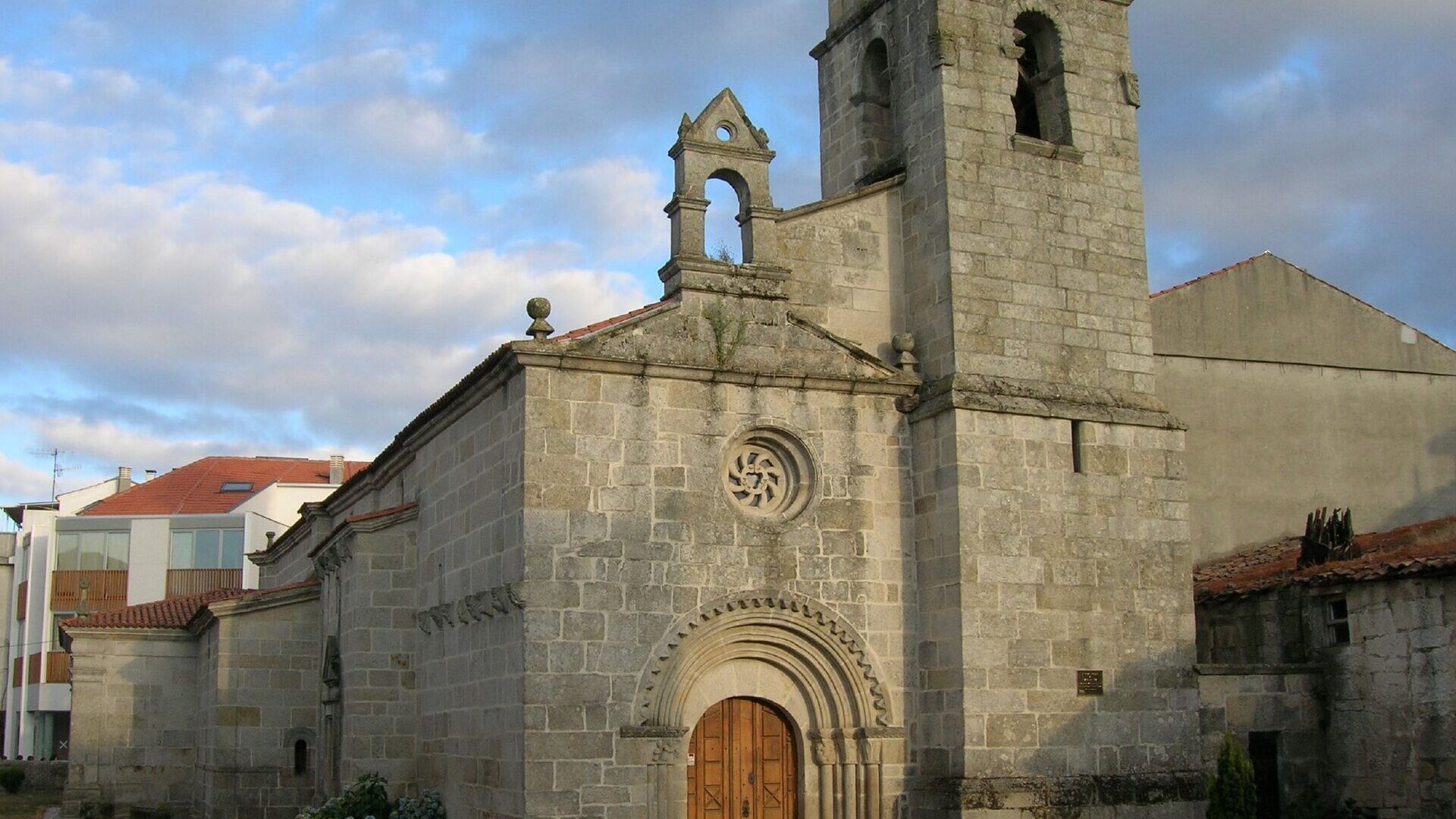
The festivity is staged around the old church of Santa Mariña, which the Concello describes as an archaeological landscape resulting from a centuries-long process [6].
- Roman remains: the excavation campaign directed by the archaeologist Manuel Xusto Rodríguez between November 1995 and February 1996 uncovered remains of the Roman world from the Flavian period (last quarter of the 1st century) to the mid-2nd, structures of the 3rd and 4th centuries, a late-Roman necropolis of tegula tombs and Paleo-Christian remains [4]. Many researchers link this site with Forum Limicorum [4][3].
- A very old temple: the parish indicates there are signs that the church has existed since the 8th century, judging by the apse of a chapel found in the excavations [1].
- The Romanesque fabric: of the 12th-century church the doorway and a stretch of wall remain; the doorway has three plain arches, plant-motif capitals and praying figures, a scallop shell recalling the Camino de Santiago and diamond points on the lintel [3][6].
- Alterations: in 1595 the visitor ordered it demolished for being too small; the bell tower was built from 1608, with the coat of arms of the Count of Monterrei; in 1613 it was ordered to raise the churchyard so that water would not get in; and the last major renovation finished in 1997 [1][3].
The new church, where the procession ends, was begun in 1908 and not finished until 1965; its façade has stained-glass windows of Santa Mariña and Saint Sebastian [1][3].
Xinzo has another great summer event, the Festa do Esquecemento, which recreates the arrival of the Romans at the river Limia. For other festivities in the comarca, see Festivities of A Limia and the entry on the parish of Xinzo de Limia.
FAQ
When are the Santa Mariña festivities?
Around 18 July, the patron saint’s day, with a programme of several days that in 2026 ran from 16 to 20 July [5][1].
What happens on 18 July?
Dawn serenade, Mass, a procession from the old church with the images of Santa Mariña and the Virgin of Carmen, and street parades with giants and big-heads [5][7].
Where are the orchestras?
The main stage for the musical nights is the Toural esplanade [5].
Why is Santa Mariña the patron saint of Xinzo?
Because tradition makes the saint a native of Antioch, a city identified with Xinzo itself, where her father, Teudio, lived [2][1].
Can the old church be visited?
Yes, it is in the historic centre of the town; some remains found in the excavations decorate its churchyard [1].
Sources
- Parroquia de Santa Mariña de Xinzo de Limia, «Historia», 11-03-2021. https://santamarinadexinzo.com/xinzo/historia/
- Edelmiro Martínez Cerredelo, «A lenda da Santa Mariña, patroa de Xinzo de Limia, festa que se celebra o 18 de xullo», Historia de Xinzo, 17-07-2014. https://historiadexinzo.wordpress.com/2014/07/17/a-lenda-da-santa-marina-patroa-de-xinzo-de-limia-festa-que-se-celebra-o-18-de-xullo/
- Edelmiro Martínez Cerredelo, «Parroquia de Santa Mariña de Xinzo de Limia», Historia de Xinzo, 11-06-2017. https://historiadexinzo.wordpress.com/2017/06/11/parroquia-de-santa-marina-de-xinzo-de-limia/
- Edelmiro Martínez Cerredelo, «Informe histórico en que se fundamenta a orixe e motivo da celebración da Festa do Esquecemento na vila de Xinzo de Limia», Historia de Xinzo, 01-07-2026. https://historiadexinzo.wordpress.com/2026/07/01/informe-historico-en-que-se-fundamenta-a-orixe-e-motivo-da-celebracion-da-festa-do-esquecemento-na-vila-de-xinzo-de-limia/
- Concello de Xinzo de Limia, «Xinzo de Limia vivirá cinco días de grandes festas…», 29-06-2026. https://www.xinzodelimia.gal/festexos/festas-patronais/xinzo-limia-vivira-cinco-dias-grandes-festas-concertos-primeiro-nivel-tradicion-diversion-todas-idades/20260629182509007096.html
- Concello de Xinzo de Limia, «A cidade». https://www.xinzodelimia.gal/estaticas/a-cidade.html — versión antiga, Wayback (24-08-2016): https://web.archive.org/web/20160824213457/http://www.xinzodelimia.es:80/estaticas/a-cidade/
- Parroquia de Santa Mariña de Xinzo de Limia, «Santa Mariña 2023». https://santamarinadexinzo.com/santa-marina-2023/
- Concello de Xinzo de Limia, «Torneo de chave das festas de Santa Mariña 2019», 19-07-2019. https://www.xinzodelimia.gal/deportes/torneo-chave-festas-santa-marina-2019/20190719213440003933.html
- Edelmiro Martínez Cerredelo, «As touradas nas festas de Xinzo», Historia de Xinzo, 15-03-2018. https://historiadexinzo.wordpress.com/2018/03/15/as-touradas-nas-festas-de-xinzo/
- «Marina of Aguas Santas», Wikipedia en inglés (CC BY-SA 4.0). https://en.wikipedia.org/wiki/Marina_of_Aguas_Santas
- Edelmiro Martínez Cerredelo, «O río Limia, o río do esquecemento», Historia de Xinzo, 31-10-2018 (nota 1). https://historiadexinzo.wordpress.com/2018/10/31/o-rio-limia-o-rio-do-esquecemento/
You may also like
 Festivals of A LimiaFestivals of A Limia month by monthCalendar of the festivals and fairs of A Limia documented in the corpus: Entroido in February or March, Santa Cruz de Lamas in May, San…
 Festivals of A LimiaCalendar of patron-saint festivals, pilgrimages and magostos of A LimiaCalendar of the patron-saint festivals, pilgrimages, magostos and traditional fairs of the concellos of A Limia (except Os Blancos), with…
 FestivalThe magosto in A LimiaThe magosto in A Limia and Limia-Arnoia: the festival of chestnuts, fire and new wine in November, its origin linked to Samaín and the…
