


The Middle Ages in A Limia: frontier, towers and castles
Medieval A Limia, a border land between Galicia, León and Portugal: Ouvigo and Odoino's will, Afonso Henriques in 1130, the towers of A Pena, Sandiás and A Forxa, the irmandiños of 1467 and the destruction of the Picoña in 1650.
- Frontier
- Galicia–Portugal, disputed from 1130
- Towers
- A Pena (Xinzo), Castro (Sandiás), A Forxa (Porqueira), A Picoña (Calvos de Randín)
- Irmandiño revolt
- 1467 (Sandiás tower)
- Monterrei–Lemos ruling
- 1610
The Middle Ages in A Limia are, above all, the history of a border land. Between the kingdoms of Galicia and León and the new kingdom of Portugal, the comarca saw towers and castles rise and change hands several times. This page summarises the best-documented facts and points out the doubts that remain. For earlier times see The Limici and Romanisation; for the following centuries, The early modern period in A Limia.
From the Empire to the early Middle Ages
The early Christian sanctuary of Ouvigo (Os Blancos), an oratory of the late 4th or early 5th century discovered by Antonio Rodríguez Colmenero in the summer of 1971, is one of the oldest Christian testimonies in the comarca; in the repopulation under Alfonso III there is a new building impulse and one of the graves has a tablet dated to the year 904 [8]. Later, the will of the monk Odoino (982), in the Celanova cartulary, speaks of clashes between Galician counts centred on A Limia (see The battle of Aguioncha, 966).
Afonso Henriques and the Portuguese border
According to the Galipedia, in 1130 Afonso Henriques, after taking Tui, entered A Limia with the help of the tenente Rodrigo Pérez and incorporated it into his crown, building the castle of Celme; in 1169, after the Badajoz disaster, he had to return Toroño and A Limia to Ferdinand II of León [1]. The data should be checked against the biography of Afonso Henriques at the Real Academia de la Historia.
The frontier towers
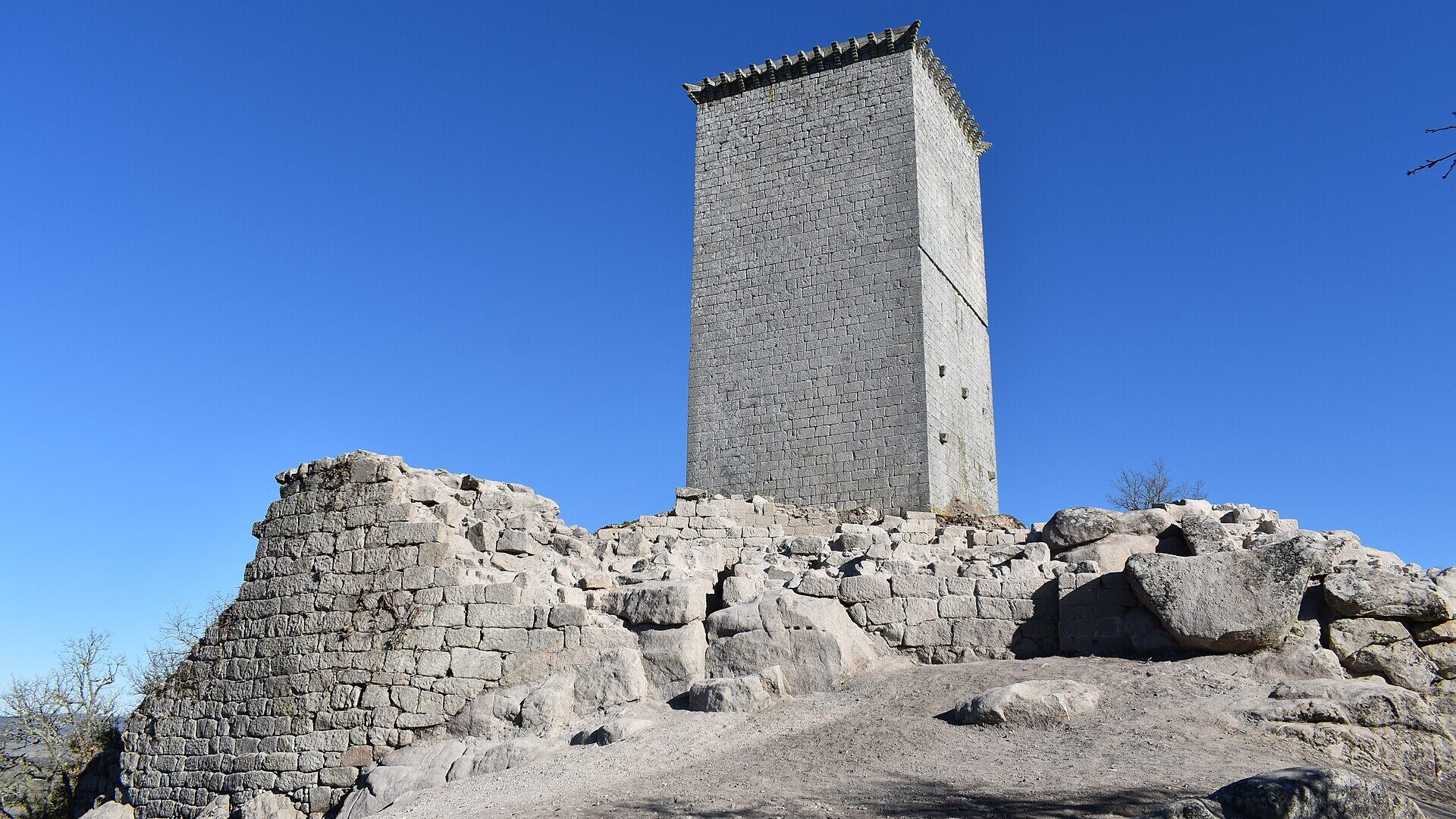
- Torre da Pena (Xinzo de Limia). The first documented mention is from 1217, when Alfonso IX gave his daughters Sancha and Dulce the castellum of Portela; in 1336 Alfonso XI granted it to Rui Páez de Biedma [2]. Adolfo Taboada places the tower’s foundation in the first third of the 14th century and gives the 1406 marriage of Elvira de Biedma to Diego López de Zúñiga, lord of Monterrei [3]. In spring 1387 the Duke of Lancaster occupied the castles of A Limia [2]. The ruling of 16 September 1610 gave the fortress to the Count of Lemos after a long lawsuit with Monterrei [2]. It is at Torre da Pena.
- Torre do Castro (Sandiás). According to Fronteira Esquecida, it was built in the 12th century, in the struggles between Alfonso VII and Afonso I of Portugal over the county of A Limia; in the 15th century it belonged to Alonso Pimentel, Count of Benavente, and in 1467, in the second irmandiño revolt, Alonso de Paredes’s men tore it down and burned it [4][5]. See Torre do Castro of Sandiás.
- Torre da Forxa (Porqueira). In 1157 Alfonso VII ceded the monastery or castle of Porqueira to the cathedral of Ourense and in 1204 Alfonso IX sold the bishop what he had there for 2,500 sueldos [6]. In 1387 it was briefly occupied by the Duke of Lancaster and in the second half of the 15th century, by then belonging to the house of Monterrei, the irmandiños attacked it without demolishing it; it was the council house from 1837 and has been a BIC since 17 November 1994 [6].
- Picoña castle (Calvos de Randín). A Portuguese castle linked to the Couto Mixto: according to Fronteira Esquecida, it was ordered built by Alfonso III of León in the 10th century, destroyed by Castilian troops in the 14th century, rebuilt, appears in the Livro das Fortalezas and was destroyed in 1650 in the War of Restoration [7]. In 1864 the Treaty of Limits passed its territory to Spain. See History of the Couto Mixto.
Smuggling and a blurred border
In the Upper Limia of the 15th century the border was poorly defined and the area was one of contact rather than separation: in 1447 and 1479 the council of Ourense banned buying stolen livestock from Portugal [9].
Frequently asked questions
How many towers defended A Limia? The Torre da Pena source speaks of four A Limia towers on the border with Portugal; the best known are A Pena, Sandiás, A Forxa and A Picoña [2][4][6][7].
Who tore down the Sandiás tower? Alonso de Paredes’s men, in the irmandiño revolt of 1467 [4].
Links
Sources
- «Xinzo de Limia», Galipedia (CC BY-SA 4.0). https://gl.wikipedia.org/wiki/Xinzo_de_Limia
- Edelmiro Martínez Cerredelo, «A Torre de Pena (Xinzo de Limia)», Historia de Xinzo, 12-10-2018. https://historiadexinzo.wordpress.com/2018/10/12/a-torre-de-pena-xinzo-de-limia/
- Adolfo Taboada Sanz, «A torre-castelo de Pena», Historia de Xinzo, 10-07-2023. https://historiadexinzo.wordpress.com/2023/07/10/a-torre-castelo-de-pena-por-adolfo-taboada-sanz/
- Fronteira Esquecida, «Torre do Castro de Sandiás». https://fronteiraesquecida.eu/en/fichas/tower-of-sandias-castro-tower/
- Concello de Sandiás, «Coñece Sandiás». https://www.sandias.es/conece-sandias/
- «Torre da Forxa», Galipedia (CC BY-SA 4.0). https://gl.wikipedia.org/wiki/Torre_da_Forxa
- Fronteira Esquecida, «Castelo da Picoña». https://fronteiraesquecida.eu/en/fichas/piconha-castle/
- Antonio Rodríguez Colmenero, «O oratorio paleocristián de Ouvigo», Museo Arqueolóxico Provincial de Ourense, setembro de 2003. https://musarqourense.xunta.gal/sites/default/files/doc/peza_mes/2003/9/pm_2003_09_esp.pdf
- J. A. Vila Álvarez e S. Moure Fraga, Minius XV, 2007, pp. 339–346. https://revistas.uvigo.es/index.php/mns/article/download/3135/2929/6259
You may also like
 History of A LimiaPrehistory and castros of A LimiaFrom the Pedra Alta de Antela to the castro of Bóveda: megaliths, the Roufeiro weapons, the Outeiro de Baltar and the gold earring of Vilar…
 History of A LimiaThe Limici in Roman inscriptions: Celer’s gladiatorial tessera and Corellius LimicusTwo epigraphic pieces outside A Limia that mention a "Limicus": the bronze gladiatorial tessera from Niebla (Huelva), of the 1st century,…
 History of A LimiaThe battle of the Xinzo bridge (23 February 1809)On 23 February 1809 farmers, abbots and friars of A Limia, poorly armed, tried to stop Soult's French vanguard at the Xinzo bridge; they…
History of A LimiaThe Limici and Romanisation: Civitas, Forum Limicorum and Via NovaWhat is known of the Limici and Roman Limia: the Civitas Limicorum, the debate over where the Forum Limicorum stood (A Cidá of Nocelo da…
 History of A LimiaThe Praza Maior, the Ladeira and the Toural: history of Xinzo’s central placesHistory of the Praza Maior (fairs since the 16th century, the 1907 Espolón, the fountain), the Ladeira and the Toural (the lagoon, the…
History of A LimiaLight, chocolate, fizzy drinks and roads: the industrial and service Xinzo of the 20th centuryHow electricity (1911), the printing press, chocolate and soda factories, the Rubio Cold-Storage Slaughterhouse and buses to Ourense and…
