


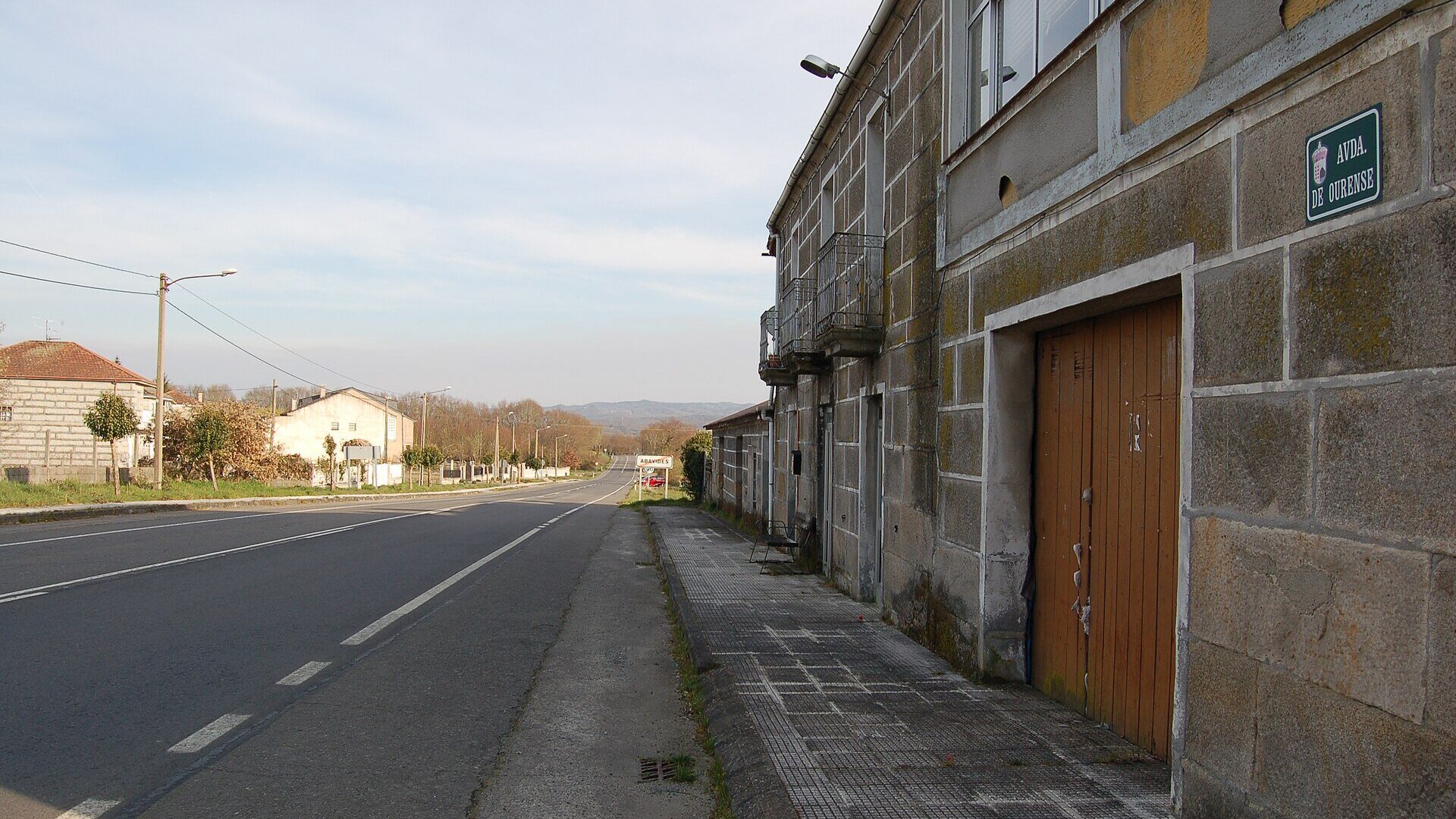
The Villacastín-Vigo road and Xinzo as seat of the judicial district
Xinzo de Limia on the map of communications and justice: the Villacastín-Vigo road (1860-1863), today the N-525, which crosses the town, and the Xinzo judicial district, grouping the comarca's ten concellos with its seat on Rúa Ladeira.
- Road
- Villacastín-Vigo, 572 km, built mostly between 1860 and 1863
- Modern route
- N-525 (and other national roads in stretches)
- Judicial district
- no. 3 of the province of Ourense
- Concellos in the district
- 10, headed by Xinzo de Limia
Xinzo de Limia has been, for over a century and a half, a hub of communications and justice in south-eastern Ourense. Two of the keys are the road that crosses the town and the judicial district of which it is the seat [1][2].
The Villacastín-Vigo road
The Villacastín-Vigo road, laid out and built for the most part between 1860 and 1863, was 572 kilometres long and linked Villacastín (Segovia) with Vigo through Ávila, Peñaranda de Bracamonte, Salamanca, Zamora, Puebla de Sanabria, Verín, Xinzo de Limia, Ourense and O Porriño. It is the historic corridor that Fialho de Almeida travelled by stagecoach in 1905, from Ourense via Allariz to Xinzo and Verín; see Xinzo in 1905 [1].
Because of its strategic importance, some theories hold that it came close to being national radial VII in the Law of Bases of Railway Planning and Road Transport of 1941, but the Spanish Wikipedia says that is an erroneous theory with no documentary basis: the General Plan of Public Works of 1940 does not mention a seventh radial, and lists the road as sub-radial N-525. Even today the name "Villacastín-Vigo" survives in many streets of the towns along the route. The current route coincides, by increasing kilometre mark, with several national roads (N-110, N-501, N-630, N-631, N-525 and N-120), and all but the N-631 have been dualled or converted into motorway [1].
On vehicle traffic on the road, see Transport and accidents in A Limia.
The judicial district of Xinzo
The judicial district of Xinzo de Limia is one of the 45 in Galicia and number 3 in the province of Ourense. It comprises the ten concellos of the comarca: Baltar, Os Blancos, Porqueira, Rairiz de Veiga, Sandiás, Sarreaus, Trasmiras, Vilar de Barrio, Vilar de Santos and Xinzo de Limia. The seat of the judicial institutions is Xinzo, on Rúa Ladeira, where there is a Court of First Instance and Instruction [2]. On the town’s weight in the 20th century, see Xinzo: industry and services in the 20th century.
Frequently asked questions
Which concellos make up the Xinzo judicial district? Baltar, Os Blancos, Porqueira, Rairiz de Veiga, Sandiás, Sarreaus, Trasmiras, Vilar de Barrio, Vilar de Santos and Xinzo de Limia [2].
Which road crosses Xinzo? The Villacastín-Vigo, today the N-525 in its Galician stretch [1].
Links
- History of A Limia
- Xinzo in 1905 according to Fialho de Almeida
- Xinzo: industry and services in the 20th century
- Transport and accidents in A Limia
Sources
- «Carretera Villacastín-Vigo», Wikipedia en español (CC BY-SA 4.0). https://es.wikipedia.org/wiki/Carretera_Villacasti%C3%ADn-Vigo
- «Partido judicial de Ginzo de Limia» (cita), Wikipedia en español (CC BY-SA 4.0). https://es.wikipedia.org/wiki/Partido_judicial_de_Ginzo_de_Limia
You may also like
 History of A LimiaPrehistory and castros of A LimiaFrom the Pedra Alta de Antela to the castro of Bóveda: megaliths, the Roufeiro weapons, the Outeiro de Baltar and the gold earring of Vilar…
 History of A LimiaThe Limici in Roman inscriptions: Celer’s gladiatorial tessera and Corellius LimicusTwo epigraphic pieces outside A Limia that mention a "Limicus": the bronze gladiatorial tessera from Niebla (Huelva), of the 1st century,…
 History of A LimiaThe battle of the Xinzo bridge (23 February 1809)On 23 February 1809 farmers, abbots and friars of A Limia, poorly armed, tried to stop Soult's French vanguard at the Xinzo bridge; they…
History of A LimiaThe Limici and Romanisation: Civitas, Forum Limicorum and Via NovaWhat is known of the Limici and Roman Limia: the Civitas Limicorum, the debate over where the Forum Limicorum stood (A Cidá of Nocelo da…
 History of A LimiaThe Praza Maior, the Ladeira and the Toural: history of Xinzo’s central placesHistory of the Praza Maior (fairs since the 16th century, the 1907 Espolón, the fountain), the Ladeira and the Toural (the lagoon, the…
History of A LimiaLight, chocolate, fizzy drinks and roads: the industrial and service Xinzo of the 20th centuryHow electricity (1911), the printing press, chocolate and soda factories, the Rubio Cold-Storage Slaughterhouse and buses to Ourense and…
