

Transport and accidents in A Limia: Monteagudo 1944, Trasmiras 1997 and Prado station
The British Hudson that crashed at Monteagudo (Calvos de Randín) in 1944, the 1997 accident at the Trasmiras airfield and the disused halt of A Albergaría-Prado, on the edge of Vilar de Barrio.
Three episodes in the history of transport touch A Limia: an Allied warplane, a light aircraft at an abandoned airfield and a railway halt without trains. The information comes from the Galipedia [1][2][3].
The Monteagudo accident (22 February 1944)
A Lockheed Hudson (EW916) of No. 48 Squadron of the Royal Air Force was flying from Gibraltar to England with twelve other aircraft. The squadron was returning to be re-equipped with Douglas Dakotas and become a transport unit for Operation Overlord, three months before D-Day. The aircraft was carrying artillery; on board were three Britons (John William Simpson, Ivor John Williams and George Benjamin Partt) and three Canadians (James Douglas Morgan, Alexander Stalker and Alfred Ian Gregg) [1].
At 4 a.m. it grazed a hill at Montalegre, in Portugal, and struck the summit of Monteagudo, near the places of Vilar and Vilariño, in the parish of Randín (Calvos de Randín), 40 metres from the border. It slid 800 m down the northern slope and the munitions and explosives went off; the fire lasted six hours. All on board died, although the pilot was thrown clear still strapped to his seat. Another Hudson from the same mission crashed in the Portuguese Serra da Estrela. The event inspired Luís García Mañá’s novel Por que as sombras non teñen ollos (Xerais, 2015) [1].
The Trasmiras accident (12 April 1997)
A light aircraft crashed at the Trasmiras airfield soon after take-off and two people were killed. The airfield was abandoned afterwards; years later someone was convicted of stealing parts from the crashed aircraft [2].
A Albergaría-Prado station
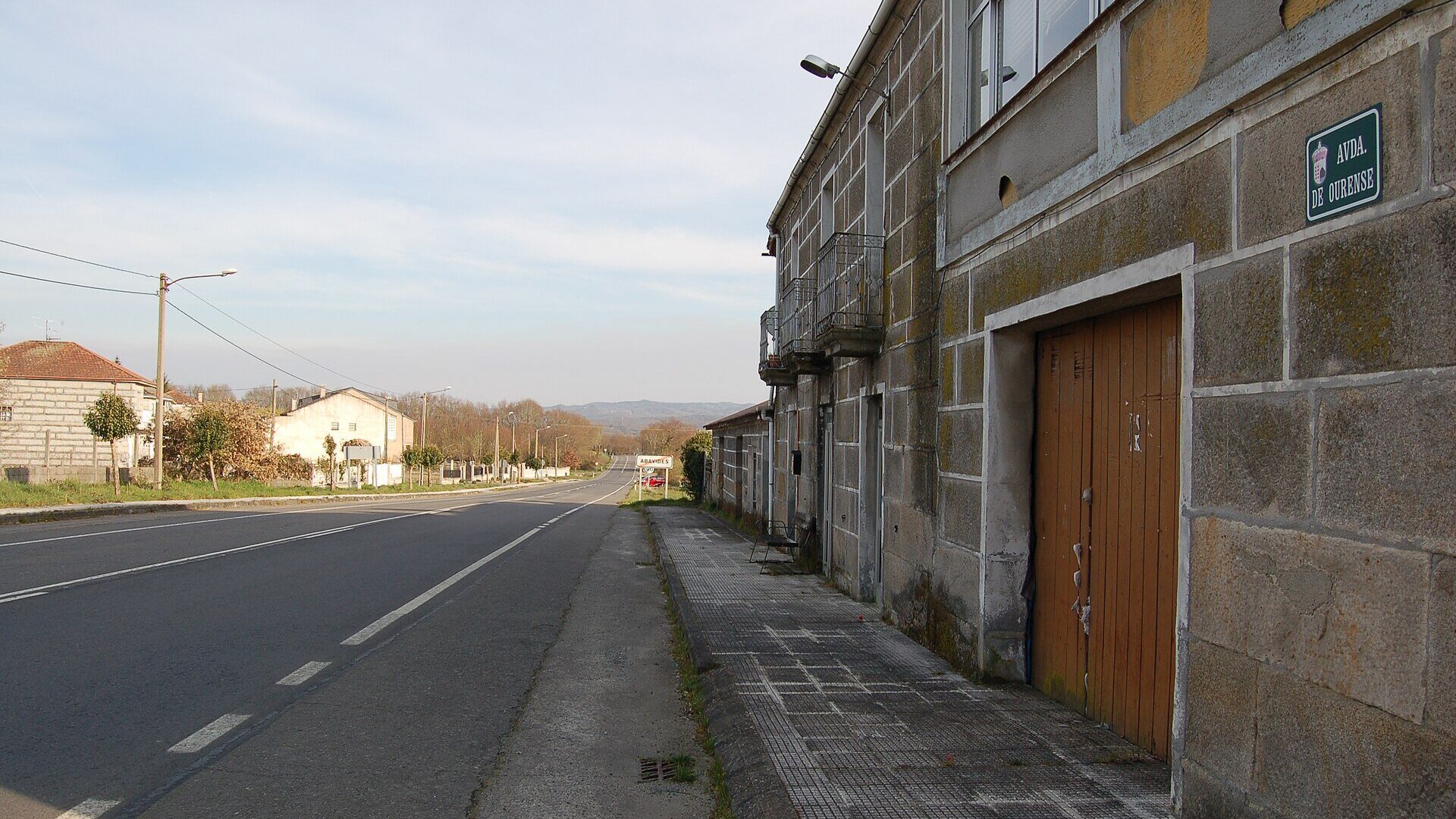
It is an Adif halt on the boundary between the parishes of Castro de Laza (Laza) and Prado (Vilar de Barrio), 2.5 km from the village of Prado and 4.5 km from A Albergaría, at kilometre point 194.086 of the Zamora–A Coruña line via Ourense, at 767 m above sea level, between Laza-Cerdedelo and Vilar de Barrio, near the Serra Pequena tunnel (1,876 m). It opened on 1 July 1957 with the Ourense–A Pobra de Sanabria section and has had no service since the line closed in 2013 [3].
Links
Sources
- «Accidente de Monteagudo», Galipedia (CC BY-SA 4.0). https://gl.wikipedia.org/wiki/Accidente_de_Monteagudo
- «Accidente de Trasmiras», Galipedia. https://gl.wikipedia.org/wiki/Accidente_de_Trasmiras
- Article «Estación da Alberguería-Prado», Galipedia. https://gl.wikipedia.org/wiki/Estación_da_Alberguería-Prado
You may also like
 Curiosities of A LimiaThe miser of Xinzo: José Oterino’s hidden fortune (1891)In November 1891 José Oterino, aged 43, died in Xinzo and the judge found 432 gold ounces in his house: the "miser of Xinzo" appeared in…
Curiosities of A LimiaXinzo at the 1878 Paris Universal Exhibition: the soap and linen of A LimiaIn 1878 José Romero took Xinzo's linen and soaps to the Paris Universal Exhibition: he won a gold medal for the linen and an honourable…
Curiosities of A LimiaThe Escornabois plague (1598-1599): 118 dead in a Limia parishBetween September 1598 and 1599 the plague killed 118 people in Santa Mariña de Escornabois (Trasmiras); the priest Francisco Rodríguez…
 Curiosities of A LimiaThe great Randín fire (1889) and the solidarity that followedOn 20 November 1889 a fire left Randín (Calvos de Randín) almost in ashes, with straw roofs and strong wind; press figures vary, and aid…
 Curiosities of A LimiaFair traders, cinzarradas and proxy weddings: customs of old XinzoThree customs of 20th-century Xinzo told by Edelmiro Martínez Cerredelo: the traders at the fairs of the 14th and 27th and Remy of the…
 Curiosities of A LimiaThe 1918 flu in Xinzo de Limia and MoreirasIn autumn 1918 the flu killed 60 people in the concello of Xinzo and 56 in that of Moreiras, which had far fewer inhabitants; Xinzo's first…
