

Inés de Castro, the Queen Tradition Says Was Born in A Limia
Inés de Castro (c. 1320 – Coimbra, 1355), natural daughter of a Galician nobleman, loved Prince Pedro of Portugal, was executed on Afonso IV's orders and crowned queen posthumously; A Limia claims her as a daughter of its land.
Inés de Castro was born, according to the biographical entry of the Real Academia de la Historia, in A Limia (Ourense) on 17 December 1320 (the date carries a question mark) and died in Coimbra on 7 January 1355. She became Queen of Portugal after her death [1].
Life
She was the natural daughter of Pedro Fernández de Castro and the Portuguese lady Aldonza Soares de Valladares. Her mother’s early death and her distant kinship with the Castilian royal family took her to Peñafiel (Valladolid), to the court of the infante-poet don Juan Manuel [1].
In 1341 she travelled to the Portuguese court as lady-in-waiting to Constanza Manuel, betrothed of Prince Pedro (1320-1367), of whom she soon became the lover; the relationship was consolidated by Constanza’s death in 1345. Inés’s growing influence alarmed King Afonso IV, above all because behind her stood her brothers, heads of the Castilian party of the Castros, which might involve Portugal in the dynastic struggles over the crown of Castile [1].
Retired to Coimbra, Pedro and Inés had three children, Beatriz, João and Dinis (another, Afonso, lived only a few months). If the union were regularised, they were strong candidates for the throne to the detriment of the future Fernando I, son of Constanza. For that reason, with the court’s backing, Afonso IV decreed Inés’s execution, carried out by three court knights (Álvaro Gonçalves, Pero Coelho and Diogo Lopes Pacheco) on 7 January 1355 at the Quinta das Lágrimas in Coimbra [1].
Pedro’s revenge and the posthumous coronation
After Inés’s death the prince took up arms against his father and led a civil war for two years. Soon after peace was signed, Afonso IV’s death brought him to the throne in 1357. Pedro I executed Inés’s murderers (except Pacheco, who fled to the papal court in Avignon), proclaimed the marriage he said he had secretly contracted in 1354 and, when the Cortes of Cantanhede recognised it, crowned Inés Queen of Portugal [1].
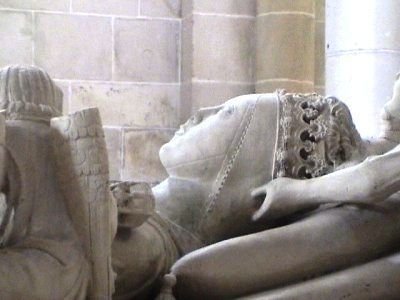
Legend says that Pedro I had his wife’s corpse exhumed and forced the court to pay homage to her. This is probably only an idealisation of the transfer of her remains to the mausoleum he had built in the monastery of Santa Maria de Alcobaça (1360), which the king supervised personally, so that the recumbent statue is regarded as the most faithful portrait of the queen [1].
A theme in literature and art
The story first appears in the Crónica de Afonso IV (14th century). Verses were inspired by García de Resende (Trovas à morte de dona Inês de Castro, 1516) and Mota; Camões mentioned her in Os Lusíadas (1572) and António Ferreira wrote the first dramatic work of the Portuguese theatre, Tragédia de dona Inês de Castro (1558). From Portuguese literature it passed into Spanish: Jerónimo Bermúdez (Nise lastimosa, 1577), Luis Vélez de Guevara (Reinar después de morir, 1625) and, in the 20th century, Alejandro Casona (Corona de amor y muerte, 1955). Lope de Vega wrote a drama now lost. In France she was brought to the stage by Houdar de la Motte (1723), Victor Hugo (1822) and Henry de Montherlant (La reine morte, 1942); there were operas by Persiani (1835) and Thomas Pasatieri (1976), a painting by Martínez Cubells (1887), the Spanish-Portuguese film of 1944 and the Galician-Portuguese co-production Inés de Portugal (1997) [1].
A Limia and the Torre da Pena
The Academy of History entry places her birth in A Limia, and the Torre da Pena (Xinzo de Limia) appears in local legends as the place where she was born. The blog Historia de Xinzo illustrates the entry with a photo of the castle of A Pena, by Pepe Xoga [1]. A distinction must be made: the date and the specific place of her birth are not documented, and the link with the tower belongs to oral tradition and legend.
Links
- People of A Limia
- A Pena, parish of the Torre da Pena
- History of A Limia
Sources
- María Pilar Queralt del Hierro, «Castro, Inés de», Diccionario Biográfico electrónico of the Real Academia de la Historia, reproduced in Historia de Xinzo, 27/03/2023. https://historiadexinzo.wordpress.com/2023/03/27/ines-de-castro-a-limia-ourense-17-xii-1320-coimbra-portugal-7-0i-1355-raina-de-portugal/
- «[Idade Media / lenda] Inés de Castro e o cárcere da Pena: a tradición di que Inés de Castro naceu na torre, pero non hai respaldo documental. A torre conservous». https://fronteiraesquecida.eu/en/fichas/watchtower-pena/.
You may also like
 Notable personOlimpia Valencia López, the First Woman in Galicia to Graduate in MedicineBorn in Baltar in 1898, Olimpia Valencia was the first Galician woman to graduate in Medicine (1925) and in 1928 opened a general medicine…
 Notable personAntón Tovar, the Poet of A Pereira (Rairiz de Veiga)Antón Tovar Bobillo (A Pereira, Rairiz de Veiga, 1921 – Ourense, 2004) was an existentialist poet in Galician and Spanish, honorary member…
 Notable personCarlos Casares, the Writer Who Grew Up in Xinzo de LimiaCarlos Casares (Ourense, 1941 – Vigo, 2002) spent his childhood in Xinzo de Limia, between Lamas and Sabucedo; he was a novelist, RAG…
 Notable personAlfredo Nan de Allariz, Poet and Playwright from Xinzo in HavanaAlfredo Fernández, «Nan de Allariz», was born in Xinzo de Limia (1874 or 1875) and died in Madrid in 1927; poet, playwright and composer,…
 People of A LimiaHistorical Figures of A Limia: A TimelineTimeline of historical figures linked to A Limia, from Roman times to the 20th century: Limicians of Rome, Hidatius, counts, medieval…
 Notable personCástor Méndez Brandón, Baritone and Folk-Song Poet Born in XinzoCástor Méndez Brandón (Xinzo de Limia, 1864 – Celanova, 1920) was a lawyer, baritone at the Teatro Real in Madrid, poet and mayor of…
