

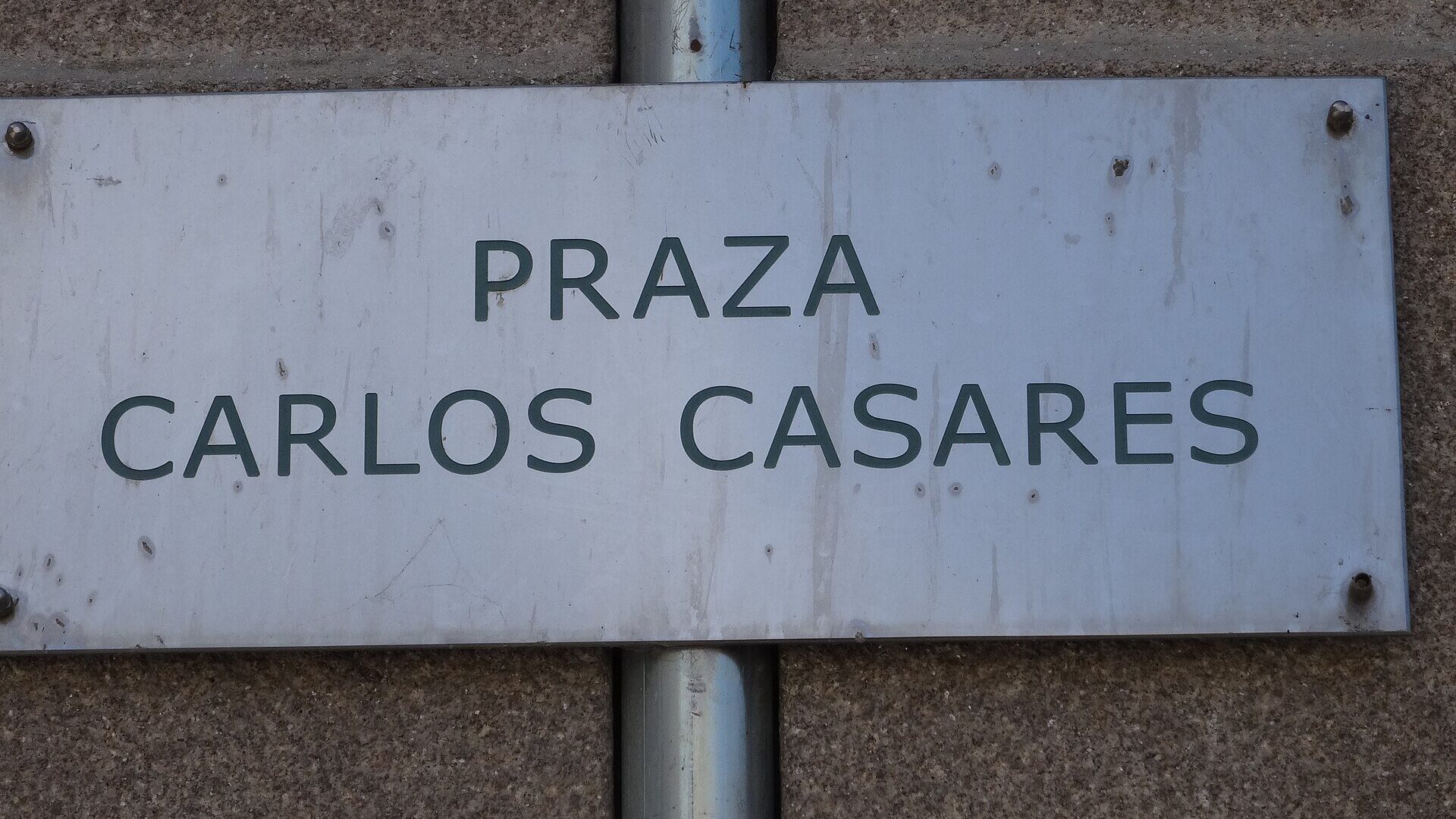
Carlos Casares, the Writer Who Grew Up in Xinzo de Limia
Carlos Casares (Ourense, 1941 – Vigo, 2002) spent his childhood in Xinzo de Limia, between Lamas and Sabucedo; he was a novelist, RAG academician, member of parliament, director of Galaxia and president of the Consello da Cultura Galega.
Carlos Casares Mouriño was born in Ourense on 24 August 1941 and died in Vigo on 9 March 2002. He was a writer in Galician, a literary critic and a politician, and his name is bound up with Xinzo de Limia, where he was taken at the age of three and where his childhood was spent [1][2]. In 2017 the Día das Letras Galegas was dedicated to him [1].
A Limian childhood
His father, Francisco Casares Dacal, was a schoolteacher and taught in Xinzo de Limia; his younger brother Xabier was born there in 1945 [1]. Carlos’s childhood was divided among three places: Lamas, where his paternal grandparents’ house stood; Sabucedo, in the house of Benito and Isolina, his maternal grandmother’s sister; and Beiro, where his maternal uncle Xosé was parish priest, in the parish once held by Basilio Álvarez [1]. So he spent his early childhood in rural Galicia, closely tied to the language: although his mother spoke Spanish, Galician was the dominant language around him [1].
With a family with many religious connections, he was sent to the seminary in Ourense (Humanities, 1952-1957). The linguistic repression he experienced there awakened a rebellious spirit in him and produced his first literary venture, the clandestine newspaper El averno. He left the seminary, studied for the bachillerato as an independent student and won a provincial Christmas short-story competition, which allowed him to meet Vicente Risco [1].
Studies, teaching and politics
He studied Philosophy and Letters in Santiago (1961-1967), specialising in Romance philology, and there he met Ramón Piñeiro, who left a deep mark on him. After graduating he returned to Xinzo de Limia to wait for the public examinations. In 1969 he was a teacher in Viana do Bolo, where he was expelled for his activities and barred from teaching anywhere in Galicia. At that time he was in a relationship with Dolores Villarino, to whom he dedicated Cambio en tres (1969) [1].
In 1971 he married Karin Berg, a Swede from Halmstad, and they had two sons, Håkan (1974) and Christian (1976). In 1974 he obtained a post in Cangas de Morrazo and shortly afterwards was disciplined for supporting non-tenured teachers [1]. In 1975 he won the Galaxia Prize with Xoguetes para un tempo prohibido and in 1978 he joined the Royal Galician Academy (its youngest full member at the time), with the address O desastre de 1898 e os escritores galegos [1].
He signed the Realidade Galega manifesto and, in 1981, entered the first Galician Parliament as an independent on the PSOE lists; he promoted the Language Normalisation Law (1983) and the Consello da Cultura Galega. In 1987 he left politics and ran the publishing house Galaxia (1986-2002) and the journal Grial (1989-2002); he chaired the PEN Club of Galicia (1996-1999) and the Consello da Cultura Galega (1996-2002) [1][2].
His work
He cultivated mainly fiction. Critics distinguish an avant-garde stage (Vento ferido, 1967; Cambio en tres, 1969; Xoguetes para un tempo prohibido, 1975) and a more realist one from Ilustrísima (1980), followed by Os mortos daquel verán (1987), Deus sentado nun sillón azul (1996) and O sol do verán (2002) [1][2]. He wrote short stories (Os escuros soños de Clío, 1979), children’s literature (he translated The Little Prince and created the inventor boy Toribio) and a daily column in La Voz de Galicia (1992-1998), collected in seven volumes titled Á marxe [1][2].
He died at his home in San Pedro da Ramallosa (Nigrán) after a heart attack and was buried in San Fiz de Nigrán [1].
His name in Xinzo
The Carlos Casares Prize for Literary Journalism, organised by Xinzo de Limia council, recalls his link with the town; in 2024 it was awarded to Pilar Cernuda [3].
Links
- People of A Limia
- Xinzo de Limia
- Antón Tovar, another writer from the area
Sources
- «Carlos Casares», Galician Wikipedia (CC BY-SA 4.0). https://gl.wikipedia.org/wiki/Carlos_Casares
- «Carlos Casares Mouriño», xinzodelimia.eu (Wayback capture). http://www.xinzodelimia.eu/carlos_casares.htm
- «Premio Carlos Casares de Xornalismo Literario», Galician Wikipedia (CC BY-SA 4.0). https://gl.wikipedia.org/wiki/Premio_Carlos_Casares_de_Xornalismo_Literario
You may also like
 Notable personOlimpia Valencia López, the First Woman in Galicia to Graduate in MedicineBorn in Baltar in 1898, Olimpia Valencia was the first Galician woman to graduate in Medicine (1925) and in 1928 opened a general medicine…
 Notable personAntón Tovar, the Poet of A Pereira (Rairiz de Veiga)Antón Tovar Bobillo (A Pereira, Rairiz de Veiga, 1921 – Ourense, 2004) was an existentialist poet in Galician and Spanish, honorary member…
 Notable personAlfredo Nan de Allariz, Poet and Playwright from Xinzo in HavanaAlfredo Fernández, «Nan de Allariz», was born in Xinzo de Limia (1874 or 1875) and died in Madrid in 1927; poet, playwright and composer,…
 People of A LimiaHistorical Figures of A Limia: A TimelineTimeline of historical figures linked to A Limia, from Roman times to the 20th century: Limicians of Rome, Hidatius, counts, medieval…
 Notable personCástor Méndez Brandón, Baritone and Folk-Song Poet Born in XinzoCástor Méndez Brandón (Xinzo de Limia, 1864 – Celanova, 1920) was a lawyer, baritone at the Teatro Real in Madrid, poet and mayor of…
People of A LimiaFamous People and Sportspeople of A LimiaDirectory of well-known Limians by occupation: sportspeople, actors, musicians, advertising people, models, bishops, writers, researchers…
