

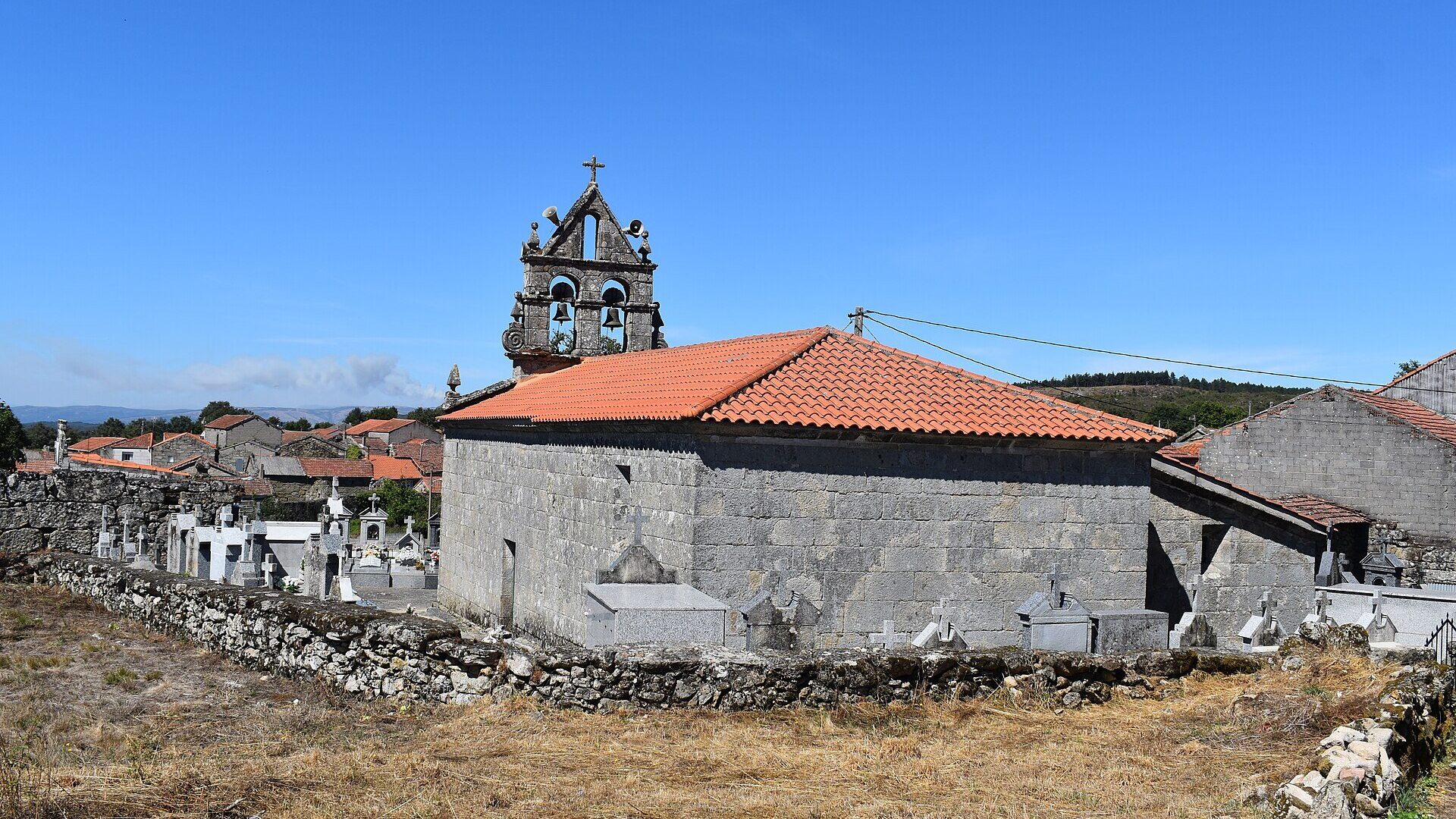
Domingo Martínez de Presa, the Abbot of Feás Who Built Automata in the 17th Century
Domingo Martínez de Presa, abbot of San Miguel de Feás (Calvos de Randín) from 1645 until his death, built water-driven and clockwork automata and published Fuerza del ingenio humano in Madrid in 1662.
- Office
- abbot of San Miguel de Feás (1645 until his death)
- Place
- Feás (Calvos de Randín)
- Work
- Fuerza del ingenio humano (Madrid, 1662)
- Distinction
- first Spanish book on automata
Domingo Martínez de Presa was a 17th-century cleric who, in the mountain hamlet of Feás, in what is now Calvos de Randín, built «ingenios» that moved in imitation of living beings, that is, automata, and wrote what is considered the first book on the subject in Spain [1]. His life is almost unknown outside his own work, but what he left in writing makes this abbot of an isolated parish one of the most singular figures in the history of A Limia.
Abbot of Feás
In 1645 the Count of Lemos, patron of the benefice of San Miguel de Feás, presented Martínez de Presa to the Bishop of Ourense so that he might be granted the cure of souls of the parish. At that time Feás lay within the jurisdiction of Xinzo de Limia; today it belongs to the municipality of Calvos de Randín. The abbot remained there until his death, twenty years later [1].
It is not known where he came from. The title of licenciado indicates that he had studied at some university, and the absence of his ordination record in the diocese of Ourense suggests that he was ordained in another [1]. In those hills «without communication», in his own words, he resolved to flee «vicious idleness» and to make things that had never been seen [1].
The automata
Almost everything we know about him comes from his book, Fuerza del ingenio humano y inventiva suya, printed in Madrid in 1662. The book describes five stringed instruments that water made sound, driven by a single wheel from which others hung, and three boxes «to delight the eye» with wooden figures arranged on several levels, some of which made sounds through the action of air. Two of them worked with water mechanisms, wheels and pulleys, and the third with a mechanism similar to a clock’s, with weights and springs [1].
Those boxes must have been a spectacle: rows of figures playing instruments, dancing or re-enacting a scene, such as the battle of Clavijo, to the sound of music. The Bishop of Ourense Alfonso de San Vitores de la Portilla, who governed the diocese between 1653 and 1659, saw one of them and liked it so much that it became the main subject of his conversations [1]. The abbot also spoke of other inventions, such as a centaur the size of a bullock that moved by itself along smooth ground, fired a crossbow, grew and shrank as it advanced and played a shawm [1].
According to the source, his inventiveness aroused admiration and also envy, since not even the engineers of the court of Philip IV were able to work out how his devices functioned [1].
The book and the Inquisition
The book is short because, as the author himself says, anyone who does not see and handle the devices will not understand them however much they are described. It has, however, a preface occupying half the work, in which he discusses miracles, which he classifies into three types, the sciences and the crafts, perhaps also to avoid suspicion from the Inquisition [1]. The censor, Fray Gaspar Salgado, lector in theology at Nuestra Señora de Atocha, was able to see some of the devices and confirmed that they moved without magic arts or diabolical intervention [1].
A forgotten book, rediscovered
The work lay forgotten for centuries. It was reissued in 2000, with a study by Mercedes Cabello Martín, from the only known copy, held by the Complutense University library [1]. In May 2022 the Museo da Marioneta e do Xoguete in Lalín added an ideal replica of one of his devices, made by the craftsmen of Xirapaus [1].
Frequently asked questions
Who was Domingo Martínez de Presa? The abbot of San Miguel de Feás (1645 until his death) who built automata in the 17th century [1].
What book did he write? Fuerza del ingenio humano, published in Madrid in 1662 [1].
Where is Feás? In the municipality of Calvos de Randín; in the 17th century it came under the jurisdiction of Xinzo de Limia [1].
Links
Sources
- Domingo Martínez de Presa, el cura más ingenioso de la Historia (Vía Lethes, Alexander de los Ríos Conde, 15-01-2017). https://vialethes.es/martinez-presa-cura-ingenioso
You may also like
 Notable personOlimpia Valencia López, the First Woman in Galicia to Graduate in MedicineBorn in Baltar in 1898, Olimpia Valencia was the first Galician woman to graduate in Medicine (1925) and in 1928 opened a general medicine…
 Notable personAntón Tovar, the Poet of A Pereira (Rairiz de Veiga)Antón Tovar Bobillo (A Pereira, Rairiz de Veiga, 1921 – Ourense, 2004) was an existentialist poet in Galician and Spanish, honorary member…
 Notable personCarlos Casares, the Writer Who Grew Up in Xinzo de LimiaCarlos Casares (Ourense, 1941 – Vigo, 2002) spent his childhood in Xinzo de Limia, between Lamas and Sabucedo; he was a novelist, RAG…
 Notable personAlfredo Nan de Allariz, Poet and Playwright from Xinzo in HavanaAlfredo Fernández, «Nan de Allariz», was born in Xinzo de Limia (1874 or 1875) and died in Madrid in 1927; poet, playwright and composer,…
 People of A LimiaHistorical Figures of A Limia: A TimelineTimeline of historical figures linked to A Limia, from Roman times to the 20th century: Limicians of Rome, Hidatius, counts, medieval…
 Notable personCástor Méndez Brandón, Baritone and Folk-Song Poet Born in XinzoCástor Méndez Brandón (Xinzo de Limia, 1864 – Celanova, 1920) was a lawyer, baritone at the Teatro Real in Madrid, poet and mayor of…
