


Monte do Viso and A Cidá: Nocelo da Pena’s candidacy for the Forum Limicorum
The hill-fort of A Cerca and A Cidá on Monte do Viso (Nocelo da Pena and Lodoselo, Sarreaus): tin mines, the Lodoselo altar, inscriptions to Hadrian and Antoninus, San Pedro hermitage and García Valdeiras's case for the Forum Limicorum.
- Where
- Monte do Viso (Nocelo da Pena and Lodoselo, Sarreaus)
- Hill-fort
- A Cerca, about 100 m across, 780 m altitude
- Period
- Iron Age, Roman and early medieval
- Main source
- García Valdeiras, Minius IX
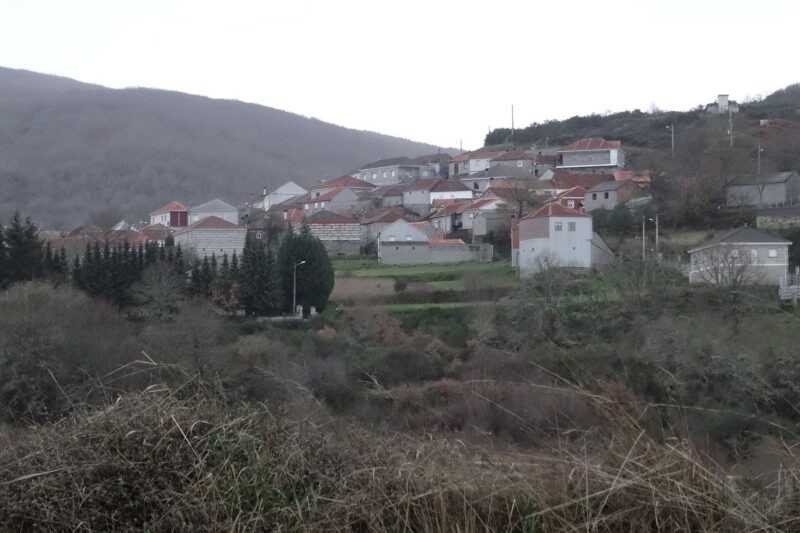
Monte do Viso, on the lands of Nocelo da Pena and Lodoselo (municipality of Sarreaus), holds one of the most complex archaeological complexes in A Limia: a hill-fort, tin mines, a necropolis and a cluster of Roman inscriptions. Since the 18th century scholarship has identified this place, which locals call A Cidá, with the capital of the Limici; today it competes with Xinzo de Limia as a candidate for the Forum Limicorum. This page summarises Manuel García Valdeiras’s study in Minius [1]. For the general debate see Os límicos e a romanización.
The hill-fort of A Cerca
On the western slope of the Viso is the hill-fort proper, A Cerca: it keeps remains of powerful walls that in places exceed 4 m in height, weaker on the south, where the natural defences are strong, and an eastern wall where what looks like a defensive tower at the entrance can be seen. Aerial photography allows a diameter of about 100 m to be calculated; the settlement lies at an average altitude of 780 m, with a spring at its foot and two streams skirting it. A concrete marker shows the boundary between the commons of the parishes of Nocelo da Pena and Lodoselo. The place name A Cidá extends over the north-west slope and includes the «Minas das Ermidas» and the hermitage of San Pedro; the author proposes that A Cerca was only the fortified acropolis of a larger settlement, since at the place called Fonte do Mauro, about 700 m away, plain Roman and decorated Castro-culture pottery, iron slag, tegulae, sigillata, glass and kiln bricks came to light during farm work [1].
The tin of the Viso
In an area of less than 4 km² there are four groups of mines and two streams used as tin-washing places (the Roupeiro and the Regueiro do Lobo). On the western slope of A Cerca are the Minas das Ermidas; along the Regueiro do Lobo, the Mina Grande and Mina Pequena of Lodoselo; and beside the eastern wall there is an «L»-shaped mine, the largest of all, which the author provisionally calls «Mina da Cerca». In the 1940s and 1950s they were reworked for wolfram (a mineral associated with tin) and locals who worked in them say that «pots, earthenware vessels, many cans (small coins) and the odd large silver coin» turned up [1].
The Roufeiro hoard (Early Bronze Age copper weapons made known in 1911) turned up in the Roupeiro stream, a little over a kilometre south of A Cidá; the author infers that it was buried long after it was made, perhaps in Gallaeco-Roman times, as a ritual deposit or as scrap to be melted down with tin [1]. See Prehistoria e castros.
The inscriptions
- The Lodoselo altar, found in the late 1940s in the Mina Grande of Lodoselo. Rodríguez Colmenero read a dedication to Rebruspro by Claudius Nusius Gallaecus, son of Ulcius; García Valdeiras proposes another difficult reading, Vlpius Proc(urator) L(ibertus) Aug(usti), which would be a vow by a procurator metallorum, an imperial freedman of the 2nd century, a figure like the well-known Ulpius Eutyches, procurator of tin in the north-west under Hadrian. The source itself warns that lines 1 and 3 are very hard to read; a second edition by Colmenero gives the reading Lebruspro [1].
- The inscriptions to the Civitas Limicorum dedicated to the emperors Hadrian and Antoninus (CIL II 2516-2517), of the 2nd century, which stood at the door of the hermitage of San Pedro when González de Ulloa copied them for Flórez [1].
- In all the Viso has yielded nine inscriptions, among them a stone to the goddess Nabia, another to Jupiter (now lost), the disputed «altar of the tricivitas» (for the author, a two-faced funerary stela) and three inscriptions on slaty schist that are almost impossible to read, comparable to the «Visigothic slates» of the northern Meseta [1].
The hermitage of San Pedro and the necropolis
About 600 m north-west of A Cerca stood the hermitage of San Pedro, where the inscriptions were built in. In the 18th century González de Ulloa described a flat area of some two miles in circumference called «la Ciudad», with a hermitage, underground caves (the mines), brick kilns and many stone urns, and a piece of tower knocked down by gold-seekers, who found only a stone tomb. That grave is anthropomorphic, trapezoidal and cut into the rock, 1.60 m long. The author gathers the evidence to classify San Pedro as a Gallaeco-Roman necropolis lasting into the Early Middle Ages [1].
The Casteles do Corniño and Kenderendi
About 400 m south of A Cerca there is a formation of granite crags forming a spur, the Casteles do Corniño, already catalogued as medieval, with excellent natural defence and a view over the Limia plain. The author identifies it with the castrus or vita of Kenderendi in the Tombo de Celanova, located between Scornaboves (Escornabois) and Lotorello (Lodoselo); Nocelo and Lodoselo do not appear in the documentation until the late 11th century [1].
Arguments for the Forum Limicorum
García Valdeiras concludes that on the Viso there is a Gallaeco-Roman settlement with possible earlier roots, of great mining importance, that lasts at least until the 8th century. Even so he sees reasons for placing the Forum Limicorum there [1]:
- Fora were markets located near a regional boundary: 700 m to the east is the Marco dos Valentes, an enormous menhir with boundary crosses at a natural pass where three municipalities (Sarreaus, Laza and Cualedro) and two regions, the Limia Alta and the Támega valley, meet.
- The religious dimension: A Pena, which gives Nocelo da Pena its name, a great granite rock with another leaning on it forming a shelter, with carved cup-marks (coviñas), legends of Moors and fertility rites and a Christianising hermitage dedicated to San Pedro, the «first stone of the church». The streams that rise on the Viso and the stone to Nabia, deity of waters, reinforce the sacred character of the hill; the author recalls that González de Ulloa already spoke of the source of the Limia in this area.
- The source acknowledges that Xinzo is the other alternative (with recent finds) and that the hill-fort of Morgade and the villa of Parada de Outeiro (Vilar de Santos) could be included, but maintains that the results from Xinzo «are not at all conclusive» and that A Cidá still offers the best possibilities; moreover almost everything known came from chance finds, not from intensive survey or excavation [1].
Links
- Patrimonio da Limia
- Os límicos e a romanización
- Os límicos nas inscricións romanas
- Nocelo da Pena
- Lodoselo
- Patrimonio de Sarreaus
Sources
- García Valdeiras, Manuel: «O "Forum Limicorum"», Minius, IX, pp. 39-50 (Universidade de Vigo). https://revistas.uvigo.es/index.php/mns/article/view/2984
© OpenStreetMap contributors
You may also like
 Heritage of A Limia: towers, convents, mills and ethnographic villagesA tour of the historic heritage of the municipality of Xinzo de LimiaA summary of the historic heritage of Xinzo de Limia: the Romanesque old church, the churches of Novás and Morgade, Torre da Pena, the Bon…
 Heritage of A Limia: towers, convents, mills and ethnographic villagesEthnographic heritage of Rairiz de Veiga: Congostro, mills, ovens and springsThe ethnographic heritage of Rairiz de Veiga: the restored village of Congostro, the San Miguel mills route, 17 mills, 5 communal ovens and…
 Heritage of A Limia: towers, convents, mills and ethnographic villagesXinzo de Limia in a day: a route through heritage, water and the lagoonA suggested one-day visit to Xinzo de Limia: Museo Galego do Entroido, the church and square of the town, Torre da Pena, the Bon Xesús…
Heritage of A Limia: towers, convents, mills and ethnographic villagesChurches and chapels of the parishes of Xinzo de LimiaIndex of the parish churches and chapels recorded in each of the 20 parishes of Xinzo de Limia, with their dedication, according to…
 Heritage of A Limia: towers, convents, mills and ethnographic villagesMills and ethnographic heritage of Calvos de RandínCalvos de Randín has 18 mills catalogued in Galicia Nomeada, plus the Oratorio, tied to the rivers and streams of the Salas valley and the…
 Heritage of A Limia: towers, convents, mills and ethnographic villagesConvento do Bon Xesús da Limia (Trandeiras): the BIC fileThe Convento do Bon Xesús da Limia, in Trandeiras (Xinzo de Limia), was built in the early 16th century; the Xunta has opened the procedure…
