


Maize in A Limia and the canastros: from the string on the balcony to the esfolla and the queen cob
Why there are canastros in Porqueira, Sarreaus, Rairiz and Vilar de Barrio and not in the rest of A Limia: the Terra do Millo, maize strung on Xinzo's balconies and the queen cob of the esfolla.
Maize came from America to help fight the hunger of the grandparents, who ate chestnuts. According to Xosé "Pepe" Calleja López, who tells it on his blog As tradicións da Limia, it reached the Peninsula in two chests that the governor of Florida, Gonzalo Méndez de Cancio, brought in 1603 when he returned to his Asturias; in Galicia he thinks it was first sown north of Lugo, and spread little by little [1].
The Terra do Millo
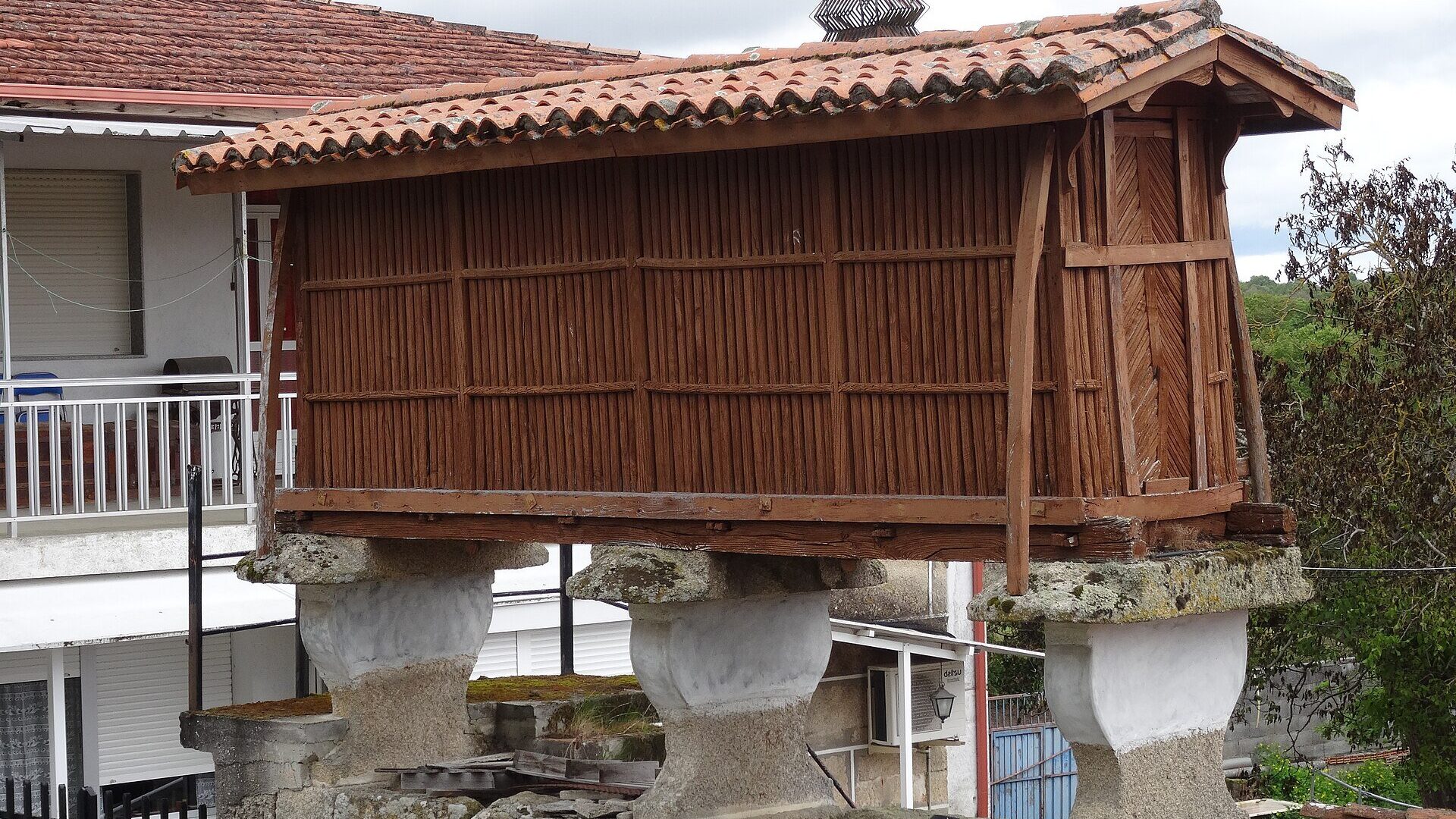
In A Limia there are lands called A Terra do Millo ("Maize Land"), in the concello of Porqueira. Anyone visiting the concello’s villages will see that canastros (maize cribs) abound, a sign that maize production was important. There are also canastros in Folgoso and Cortegada (Sarreaus), and fine examples in Rairiz de Veiga and Vilar de Barrio. In the rest of A Limia maize was sown for livestock to eat green, taking the highest part of the plant, the greenest and softest; there was no grain maize because low temperatures and high humidity make ripening difficult [1].
Maize dried on strings
In places like Xinzo the cobs were strung and hung from balconies in the sun and wind to ripen; they were put out in the morning and taken in at night, and old photos show people in warm clothes, which indicates that the drying was long. In Congostro (Rairiz de Veiga), a 1996 photo shows maize hung from the beams of a shed, with air but not preventing birds and mice from entering; since Congostro has many canastros, the author thinks of a residual harvest [1].
One theory on the origin of the canastros is that over time the balcony was covered with a roof so that rain would not wet the cobs, then closed with walls to protect the grain and, finally, the closed balcony was separated from the house. The author recalls that a miniature in the Cantigas de Santa María of Alfonso X (13th century, before maize in Galicia) shows a similar structure, a granary, which in A Limia is known as canastro, cacipo… With maize a small building for storing cereals was reinvented, now with open walls so that air enters but birds do not [1].
The esfolla and the queen cob
A tradition grew around maize, above all at the esfolla (husking), when the covering of the cob is stripped and the grains are left exposed. Young men and women hurried to husk the cobs because whoever found a queen cob (espiga reina), a purple cob, shouted "reinei" ("I reigned") and won the right to kiss and hug the esgalla (the chosen girl); many tried to flee and the party began, with tambourines, drums, tins and, with luck, a bagpipe [1].
Links
- History of A Limia
- Ethnography of A Limia
- Granaries, chests and hay lofts of Xinzo
- Porqueira
- Heritage of Porqueira
Sources
- «O MILLO SEN CANASTROS NA LIMIA – Tradicións da Limia», As tradicións da Limia. https://tradicionsdalimia.es/o-millo-sen-canastros-na-limia/
You may also like
 History of A LimiaPrehistory and castros of A LimiaFrom the Pedra Alta de Antela to the castro of Bóveda: megaliths, the Roufeiro weapons, the Outeiro de Baltar and the gold earring of Vilar…
 History of A LimiaThe Limici in Roman inscriptions: Celer’s gladiatorial tessera and Corellius LimicusTwo epigraphic pieces outside A Limia that mention a "Limicus": the bronze gladiatorial tessera from Niebla (Huelva), of the 1st century,…
 History of A LimiaThe battle of the Xinzo bridge (23 February 1809)On 23 February 1809 farmers, abbots and friars of A Limia, poorly armed, tried to stop Soult's French vanguard at the Xinzo bridge; they…
History of A LimiaThe Limici and Romanisation: Civitas, Forum Limicorum and Via NovaWhat is known of the Limici and Roman Limia: the Civitas Limicorum, the debate over where the Forum Limicorum stood (A Cidá of Nocelo da…
 History of A LimiaThe Praza Maior, the Ladeira and the Toural: history of Xinzo’s central placesHistory of the Praza Maior (fairs since the 16th century, the 1907 Espolón, the fountain), the Ladeira and the Toural (the lagoon, the…
History of A LimiaLight, chocolate, fizzy drinks and roads: the industrial and service Xinzo of the 20th centuryHow electricity (1911), the printing press, chocolate and soda factories, the Rubio Cold-Storage Slaughterhouse and buses to Ourense and…
