

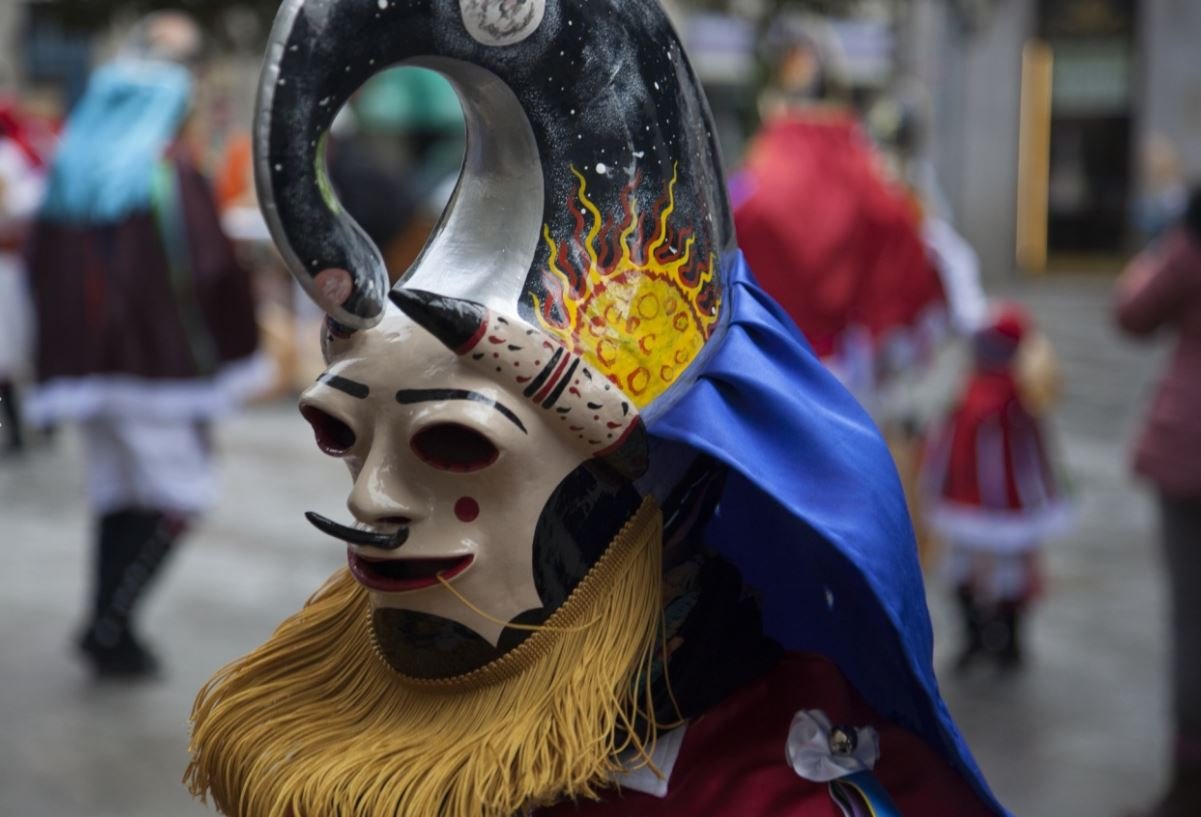
The vergallo and the bell belt of the Pantalla
The lost vergallo of the Xinzo mask, the belt of bells and jingles that announces the Pantallas and the belt-makers who made it, with measurements and dates of a 1910 to 1979 belt and the leather belt of Manolo Ramos Cid.
Two accessories of the Pantalla give noise and presence: the belt of bells and jingles, which still sounds through the streets, and the vergallo, which was almost lost. Both pieces were studied by Xosé "Pepe" Calleja López on his blog As tradicións da Limia.
The vergallo, a lost element
The vergallo is, according to the dictionaries Calleja cites, the genital organ of the ox or horse once cut and dried, and the whip made from it [1]. Vicente Risco describes in his ethnography studies the Damas and the Galán of the Xinzo Entroido with "knitted shirts and breeches, little bells and an ox vergallo in hand" [1]. Risco’s informant, possibly a teacher from Lamas, also spoke of a red sash, necklaces of little bells and a vergallo with a pig’s bladder tied to the tip [1].
The memory in Xinzo survived that the mask carried a vergallo, but nobody can say clearly what for. The most repeated explanation is that it served to scare off dogs, frightened by the noise and shape of the Pantallas; Calleja supposes it was used for striking, as with so many whip-wielding masks of the Galician Entroido. Over time the piece was lost and the bladder at the tip moved to the hand: it hits no one, it only makes a noise that, together with the bells on the belt, announces the arrival of the Pantallas [1].
The name was kept and recovered for the vergalleiro, the mask of Sarreaus, which shares the stage with the peliqueiros of Freixo and Freande [1]. Today some people who go out as a Pantalla wear a vergallo hanging from the wrist. The article describes a 46 cm example, air-dried with a weight at the tip, coiled, reinforced with wire, varnished and with a cord handle, made not for striking but for show [1]. The leatherworker Manolo Ramos Cid said he bought ready-made vergallos from a company in Allariz and sold them as whips for animals, never for Pantallas [1].
The belt of bells and jingles
In Xinzo the belt carries bells and jingles that sound when walking and running; their buzz stays in the ears for several days after the Entroido. From old photographs and the accounts of elders we know that not everyone had a belt: they used the bells of sheep, goats and cows from the sheds, which went out to pasture without them on those days. On the Pantallas of Xinzo the bells hang in front of the body; on other masks, because of the size of the cowbells, they hang down the back. In many photos children wear the belt crossed over the chest because it was an adult’s [2].
Manolo Ramos Cid’s belts
In the last third of the 20th century many Pantalla belts were the work of Manolo Ramos Cid, who settled in Xinzo in 1969. The norm was two rows of bells of different sizes (the large ones above, the small below) and rarely a row of jingles; customers specified the number. He bought the bells in Portugal, in the shop of a trader in Tourém. The belt studied is of natural leather, one metre long, with two pairs of guide lines and 18 bells (10 above and 8 below) [3]. Calleja also photographed, in 2019, the making of a bell belt in a Xinzo shoe shop [2].
A belt from 1910 to 1979
Another belt, worn by Eligio Suárez (remembered by two neighbours as "the best Pantalla in Xinzo") and later by his son Enrique Suárez Gómez, Quique de Barcelona, born in 1935, is still in use by inheritance. It is of natural leather, one metre long and 5 cm wide, and carries only jingles, 37 in all, in sizes numbered 5 to 9; on the back it is engraved "1910=al=1979" and Enrique’s initials, and it weighs 1,495 grams [4].
Links
- Entroido of Xinzo de Limia
- Sounds of the Pantalla and the mystery of the risco
- Styles and workshops of the Pantalla
- The 1955 cape
Sources
- «O VERGALLO. UN ELEMENTO IMPORTANTE DA MÁSCARA DE XINZO DE LIMIA – Tradicións da Limia», As tradicións da Limia. https://tradicionsdalimia.es/o-vergallo-un-elemento-importante-da-mascara-de-xinzo-de-limia/
- «OS SONS DA MÁSCARA DO ENTROIDO DE XINZO DE LIMIA. (Reportaxe fotográfica) – Tradicións da Limia», As tradicións da Limia. https://tradicionsdalimia.es/os-sons-da-mascara-do-entroido-de-xinzo-de-limia-reportaxe-fotografica/
- «CINTO DE MANOLO RAMOS CID PARA MARIA JESUS ROMERO – Tradicións da Limia», As tradicións da Limia. https://tradicionsdalimia.es/cinto-de-manolo-ramos-cid-para-maria-jesus-romero/
- «UN CINTO DE PANTALLA (1910 A 1979) – Tradicións da Limia», As tradicións da Limia. https://tradicionsdalimia.es/un-cinto-de-pantalla-1910-a-1979/
You may also like
 Entroido of Xinzo de LimiaHistory of the Entroido of Xinzo de Limia: from the name to the international designationFrom the name "entroido" (documented in Galician since 1251) to the 1889 chronicle, the A Pantalla Association of 1996, the Museo Galego do…
Entroido of Xinzo de LimiaThe Xinzo Entroido cycle, day by dayA guide to the days of the Entroido of Xinzo de Limia according to the Town Council's official website: Petardazo, Fareleiro, Oleiro, Meco,…
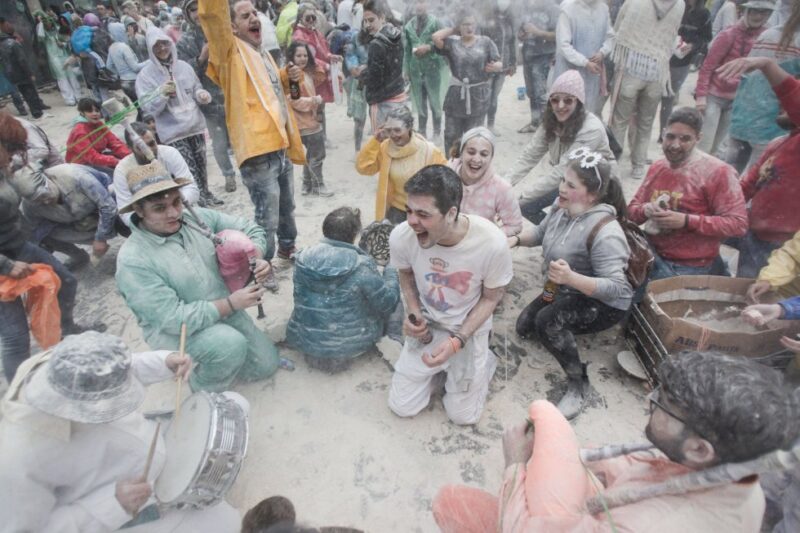 Entroido of Xinzo de LimiaFareleiro Sunday: the flour battle that opens the Xinzo EntroidoFareleiro Sunday opens the traditional cycle of the Xinzo Entroido with a bran and flour battle in the Praza Maior; it is a day designed…
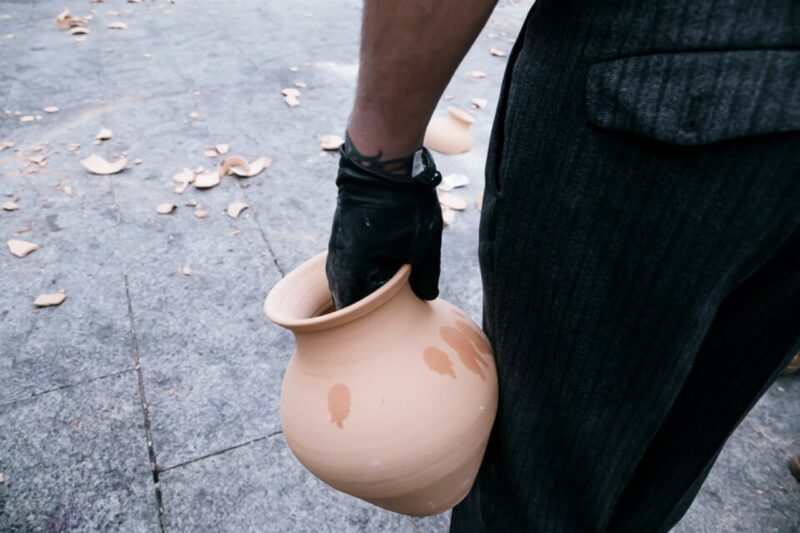 Entroido of Xinzo de LimiaOleiro Sunday and the Game of the Pots of the Xinzo EntroidoOn Oleiro Sunday of the Xinzo Entroido hundreds of clay pots from Niñodaguia fly across the Praza Maior and smash on the ground; whoever…
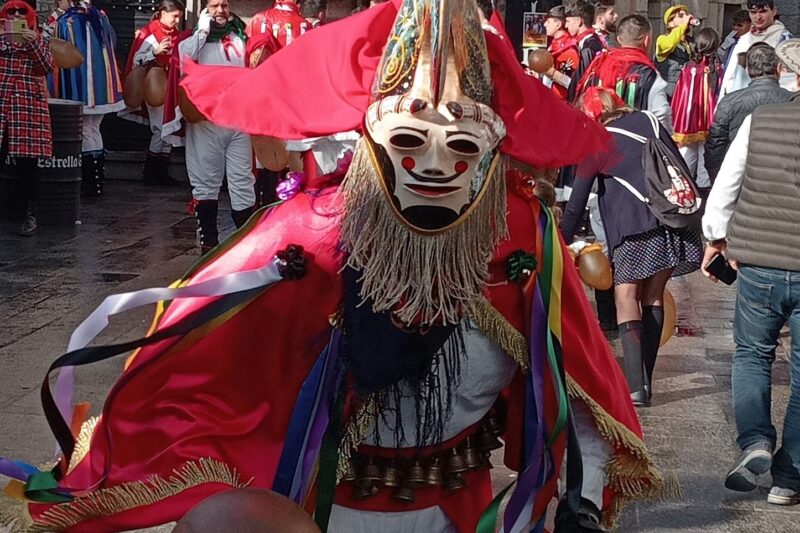 Entroido of Xinzo de LimiaThe Pantalla among the masks of the Galician Entroido: peliqueiros, cigarrones, felos and vergalleirosThe Xinzo Pantalla shares a family with the Ourense masks: the peliqueiro of Laza, the cigarrón of Verín, the felo of Maceda and, in A…
Entroido of Xinzo de LimiaThe FESMOU Entroido Gathering in Xinzo: traditional masks from all over GaliciaThe Xuntanza de Entroidos, known as FESMOU, brings together in Xinzo de Limia more than 30 traditional entroido groups from all over…
