

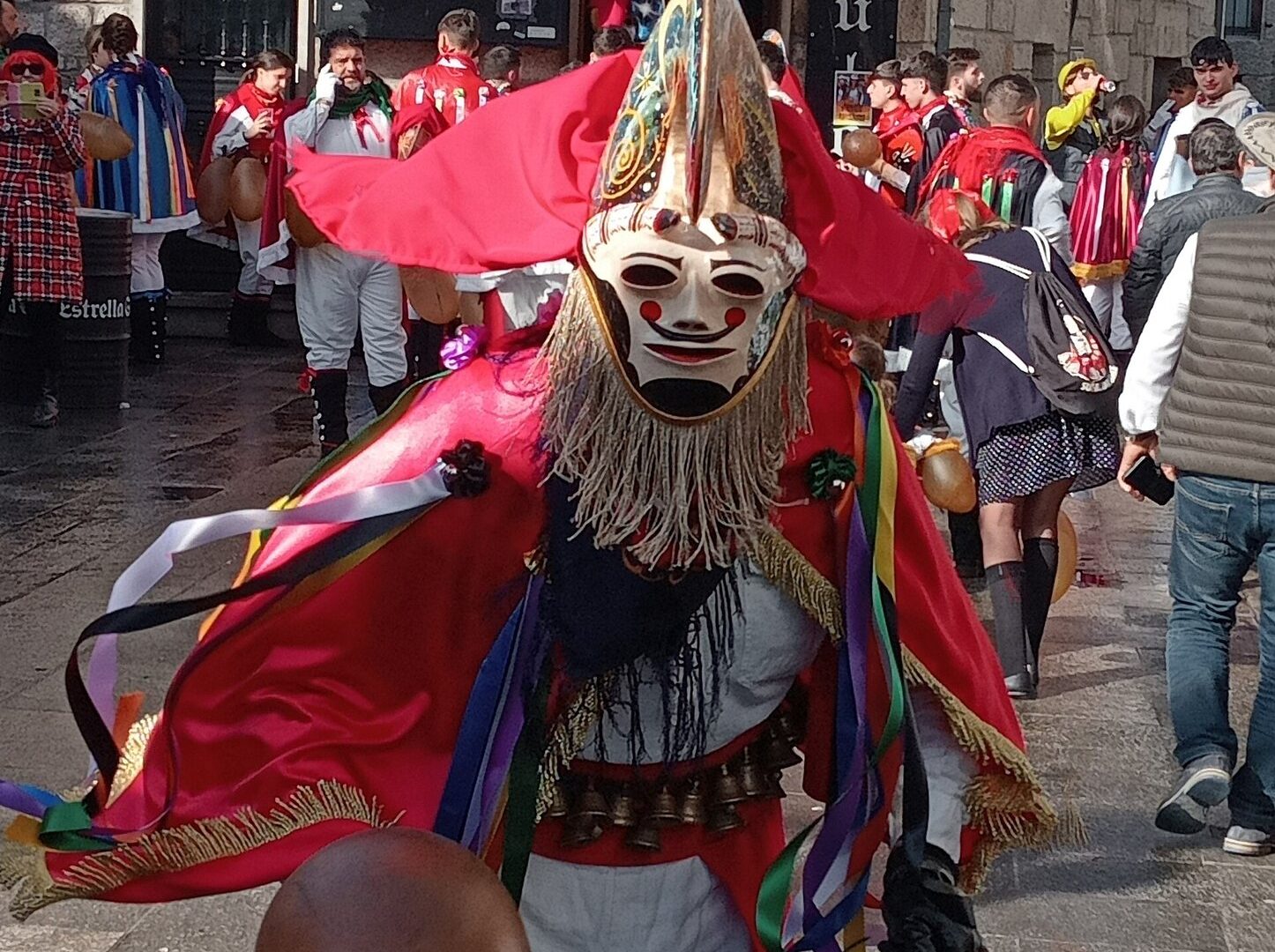
The Pantalla among the masks of the Galician Entroido: peliqueiros, cigarrones, felos and vergalleiros
The Xinzo Pantalla shares a family with the Ourense masks: the peliqueiro of Laza, the cigarrón of Verín, the felo of Maceda and, in A Limia itself, the vergalleiro of Sarreaus; this page places each one and explains the folións.
- Family
- Ourense masks (arc from Maceda and Allariz across the south of the province)
- Xinzo's mask
- the Pantalla
- Neighbouring Limia mask
- the vergalleiro of Sarreaus
- Shared role
- frightening, striking and chasing off the neighbours
The Pantalla of Xinzo de Limia is not an isolated mask: it belongs to the group of the so-called Ourense masks, those of the arc of towns that, according to the Galician Wikipedia, begins in Maceda and Allariz, spreads across the south of the province and climbs east to the Ribeira Sacra [1]. To understand the Xinzo Entroido it helps to know whom it shares a family with, and how it differs.
What the Ourense masks have in common
They are, as a rule, colourful masks that cover the face, many of them made of wood, and their job is to frighten, scare, strike the neighbours or chase them off; although they sometimes go out in groups, their presence is normally individual [1]. The encyclopedia contrasts this group with the masks of the Atlantic zone (the generals of the Ulla and Deza, the damas and galáns of Vilaboa), also in showy costumes but usually leaving the face uncovered and whose weight lies in collective performance [1].
Within the Ourense group, the list of characters of the Galician Entroido places each figure [2]:
- Peliqueiro: Laza, Castrelo do Val and Sarreaus.
- Cigarrón: Verín.
- Folión: Viana do Bolo, Manzaneda, Vilariño de Conso, A Gudiña, O Bolo, A Veiga and A Pobra de Trives.
- Boteiro: Viana do Bolo, Vilariño de Conso, A Gudiña and A Pobra de Trives.
- Felo: Maceda, Arnuíde and Vilar de Barrio (and, in another variant, Folgoso do Courel).
- Vergalleiro: Sarreaus.
- Pantalla: Xinzo de Limia.
The Pantalla, Xinzo’s mask
The Town Council’s official website defines the Pantalla as Xinzo’s traditional mask and "guardian of the Entroido", with permission to seize anyone who is not in costume and carry them bodily to the nearest bar, where they must buy a round [5]. Its costume (white shirt and trousers, red sash, black gaiters and a red cape with coloured ribbons), the belt of bells and jingles and the cow bladders make it unmistakable; the details are in Anatomy of the Pantalla.
A Limia has more masks: the vergalleiro of Sarreaus
In the neighbouring concello of Sarreaus the vergalleiro, the traditional mask of its Entroido, survives. According to Wikipedia, its roots lie in the comarca’s traditional Entroido, with references to similar masks between the 19th and mid-20th centuries: in Sarreaus there were other characters, such as the Matalobos or the Polainas, which lost ground through the proximity and influence of the great neighbouring entroidos, above all those of Xinzo, Verín and Laza [3]. In the early 1990s the recovery of the mask and its costume was promoted; the costume has black gaiters with red pompoms, a red sash with cowbells, a white linen blouse, white breeches with black, red and green ribbons, a black felt waistcoat and a papier-mâché mask; the most characteristic element is the cow horn, with which the vergalleiro goes through the streets calling for participation [3]. It parades on Entroido Sunday, and ends with a communal meal [3].
The folións
The folións are not a mask but a musical procession: Wikipedia lists the folións among the collective, performative rites of the Galician Entroido and, in its list of characters, associates the folión figure with concellos around Trives, Viana and their surroundings [1][2]. Elsewhere the same encyclopedia recalls that the Laza cycle begins at the chimes on New Year’s Day with the first folión [1]. The sound that identifies the Xinzo Entroido is, by contrast, that of the Pantalla itself: cowbells, jingles and cow bladders [5].
Where to see them all together
The Museo Galego do Entroido devotes its central room to the "queens of the Entroido", with the costumes of Galicia’s best-known characters: the felo of Maceda, the boteiro of Viana do Bolo, the vergalleiro of Sarreaus, the vellarrón of Riós, the mázcara of Manzaneda, the peliqueiro of Laza, the cigarrón of Verín, the labardeiro of Mugares, the troteiro of Bande, the bonita of Sande, the general of the Ulla, the volante of Chantada and the Pantalla of Xinzo [4].
Links
Sources
- «Entroido de Galicia», Wikipedia en galego (CC BY-SA 4.0). https://gl.wikipedia.org/wiki/Entroido_de_Galicia
- «Lista de personaxes do Entroido de Galicia», Wikipedia en galego (CC BY-SA 4.0). https://gl.wikipedia.org/wiki/Lista_de_personaxes_do_Entroido_de_Galicia
- «Vergalleiro», Wikipedia en galego (CC BY-SA 4.0). https://gl.wikipedia.org/wiki/Vergalleiro
- «Museo Galego do Entroido», Wikipedia en galego (CC BY-SA 4.0). https://gl.wikipedia.org/wiki/Museo_Galego_do_Entroido
- Concello de Xinzo de Limia, «A Pantalla». http://xinzo.gal/entroido/info/a-pantalla/
You may also like
 Entroido of Xinzo de LimiaHistory of the Entroido of Xinzo de Limia: from the name to the international designationFrom the name "entroido" (documented in Galician since 1251) to the 1889 chronicle, the A Pantalla Association of 1996, the Museo Galego do…
Entroido of Xinzo de LimiaThe Xinzo Entroido cycle, day by dayA guide to the days of the Entroido of Xinzo de Limia according to the Town Council's official website: Petardazo, Fareleiro, Oleiro, Meco,…
 Entroido of Xinzo de LimiaFareleiro Sunday: the flour battle that opens the Xinzo EntroidoFareleiro Sunday opens the traditional cycle of the Xinzo Entroido with a bran and flour battle in the Praza Maior; it is a day designed…
 Entroido of Xinzo de LimiaOleiro Sunday and the Game of the Pots of the Xinzo EntroidoOn Oleiro Sunday of the Xinzo Entroido hundreds of clay pots from Niñodaguia fly across the Praza Maior and smash on the ground; whoever…
Entroido of Xinzo de LimiaThe FESMOU Entroido Gathering in Xinzo: traditional masks from all over GaliciaThe Xuntanza de Entroidos, known as FESMOU, brings together in Xinzo de Limia more than 30 traditional entroido groups from all over…
 Entroido of Xinzo de LimiaAnatomy of the Pantalla: what the Xinzo Entroido mask looks like and how it is fittedHow a Xinzo Pantalla is made: face perimeter, beard, mouth, eyes, the horn and its dots, the hat and the traditional cut, and how…
