

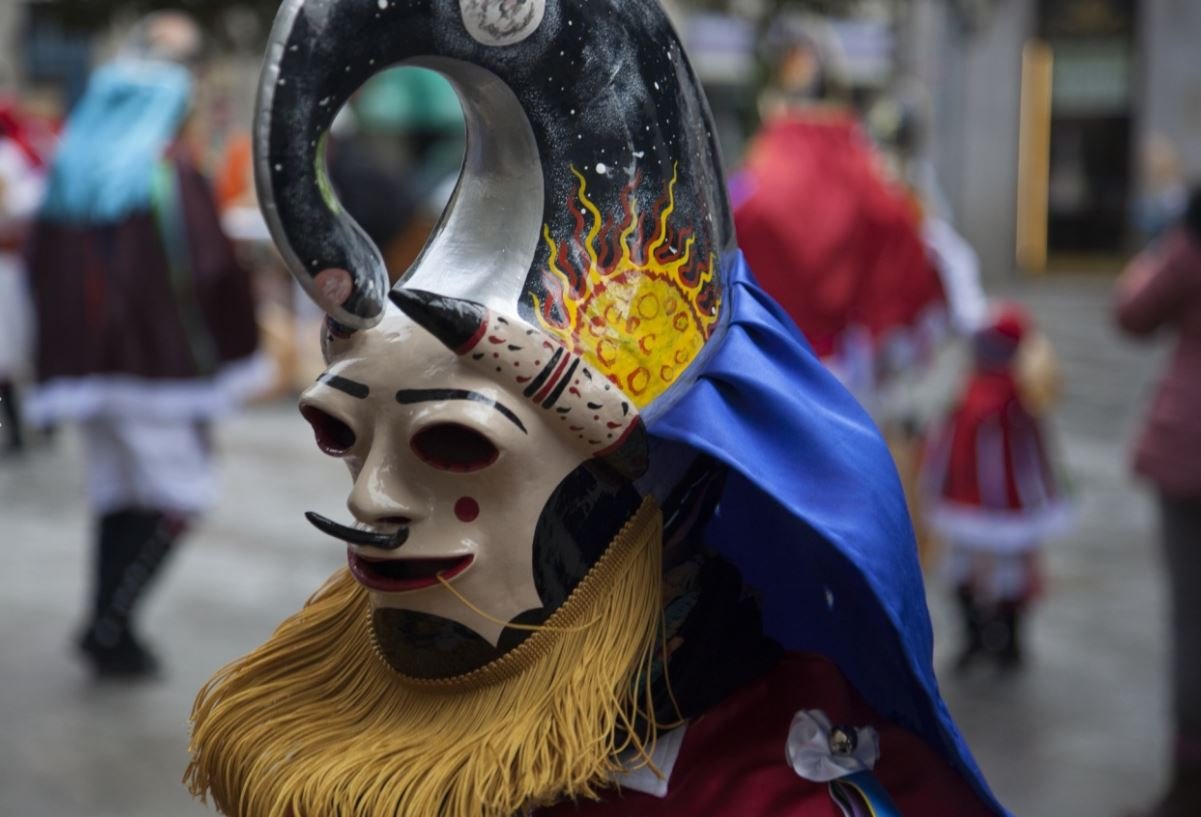
Anatomy of the Pantalla: what the Xinzo Entroido mask looks like and how it is fitted
How a Xinzo Pantalla is made: face perimeter, beard, mouth, eyes, the horn and its dots, the hat and the traditional cut, and how measurements are taken to sew the face and horn to the wearer.
The Pantalla is the central character of the Entroido of Xinzo de Limia: a mask with its own costume which, according to Xosé "Pepe" Calleja López, is "unique in the world". His blog As tradicións da Limia studies one by one the old pantallas that people lend him, measuring each part; this page summarises what those studies teach [1].
A character with rules
The Pantalla is a very dynamic mask: it runs, jumps, ducks, dances and grabs people to take them into the taverns. That is why it is essential that the mask is well fitted to the person, so that it does not move [2]. Calleja recalls that the Pantalla is not lent: it is checked and repaired months before use, and mockery or disrespect for the costume-and-mask ensemble is not allowed. In the past, he says, the belts measured the backs of more than one person who disparaged a Pantalla; to disparage is also to dress badly, not to know what a Pantalla does, to throw yourself on the ground or to treat it as a mere "costume", without feeling the transformation into a different entity, with different behaviour [4].
A neighbour who went out as a Pantalla again thirty years later (he had stopped in 1992) explained why: he disliked the attitude of many pantallas at the time, drunk, hitting the mask with bladders, urinating and stumbling in the street, badly dressed and not fulfilling the role that is theirs by inheritance. His mother, who never went out as a Pantalla because in her day only men did, passed on to him what a Pantalla should and should not do [3].
The face
Calleja describes pantallas front-on and in centimetres. The perimeter of the face is around 25–33 cm and the distance from forehead to chin ranges from 12 to 21 cm depending on the pantallas studied (for example, 32 cm and 19 cm in Santi’s 1989 one) [1]. The parts he measures are:
- The beard, black, which starts from the horns or from the base of the ears and makes one or two waves on each side of the face and one at the chin; it is never perfectly symmetrical [1].
- The mouth, red and wide, with upper and lower lip [1].
- The moustache, of paper painted black, and two rosy cheeks, red circles less than 1 cm in diameter [1].
- The nose, with a septum of about 3.7 cm, and the eyes, with counted lashes (six above and five below, for example) [1].
- The eyebrows, irregular: a brushstroke that changes in width and length [1].
The horn and the hat
The face is completed by the horn (the "ears"), a large piece of fabric sewn over card that extends behind and along the sides. On the 1989 Pantalla the height from the percaline (the fabric hanging at the back) to the highest point was 31 cm, and the width 18.4 cm at the bottom and 28 cm in the middle [1]. The horn has a coloured background (purple, in that case) with a dark blue outer ribbon and a pattern of dots of several colours (blue, gold, white, red), which on many pantallas are arranged in pyramid-shaped groups; the study counts, group by group, the dots in each line, which shows how precisely it is done [1]. On the tip of the small horn, above the face, go blades of grass, green lines and other motifs [1].
The face is made on a hat. The cut of the hat identifies who made it: the traditional one is that made by Julio Villarino, while Pucho and Barge made a very particular cut, with a "V" shape at the top reaching down to the eyes [1][5].
How it is fitted
The traditional measuring method for sewing the face and horn, visible on some old masks whose paint has fallen away and shows the newspaper with marks underneath, is this [2]:
- The person who will wear the mask places the parts so they fit to their liking and the craftsman adjusts the horn.
- The craftsman centres the face using the curl of the horn as a reference (that is "aplomar", plumbing) and marks in pencil what is left over of the horn at face level.
- The excess is cut off, the person puts the mask on again and the final adjustments are made.
- The first line is marked on the face and horn, then the second.
- The same marks are made on the other side. The next step is to sew face and horn using the side and central marks as references.
Calleja learned the method from three friends, Gude, Poly and Pipo, who as young men learned from Julio Villarino [2].
Links
Sources
- Xosé Calleja López, «Pantalla de 1989. Do Santi», As tradicións da Limia, 26/05/2021, e estudos de pantallas posteriores. https://tradicionsdalimia.es/pantalla-de-1989-do-santi/
- «Toma de medidas para coser a cara e o corno dunha Pantalla», As tradicións da Limia, 10/10/2025. https://tradicionsdalimia.es/toma-de-medidas-para-coser-a-cara-e-o-corno-dunha-pantalla/
- «Pantalla 30 anos despois», As tradicións da Limia, 03/04/2022. https://tradicionsdalimia.es/pantalla-30-anos-despois/
- «A Pantalla do Pepe Calleja. Obradoiro do Santi e Aurora 2021-2022», As tradicións da Limia, 14/12/2024. https://tradicionsdalimia.es/a-pantalla-do-pepe-calleja-obradoiro-do-santi-e-aurora-2021-2022/
- «Pantalla do 1988 do Barge» e «Pantalla do Pucho do ano 1985 remozada no 2019», As tradicións da Limia, 2023. https://tradicionsdalimia.es/pantalla-do-1988-do-barge/
You may also like
 Entroido of Xinzo de LimiaHistory of the Entroido of Xinzo de Limia: from the name to the international designationFrom the name "entroido" (documented in Galician since 1251) to the 1889 chronicle, the A Pantalla Association of 1996, the Museo Galego do…
Entroido of Xinzo de LimiaThe Xinzo Entroido cycle, day by dayA guide to the days of the Entroido of Xinzo de Limia according to the Town Council's official website: Petardazo, Fareleiro, Oleiro, Meco,…
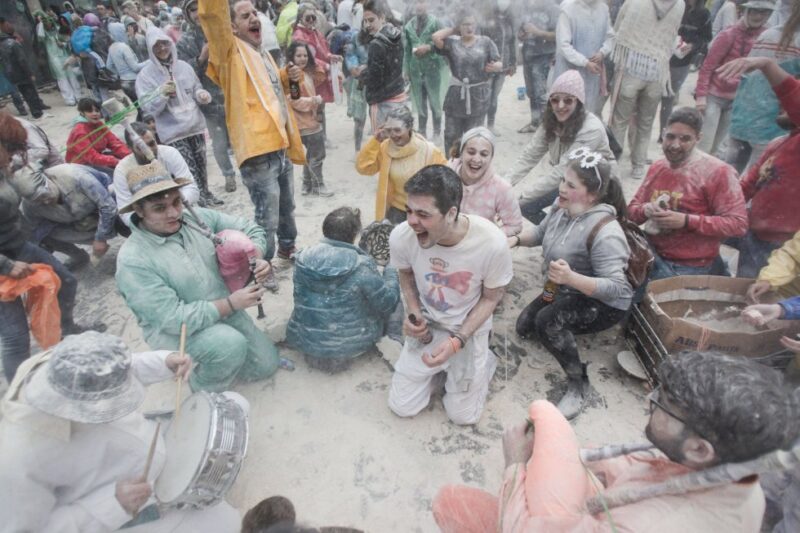 Entroido of Xinzo de LimiaFareleiro Sunday: the flour battle that opens the Xinzo EntroidoFareleiro Sunday opens the traditional cycle of the Xinzo Entroido with a bran and flour battle in the Praza Maior; it is a day designed…
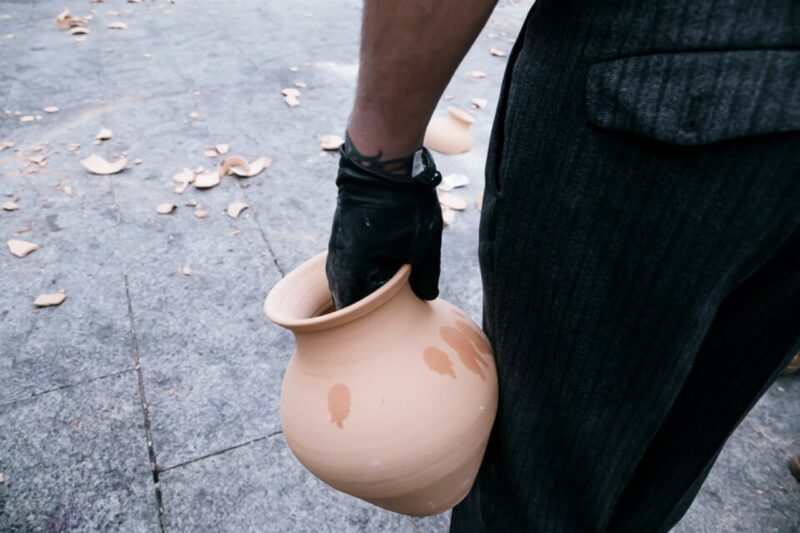 Entroido of Xinzo de LimiaOleiro Sunday and the Game of the Pots of the Xinzo EntroidoOn Oleiro Sunday of the Xinzo Entroido hundreds of clay pots from Niñodaguia fly across the Praza Maior and smash on the ground; whoever…
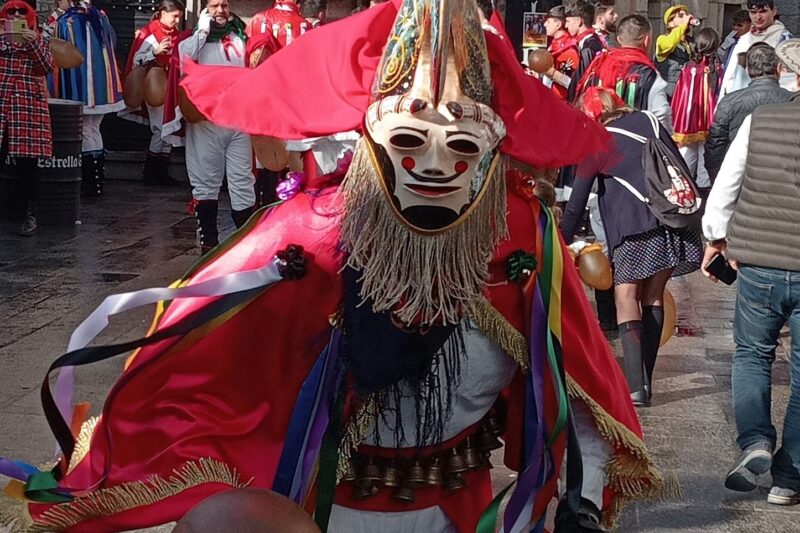 Entroido of Xinzo de LimiaThe Pantalla among the masks of the Galician Entroido: peliqueiros, cigarrones, felos and vergalleirosThe Xinzo Pantalla shares a family with the Ourense masks: the peliqueiro of Laza, the cigarrón of Verín, the felo of Maceda and, in A…
Entroido of Xinzo de LimiaThe FESMOU Entroido Gathering in Xinzo: traditional masks from all over GaliciaThe Xuntanza de Entroidos, known as FESMOU, brings together in Xinzo de Limia more than 30 traditional entroido groups from all over…
