


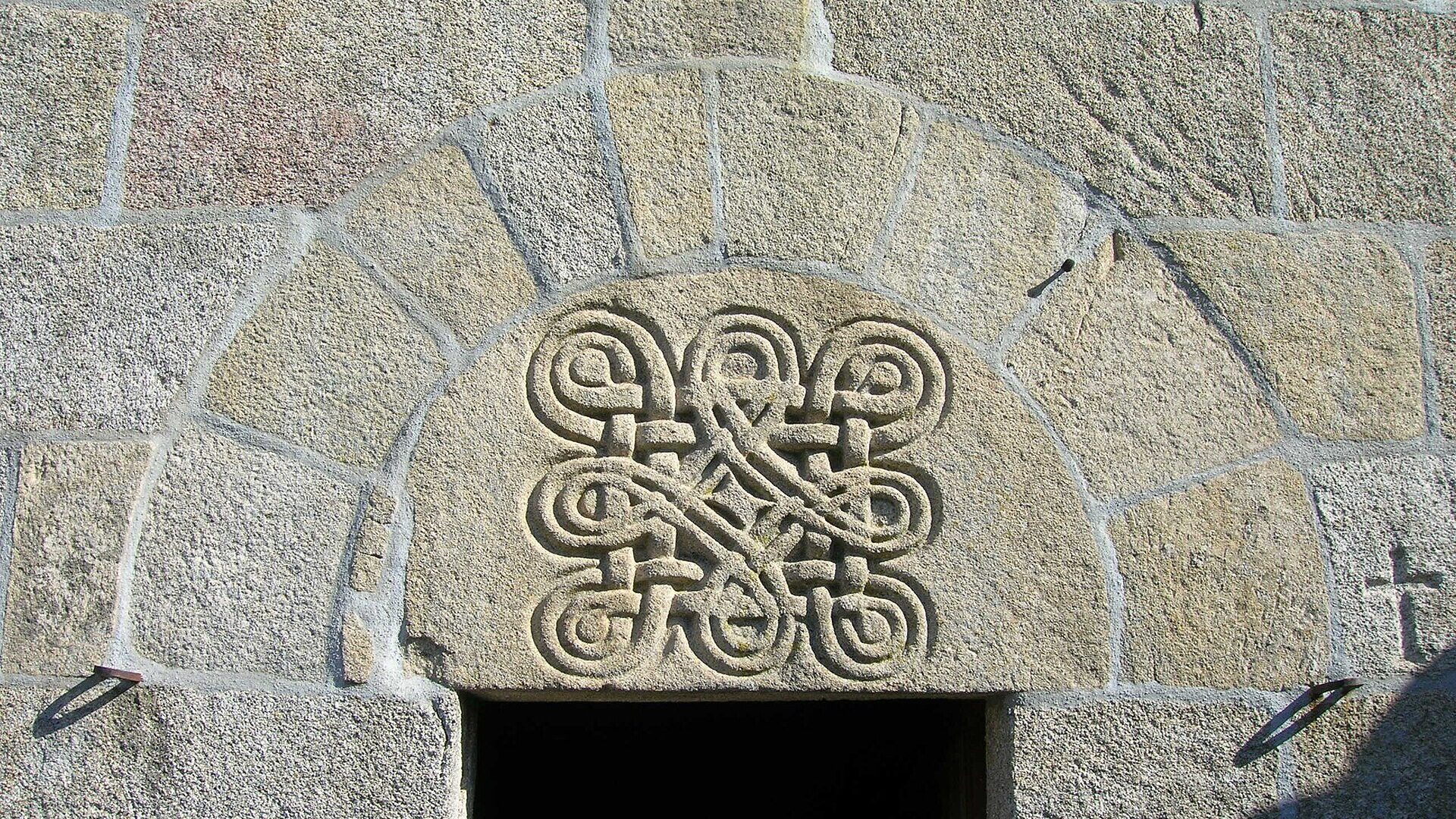
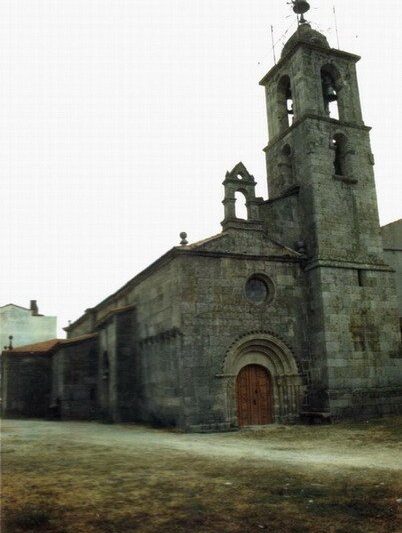
The Romanesque church of Santa María de Zos (Trasmiras)
The church of Santa María de Zos, in Trasmiras, is a 13th-century Romanesque temple with a four-archivolt portal, a capital showing the pelican and a tympanum with unusual interlace, extended in the 16th century and on the Mozarabic Way.
The church of Santa María de Zos is in the parish of Zos, in the municipality of Trasmiras. The tourist network 25 Motivos describes it as a gem of Galician Romanesque that looks humble at first glance and dates back to the 13th century [1].
The Romanesque
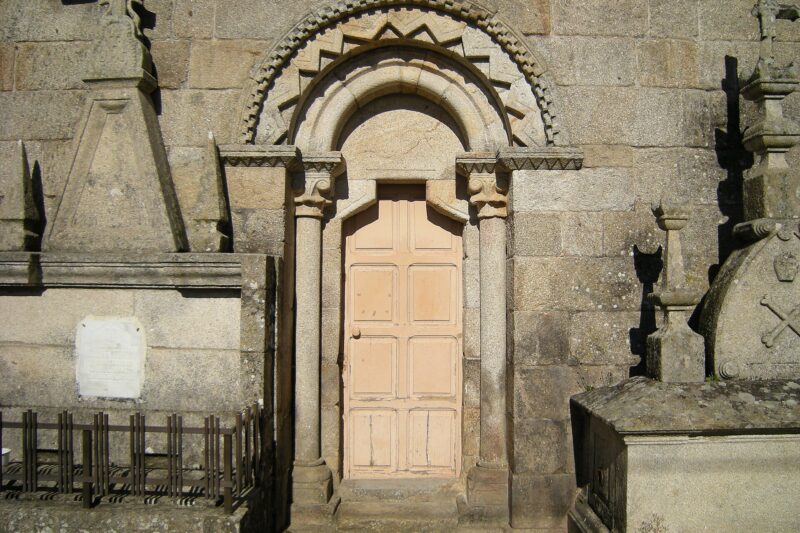
The rectangular apse and the main portal are the oldest parts of the building. The portal, facing west, has four archivolts decorated with rope-moulding, sawtooth and triangular motifs; the columns end in capitals with plant and figurative motifs, and the source singles out a pelican, the Christian symbol of sacrifice and resurrection [1].
On the south side there is a second, simpler door whose tympanum preserves an interlace that some studies attribute to Castro-culture origin and that, according to the source, has no parallel in other Galician churches of the period [1]. The single nave is lit through the splayed windows of the south wall [1].
Later extensions
The chevet was rebuilt in later periods. In the 16th century a new nave and the bell tower, Baroque in style, were added, and the high altar has a Baroque altarpiece [1].
A building of many parts
The source stresses that the mixture of styles does not break the unity of the church: the 13th-century Romanesque coexists with the 16th-century nave and tower and the Baroque altarpiece, which gives it a hybrid and deeply Galician character. Around it, the rural setting of A Limia (open meadows and fields) completes the visit [1].
The Way and protection
The source places the church on the Vía de la Plata, the Mozarabic Way, where many pilgrims stop, and says it is protected for its historical and artistic value and included in the Romanesque routes of Ourense [1]. The rest of the parish’s heritage is in the Trasmiras inventory and on the page for Zos.
Links
Sources
- «Igrexa de Santa María de Zos», 25 Motivos. http://25motivos.gal/xi-tangarano-cultural-4/
You may also like
 Heritage of A Limia: towers, convents, mills and ethnographic villagesA tour of the historic heritage of the municipality of Xinzo de LimiaA summary of the historic heritage of Xinzo de Limia: the Romanesque old church, the churches of Novás and Morgade, Torre da Pena, the Bon…
 Heritage of A Limia: towers, convents, mills and ethnographic villagesEthnographic heritage of Rairiz de Veiga: Congostro, mills, ovens and springsThe ethnographic heritage of Rairiz de Veiga: the restored village of Congostro, the San Miguel mills route, 17 mills, 5 communal ovens and…
 Heritage of A Limia: towers, convents, mills and ethnographic villagesXinzo de Limia in a day: a route through heritage, water and the lagoonA suggested one-day visit to Xinzo de Limia: Museo Galego do Entroido, the church and square of the town, Torre da Pena, the Bon Xesús…
Heritage of A Limia: towers, convents, mills and ethnographic villagesChurches and chapels of the parishes of Xinzo de LimiaIndex of the parish churches and chapels recorded in each of the 20 parishes of Xinzo de Limia, with their dedication, according to…
 Heritage of A Limia: towers, convents, mills and ethnographic villagesMills and ethnographic heritage of Calvos de RandínCalvos de Randín has 18 mills catalogued in Galicia Nomeada, plus the Oratorio, tied to the rivers and streams of the Salas valley and the…
 Heritage of A Limia: towers, convents, mills and ethnographic villagesConvento do Bon Xesús da Limia (Trandeiras): the BIC fileThe Convento do Bon Xesús da Limia, in Trandeiras (Xinzo de Limia), was built in the early 16th century; the Xunta has opened the procedure…
