


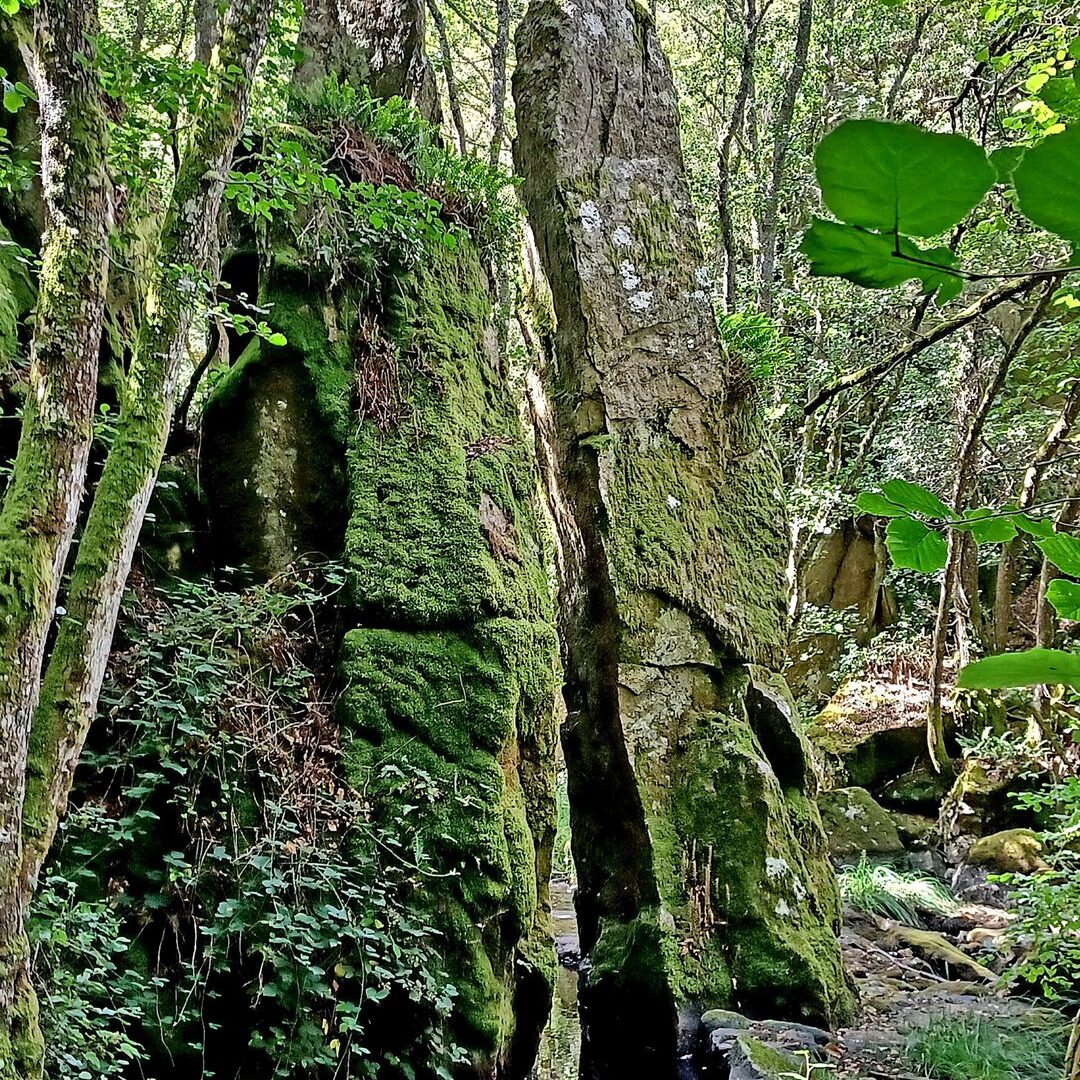
Crags, healing stones and humorous tales of A Limia
The Arangaño rock for curing children, the stones of the moura of Nocelo da Pena, the ears of Monte de Rubiás, the crags of Meaus and Penacurva, the white wolf and the humorous tales of the simpleton, the idler and the mill witch.
This page gathers legends of stones and crags and some humorous tales told in A Limia, with the source of each.
The Penedo do Arangaño (Perrelos, Sarreaus)
The Penedo do Arangaño (or Angaraño) is by the road from Xinzo de Limia to Vilar de Barrio, at Perrelos, on a hill in the parish of Os Castelos. It is a rock with a hole in it, about 1.5 m high and 3 m across. It was used to cure a very common illness among small children, a swelling of the belly that took away their appetite and could kill them. According to older people, the rite went like this: the baby was taken to the rock, the mother passed it through the hole and the godmother took it at the other side; then its clothes were removed and hung from the surrounding trees, and the child was dressed in new clothes. In thanks, coins were thrown into the rock and a lit candle left (traces of candles can still be seen and a few years ago coins were found). Not everyone says it had to be mother and godmother: the mother and a helper sufficed. As the child passed through, a formula was said, something like: "Comadre miña, heiche vai o angaraño; vóltamo sano e vivo" (My comadre, here is the angaraño for you; give it back to me healthy and alive) [1]. A recent comment cautions that it is in Perrelos and not Cortegada [5].
The stones of the moura of Nocelo da Pena and the village of A Pena
In Nocelo da Pena, a moura carried some boulders on her head and the ground she crossed became unproductive; one of the boulders is full of gold and the other of fire, but nobody dares open either for fear of choosing wrong and burning everything [2]. In the village of A Pena, Christ, dressed as a beggar, asked a lady for bread and wine and she refused; as punishment, every night a stone appeared at her door and she had to carry it on her head back to its place, or die [2].
The crags of Baltar
In Meaus, one of the three villages of the old Couto Mixto, they say that Moors and mouras still live around the crags of the Campa dos Mouros and da Bicha [2]. In San Martiño dos Peros, the Penedo de Penacurva is a singular rock whose left side acts as a roof; locals say wolves used to howl beneath it, and it gives its name to the Cultural Association Penacurva [6]. The Larouco range, between Baltar and Vilar de Perdizes (Portugal), bore the name of the pre-Roman god Larouco, to whom there are Roman altars on both sides of the border equating him with Jupiter [7].
The ears of Monte de Rubiás
On the Monte de Rubiás (Rubiás dos Mistos, Calvos de Randín) there is a rock with a hole that looks like a door, but inside it is hollow; if you try to enter, the hole shrinks and whoever already has part of their body inside cannot get out. Some shepherds, walking with their sheep, were caught by snow; the first put his head in and got stuck. The one outside decided to fetch a sledgehammer to break the rock, but, in case the wolf came for the sheep, told the trapped man to lower his trousers: "if the wolf comes, it has a cold snout, it will touch your bottom and so you can shout and scare it off". So it was: the companion, instead of going for the sledgehammer, took a snowball and dropped it between his buttocks. The trapped man, thinking it was the wolf, pulled so hard that he freed his head, but his ears stayed stuck to the rock, where the marks can still be seen. It was collected by José González Rodríguez in January 1994 from Leopoldo Escudero Rodríguez, aged 83 [3]. There is a version from Hermisende (Zamora), "O frío fociño do lobo" [3].
The simpleton and Uncle Roxo
In Calvos de Randín, Uncle Roxo was coming back from the mill on his mule and the simpleton (tardo) turned the pack-saddle round: he reached home head down and feet up without noticing his position [3].
Humorous tales from the blog As tradicións da Limia
- The idler (Emilio Martínez, of Novias, Os Blancos, 15/03/2001): an old man leaves his only donkey to the laziest of his three sons. One does not take the bread from the table to avoid moving, another lets his clogs burn in the fire and the third prefers to lose the donkey rather than climb the stairs. The donkey goes to him [4].
- The miller and the witch (Sra. Maruja, 21/05/2002, mill near Cuquexos): a miller kept losing firewood and someone lit a fire at night. He went to keep watch and found an old woman drying her hair; he wanted to throw her on the fire, but she begged: it was a curse from her mother, which would be undone by a cut on the little finger. He did it and the old woman became a beautiful girl [4].
The white wolf of A Limia
White-furred wolves are considered ill-omened. In A Limia a white wolf is seen in the same place where other wolves devoured some young men, and its presence announces the imminent death of a person. The ballad "La loba blanca", which Laureano Prieto rescued in Viana do Bolo, tells of a girl, destined by her father to marry a rich cousin, who fell in love with a shepherd; her father locked her up, her lover freed her and they fled, but her father cursed her: "May you become a she-wolf!". So it happened and her first victim was her own sweetheart; she killed without mercy and no shot wounded her, until one day she disappeared [8].
Links
Sources
- «O Penedo do Arangaño», Xavier Feixoo, Galicia Encantada; reproduce R. Novoa Rivero, «Os penedos no Val de Antela», Pontenova 8 (2003). https://galiciaencantada.com/lenda.asp?cat=13&id=341
- Rafael José Adalid Rodríguez, «Contos, lendas e mitos da auga na Limia e pequenas achegas», Revista Galicia Encantada 16 (2020); fontes orais A. M. (Lamas, 2019) e A. P. (Ourense, 2018). https://galiciaencantada.com/lenda.asp?cat=11&id=2886
- «As orellas do Monte de Rubiás» (https://galiciaencantada.com/lenda.asp?cat=18&id=716), «O tardo e o Tío Roxo» (https://galiciaencantada.com/lenda.asp?cat=19&id=574) e «O frío fociño do lobo» (https://galiciaencantada.com/lenda.asp?cat=7&id=1362), Galicia Encantada.
- «Tres contos», As tradicións da Limia, 04/02/2021. https://tradicionsdalimia.es/tres-contos/
- Comentario de 2021 en Galicia Encantada sobre a ficha do Arangaño.
- «Os vintos, un xogo popular no século XXI. San Martiño dos Peros», As tradicións da Limia, 01/10/2021. https://tradicionsdalimia.es/os-vintos-un-xogo-popular-no-seculo-xxi-san-martino-dos-peros-concello-de-baltar/
- «Serra do Larouco», Fronteira Esquecida Limia-Lima. https://fronteiraesquecida.eu/gl/fichas/serra-do-larouco/
- «Micromitos 036: A loba branca», Nós Diario, 20/10/2020. https://galiciaencantada.com/lenda.asp?cat=7&id=2976
You may also like
 LegendAntioquía, the Drowned City beneath the Lagoa de AntelaBeneath the waters of the Lagoa de Antela would sleep Antioquía, the proud city that God flooded for refusing alms to a beggar. All the…
 LegendThe Apparition at Trandeiras and the Army of King ArthurThe founding legend of the Bon Xesús of Trandeiras: the Virgin appears to Xoán Folgoso, the white and black knights and King Arthur's…
 LegendThe Raíña Loba and her castle on the crags of Covas (Os Blancos)On the crags of Covas, at about 1,150 metres, there was a rocky castle where a cruel queen lived who charged a calf, a sheep and a pig…
LegendMoors of A Limia: treasures, broken secrets and enchantmentsThe legends of Moorish men and women in A Limia: the mouras of Treboal, the Covelas mine, the gold cart of A Touza, the Moors' girl, the…
 LegendLegends of the Torre do Castro and SandiásThe legends of the Torre do Castro and Sandiás: the Moors' tower and the hammer that made the Lagoa de Antela, the treasure in the well,…
 LegendWaters, springs and the devil’s horses: legends of Porqueira and A LimiaLegends of waters and springs in A Limia: the devil's white horse of Ponte Liñares, the spring of the three rushes, the golden-haired moura…
