

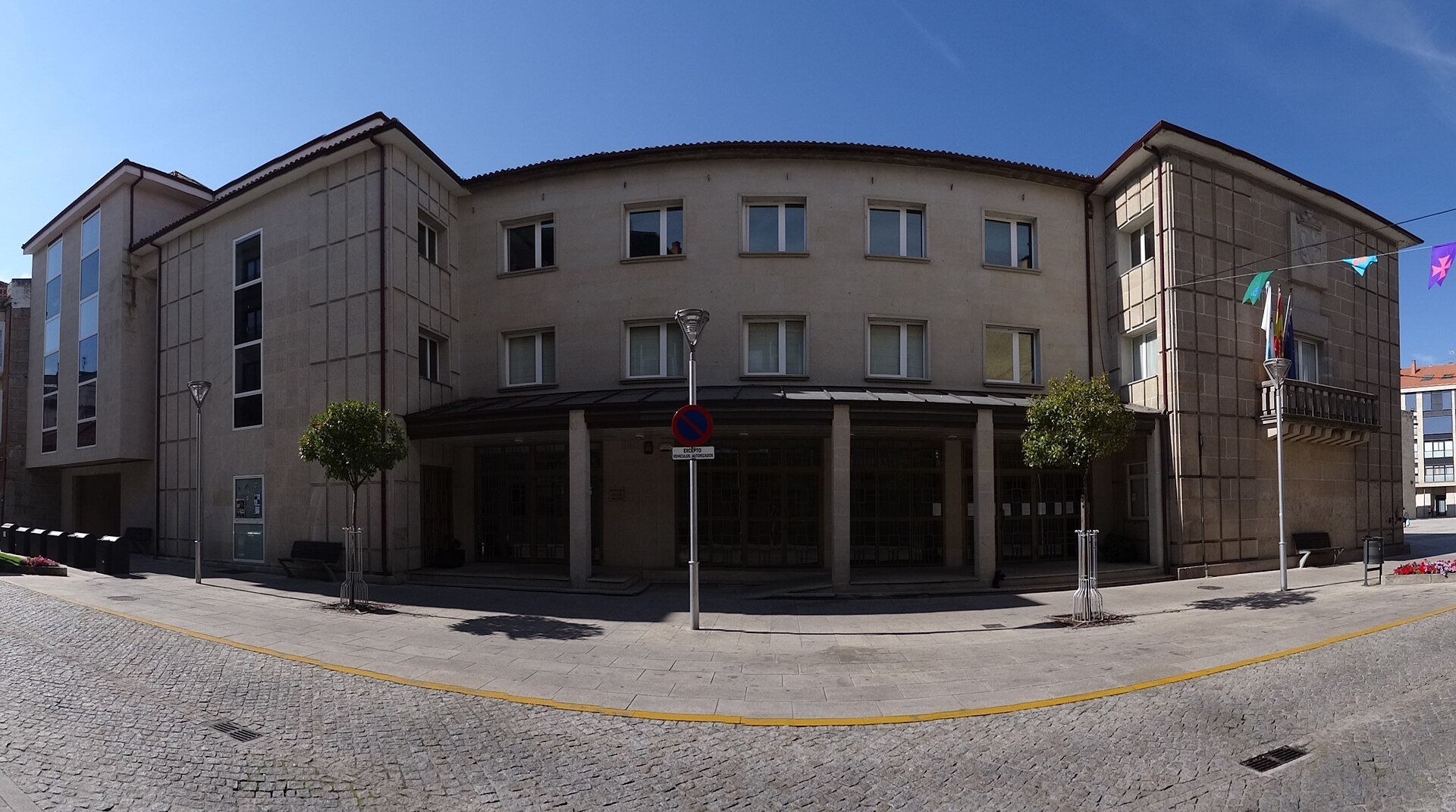
Symbols and traditions of Xinzo: coat of arms, giants, pasodoble and Lady of the Lagoon
The coat of arms of Xinzo de Limia (1979), the giants and big-heads of the festivals, the 1929 pasodoble and the sculptures of Xosé Lois Carreira, including the Dama da Lagoa dedicated to Limuhe and the women of the comarca.
Xinzo de Limia has several symbols of its own, some official and others popular. This page gathers what the works of Edelmiro Martínez Cerredelo tell [1]–[4].
The coat of arms
The current coat of arms was approved by Royal Decree 771/1979, during the mayoralty of José Pérez Rodríguez. It is "per pale and half cut": first, argent, a bend sable with a gold chain of eight links; second, or, a cock gules; third, vert, two gold ears of wheat in saltire; crest, a closed royal crown [1]. The arms of the first quarter are those of the Zúñiga, counts of Monterrei, the lineage that dominated the jurisdiction of Xinzo; the cock and the ears of wheat represent the concello’s agricultural and livestock wealth. Benito Vicetto, in his Historia de Galicia, says the cock "is worshipped throughout the Limia comarca for certain reasons", without explaining them [1].
In 2011 the author warned the mayor that coats of arms different from the official one were in circulation; in 2017–2018 the culture councillor worked with Fernando Dopico and the CSIC in Galicia, and with the Heraldic Commission of the Xunta, on a proposal for a coat of arms and a flag, which lacked political unanimity in the 2017 committee [1].
Giants and big-heads
The giants in Xinzo in the 1950s represented the Catholic Monarchs and had succeeded "El Gigante y La Giganta", which recalled the vanished Chistera and Pallona and went down the streets to the sound of bagpipers at Corpus Christi. The present ones, from 1985, made by the "Titiriti" workshop of Baiona, represent Decimus Junius Brutus and Inés de Castro, the town’s third couple. The big-heads are the Devil, the Beggar (Jesus in disguise) and the Old Woman, three characters from the legend of Antioquía: the old woman who warmed Jesus and gave him goat’s milk and a piece of bica, and was saved from the city’s flooding [2].
The 1929 pasodoble
The Tuna Antelana sang at the 1929 Entroido a pasodoble that begins «Ginzo de Limia, hermosa villa / donde el Sol brilla con mucho ardor» (quote). The music is by the maestro Pena, Xosé Pena Fuentes, of Parada de Ribeira, appointed in October 1929 director of the musical groups of the Sociedad Filarmónica Antelana for 100 pesetas a month; the lyrics, by Francisco Seijo Iglesias. When the singer María do Ceo presented a new anthem, some neighbours argued that the true one was that of 1929; Fernando Dopico was composing a Galician version, "Xinzo de Limia, fermosa vila" [3]. See Francisco Seijo Iglesias.
Xosé Lois Carreira and the Dama da Lagoa
The Limia sculptor Xosé Lois Carreira (Eibar, 1971, son of emigrants from Parada de Ribeira, graduate in Fine Arts from Bilbao and Paris) carved in 2018 "A Dama da Lagoa", a granite piece of almost seven metres and 150,000 kilos for the roundabout of Xinzo’s business park. He says it is "a tribute to Limuhe" and the women of the comarca, from prehistory to the myth of Antioquía and today’s rural world; he works with chisel, file, pick and point, without a model [4].
By the same sculptor are the monument to the Pantalla in the Parque do Pombal, in Portuguese marble, unveiled in summer 1998, the monument to the Cigarrón of Verín (2003), "Nexus-VI" (8 m and 100 tonnes) at the roundabout of Ourense’s Millennium Bridge and the sculpture in homage to Toñito Mestre, a collaborator of the Antela [4].
Links
Sources
- «O escudo e a bandeira municipal do concello de Xinzo de Limia», Historia de Xinzo, 28 de xullo de 2018. https://historiadexinzo.wordpress.com/2018/07/28/o-escudo-e-a-bandeira-municipal-do-concello-de-xinzo-de-limia/
- «Os xigantes e cabezudos nas festas de Xinzo», 19 de febreiro de 2016. https://historiadexinzo.wordpress.com/2016/02/19/os-xigantes-e-cabezudos-nas-festas-de-xinzo/
- «O pasodobre de 1929: himno oficial de Xinzo?», 12 de xullo de 2016. https://historiadexinzo.wordpress.com/2016/07/12/o-pasodobre-ginzo-de-limia-himno-oficial-de-xinzo/
- «A escultura "A Dama da Lagoa" de Xosé Lois Carreira», 11 de setembro de 2018. https://historiadexinzo.wordpress.com/2018/09/11/a-escultura-a-dama-da-lagoa-de-xose-lois-carreira/
You may also like
 Curiosities of A LimiaThe miser of Xinzo: José Oterino’s hidden fortune (1891)In November 1891 José Oterino, aged 43, died in Xinzo and the judge found 432 gold ounces in his house: the "miser of Xinzo" appeared in…
Curiosities of A LimiaXinzo at the 1878 Paris Universal Exhibition: the soap and linen of A LimiaIn 1878 José Romero took Xinzo's linen and soaps to the Paris Universal Exhibition: he won a gold medal for the linen and an honourable…
Curiosities of A LimiaThe Escornabois plague (1598-1599): 118 dead in a Limia parishBetween September 1598 and 1599 the plague killed 118 people in Santa Mariña de Escornabois (Trasmiras); the priest Francisco Rodríguez…
 Curiosities of A LimiaThe great Randín fire (1889) and the solidarity that followedOn 20 November 1889 a fire left Randín (Calvos de Randín) almost in ashes, with straw roofs and strong wind; press figures vary, and aid…
 Curiosities of A LimiaFair traders, cinzarradas and proxy weddings: customs of old XinzoThree customs of 20th-century Xinzo told by Edelmiro Martínez Cerredelo: the traders at the fairs of the 14th and 27th and Remy of the…
 Curiosities of A LimiaThe 1918 flu in Xinzo de Limia and MoreirasIn autumn 1918 the flu killed 60 people in the concello of Xinzo and 56 in that of Moreiras, which had far fewer inhabitants; Xinzo's first…
