


Encalados and encintados: the lime decoration of A Limia’s houses
The encintado protects the joints between stones from damp and the encalado decorates façades with chalices, circles, roses and dates. Examples in Faramiñás, Seiró, Cortegada, Trandeiras, Reboreda and San Martiño dos Peros.
- Encintado
- lime that protects the joints between stones from damp
- Encalado
- lime decoration on windows, façades and columns
- Motifs
- chalices, circles, six-petal roses, plants, dates and initials
- Villages recorded
- Faramiñás, Seiró, Cortegada, Solveira, Trandeiras, Reboreda and San Martiño dos Peros
In the villages of A Limia, many stone houses show on their façades a line of lime between the stones (the encintado) and, in some cases, white or coloured figures on the wall (the encalado). The researcher and photographer Xosé Calleja documented these expressions of folk art in several villages for his blog As tradicións da Limia; this page summarises his observations, which are an author’s interpretations and not an official catalogue [1][2][3].
What the encintado is for
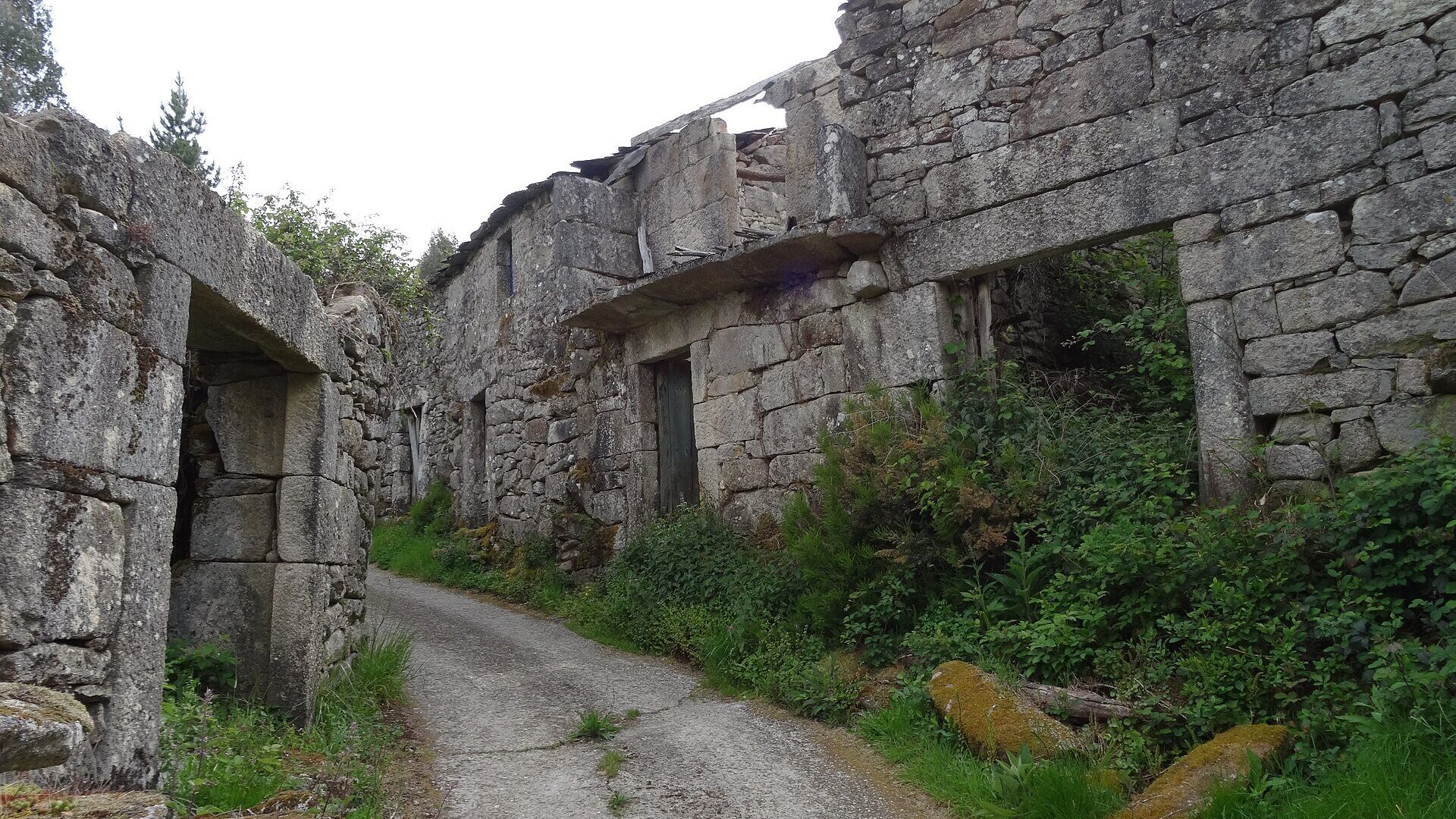
When houses were built, whoever could afford it had the stone worked by masons and left it regular (ashlar); those with less used only half-worked stones, and the poorest, rubble. In every case, the joints between the stones were filled with a paste of lime, sand and mud, because in bad weather the wind drove rainwater through the cracks to the inside. If the stone is regular, the encintado is regular; if it is irregular, the encintado is thicker and follows the irregular shapes. When the rubble is small and hard to point, the whole wall is limewashed and only the stones of doors and windows, which are regular, are left exposed [1].
Besides the protective function, the owners had an aesthetic criterion: they want the house to «look lovely». That is why thick encintados appear around windows and doors as decoration [1][3].
Motifs and interpretations
The decorative encalados repeat a series of figures that Calleja describes in positive (the white lime) and in negative (the space without lime):
- Chalices and circles. A band under the roof with half-circles, a small circle and a triangle forming a chalice, with circles in between. It appears in Seiró, Cortegada and Trandeiras. Calleja suggests it may have a religious meaning (the chalice and the host of the Mass) «or not», and that the negative part recalls the arrow-slits of a castle [2][3][4].
- Columns. In Cortegada the encalado runs round the four walls of a house and forms «columns» on the balconies and corners, with a capital and an upper encintado that would act as an architrave [3].
- Roses and flowers. Four- or six-petal roses inside a circle (the so-called «Celtic roses»), climbing plants on windows, six-petal flowers painted blue in Reboreda and the «flower of life» in San Martiño dos Peros [1][3][4][5][6].
- Dates and initials. Letters in negative, possibly the owner’s initials, house numbers and, in San Martiño dos Peros, a date (1932) on the wall of the old school [5][6].
- Figures. On that same old school, a circle that might represent the sun and a scene of two figures with a tree that Calleja interprets as Adam and Eve and the tree of good and evil; he compares the theme with the altarpiece of the church of Laroá [6].
Villages recorded
- Faramiñás (Porqueira): irregular encintado and floral encalado on two windows, in positive and negative [1].
- Seiró (Vilar de Barrio): bands of half-circles, chalices and circles on the façade of a house that was once a tavern; photographed in 2016 and revisited in 2021 [2].
- Cortegada (Sarreaus): chalices, columns and a façade with two roses, whose encintado was replaced with cement [3].
- Trandeiras (Xinzo de Limia): insulating and decorative encintados, limewashed columns and two houses with chalices, circles and roses; it is near the Bon Xesús convent [4]. See Convento do Bon Xesús.
- Reboreda (Porqueira): windows with circles and wedges, and two façades with painted encalados [5].
- San Martiño dos Peros (Baltar): the old school, with a date, a circle and a figurative scene [6].
Preserving what is left
The photographs show how many encalados have been lost (roof works, cement, lack of maintenance). Calleja points to the good condition of some and asks that they be valued as part of A Limia’s vernacular architecture [1][3][4]. See also A etnografía da Limia.
Frequently asked questions
What is an encintado? The line of lime that fills the joints between the stones of a wall to protect it from damp [1].
What do the chalices in the encalados represent? There is no documented explanation: the author suggests a religious meaning, but it is a personal hypothesis [2].
Links
Sources
- Xosé Calleja, «Encalados en Faramiñás. Porqueira», As tradicións da Limia, 26/12/2020. https://tradicionsdalimia.es/encalados-en-faraminas-porqueira/
- Xosé Calleja, «Encalados e encintados en Seiró, Vilar de Barrio», As tradicións da Limia, 24/08/2021. https://tradicionsdalimia.es/encalados-e-encintados-en-seiro-vilar-de-barrio/
- Xosé Calleja, «Encalados e encintados en Cortegada», As tradicións da Limia, 10/04/2022. https://tradicionsdalimia.es/encalados-e-encintados-en-cortega-a-limia-reportaxe-fotografica/
- Xosé Calleja, «Encalados e encintados en Trandeiras», As tradicións da Limia, 17/11/2022. https://tradicionsdalimia.es/encalados-e-encintados-en-trandeiras-a-limia-reportaxe-fotografica/
- Xosé Calleja, «Encalados e encintados en Reboreda. Porqueira», As tradicións da Limia, 12/12/2023. https://tradicionsdalimia.es/encalados-e-encintados-en-reboreda-porqueira/
- Xosé Calleja, «Encalados na antiga escola de San Martiño dos Peros», As tradicións da Limia, 06/04/2024. https://tradicionsdalimia.es/encalados-na-antiga-escola-de-san-martino-dos-peros-concello-de-baltar/
You may also like
 Heritage of A Limia: towers, convents, mills and ethnographic villagesA tour of the historic heritage of the municipality of Xinzo de LimiaA summary of the historic heritage of Xinzo de Limia: the Romanesque old church, the churches of Novás and Morgade, Torre da Pena, the Bon…
 Heritage of A Limia: towers, convents, mills and ethnographic villagesEthnographic heritage of Rairiz de Veiga: Congostro, mills, ovens and springsThe ethnographic heritage of Rairiz de Veiga: the restored village of Congostro, the San Miguel mills route, 17 mills, 5 communal ovens and…
 Heritage of A Limia: towers, convents, mills and ethnographic villagesXinzo de Limia in a day: a route through heritage, water and the lagoonA suggested one-day visit to Xinzo de Limia: Museo Galego do Entroido, the church and square of the town, Torre da Pena, the Bon Xesús…
Heritage of A Limia: towers, convents, mills and ethnographic villagesChurches and chapels of the parishes of Xinzo de LimiaIndex of the parish churches and chapels recorded in each of the 20 parishes of Xinzo de Limia, with their dedication, according to…
 Heritage of A Limia: towers, convents, mills and ethnographic villagesMills and ethnographic heritage of Calvos de RandínCalvos de Randín has 18 mills catalogued in Galicia Nomeada, plus the Oratorio, tied to the rivers and streams of the Salas valley and the…
 Heritage of A Limia: towers, convents, mills and ethnographic villagesConvento do Bon Xesús da Limia (Trandeiras): the BIC fileThe Convento do Bon Xesús da Limia, in Trandeiras (Xinzo de Limia), was built in the early 16th century; the Xunta has opened the procedure…
